The Studebaker/Porsche Project
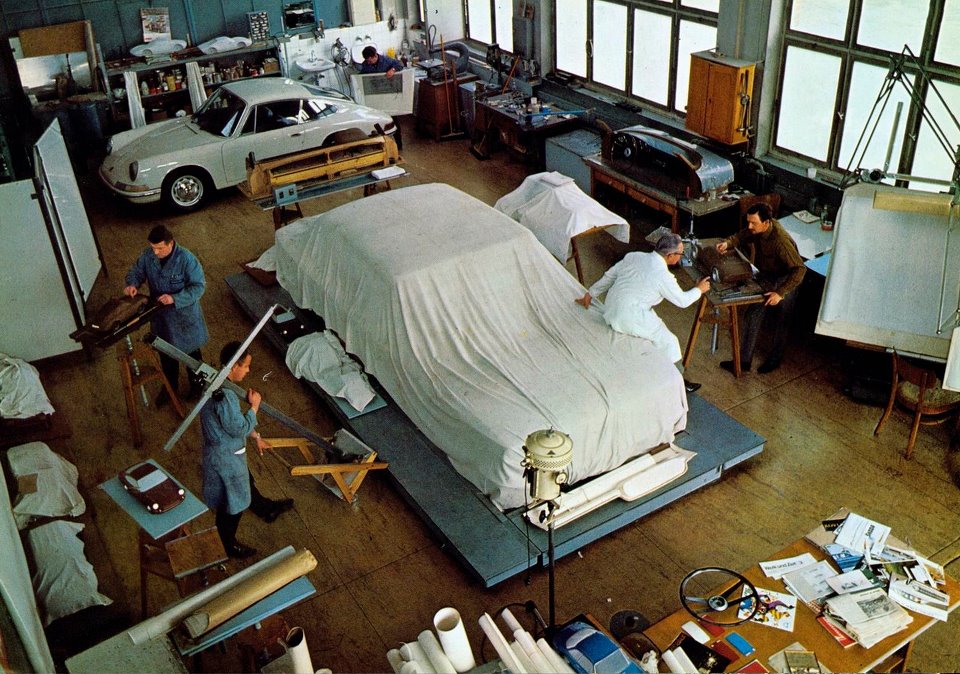
Is that the Studebaker Porsche Project Type 542 under that cover at the Porsche Design Studio?
After Ferdinand Porsche died, his son Ferry was asked by the Studebaker Company, to design a new car. Porsche suggested a 4 cylinder 1.500 cc coupe, rear engine car but that was not accepted by Studebaker, which wanted a 6 cylinder, much larger car with a front engine. Earlier in the 1950s Studebaker entered into serious discussions with Porsche regarding the German company developing a compact car for the South Bend firm.
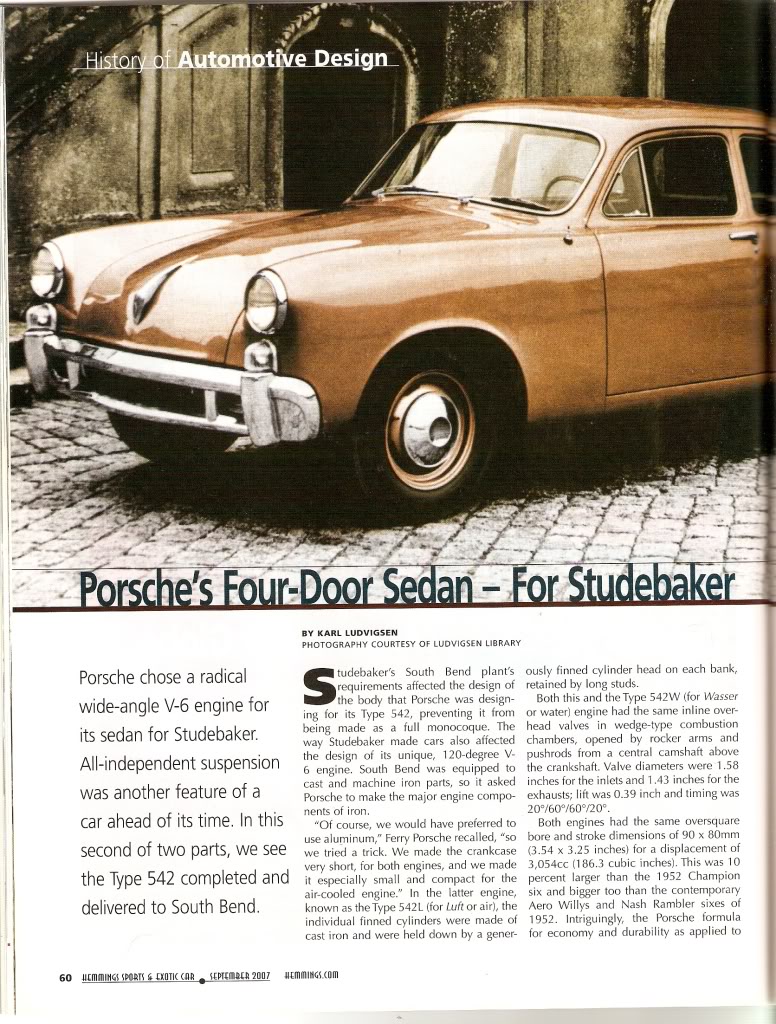
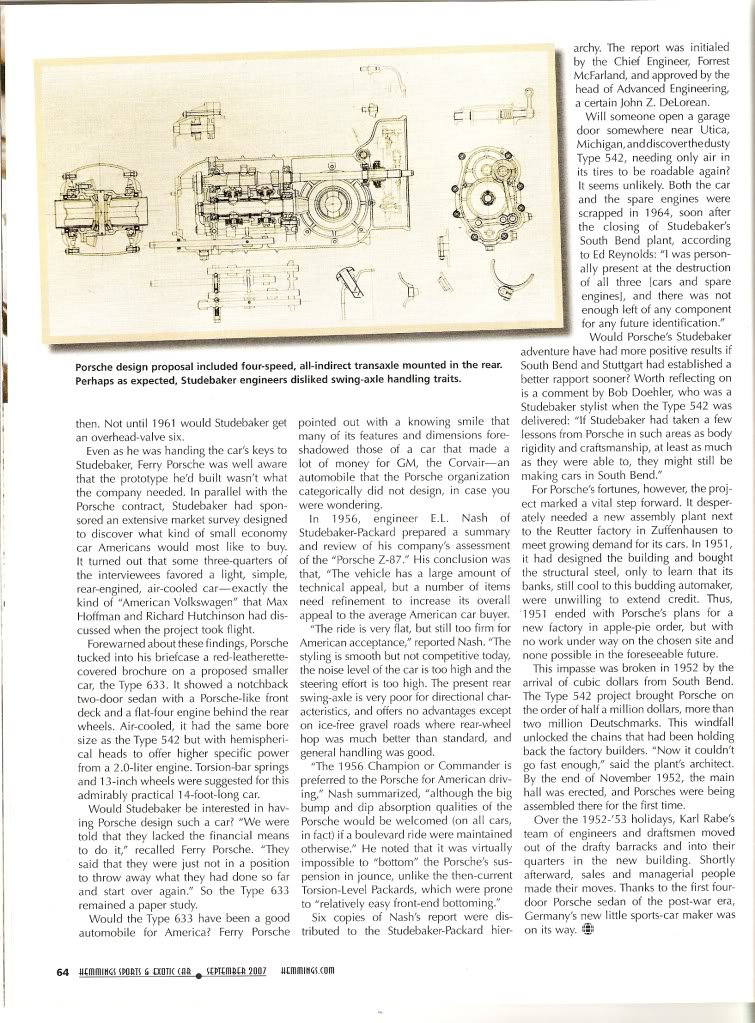
Anxious to expand its presence in the U.S. and prodded by Volkswagen importer Max Hoffman, Porsche worked up a design proposal that it dubbed the Type 542, a rear-engined, four-door sedan somewhat smaller than Studebaker’s Champion.
Porsche produced a running protype and sent it to South Bend for evaluation. Distracted by its financial problems, Studebaker didn’t take a serious look at the prototype until 1956 when the company’s director of experimental engineering, John Z. DeLorean, gave it a thumbs-down and the project was DOA.
|
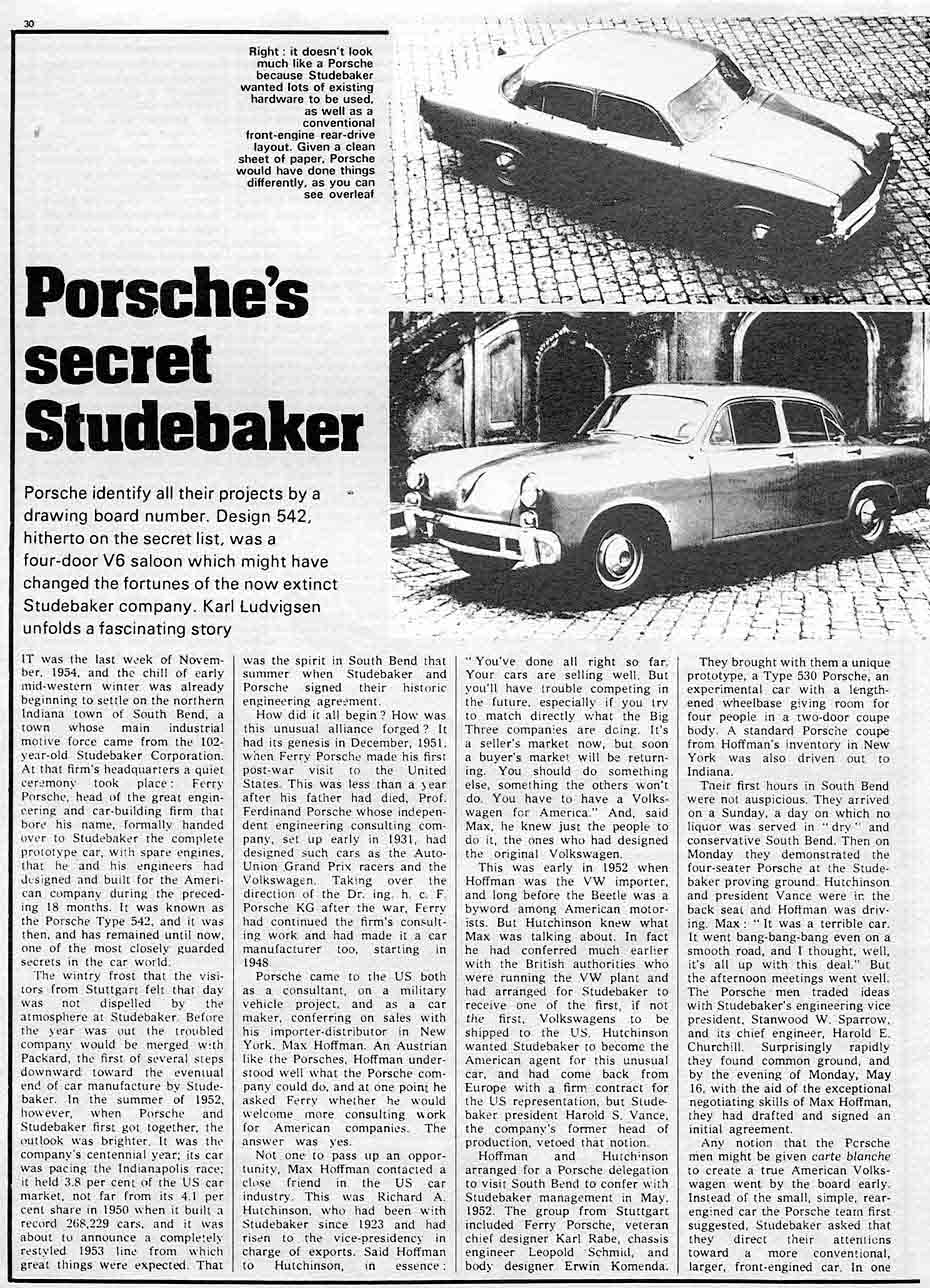
Turning Wheels, February 1977
In 1952 Porsche begins the project and after 18 months the prototype was ready to be tested. Labeled as Porsche Project 542. Karl Rabe was the chief engineer.
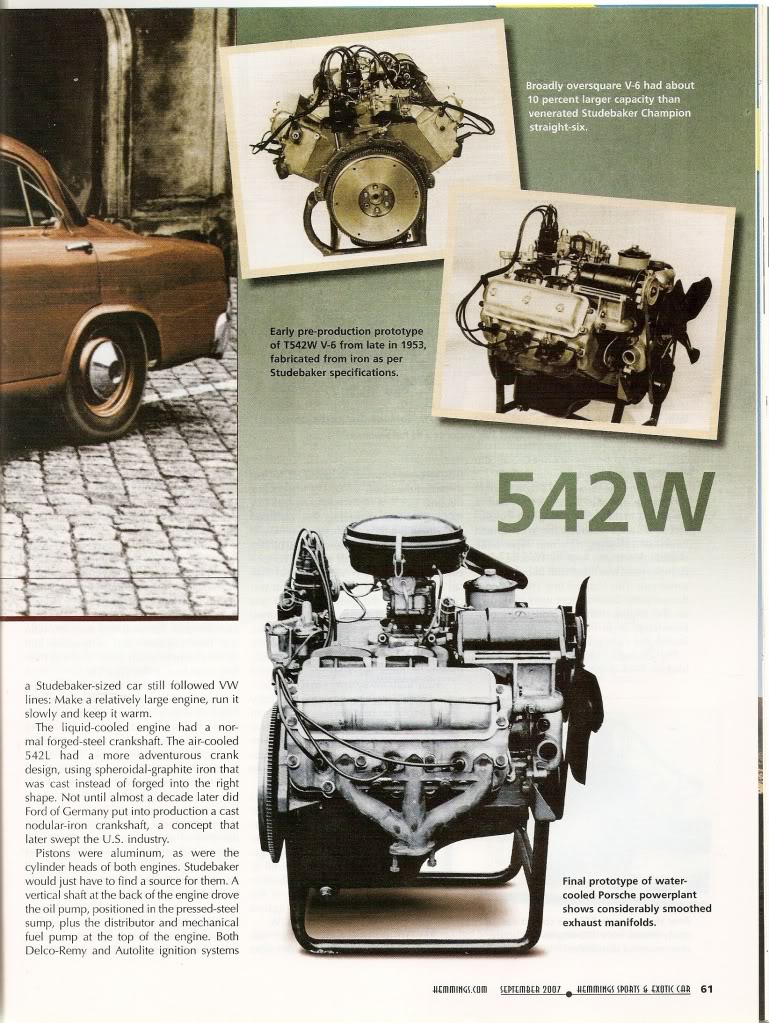
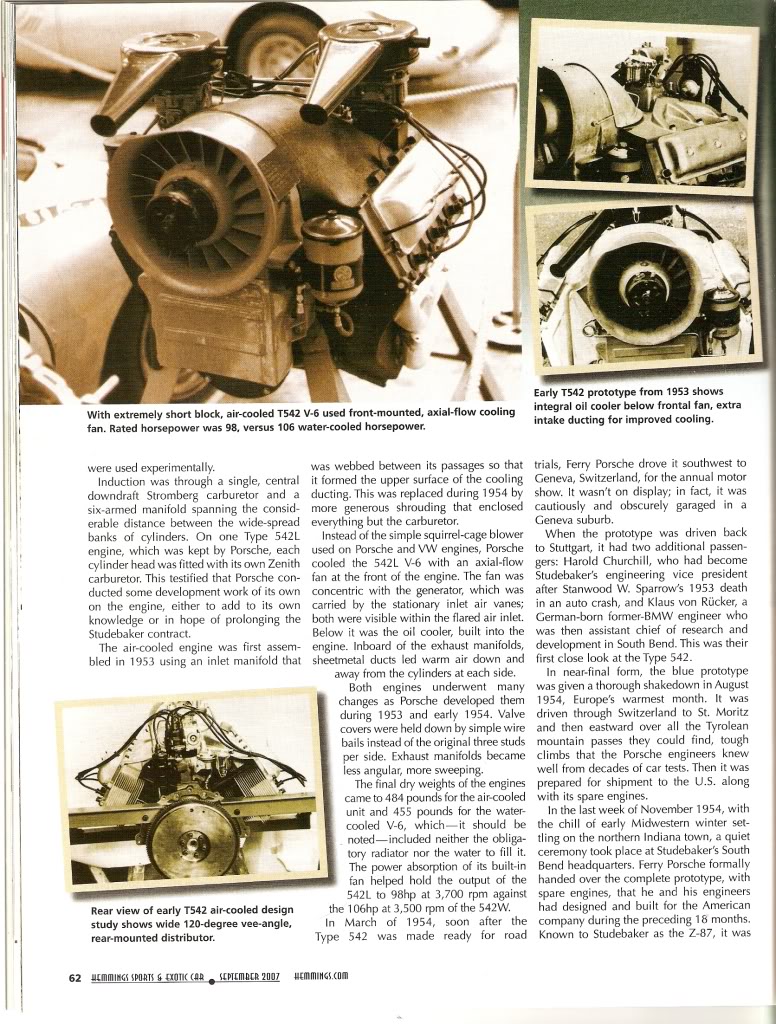
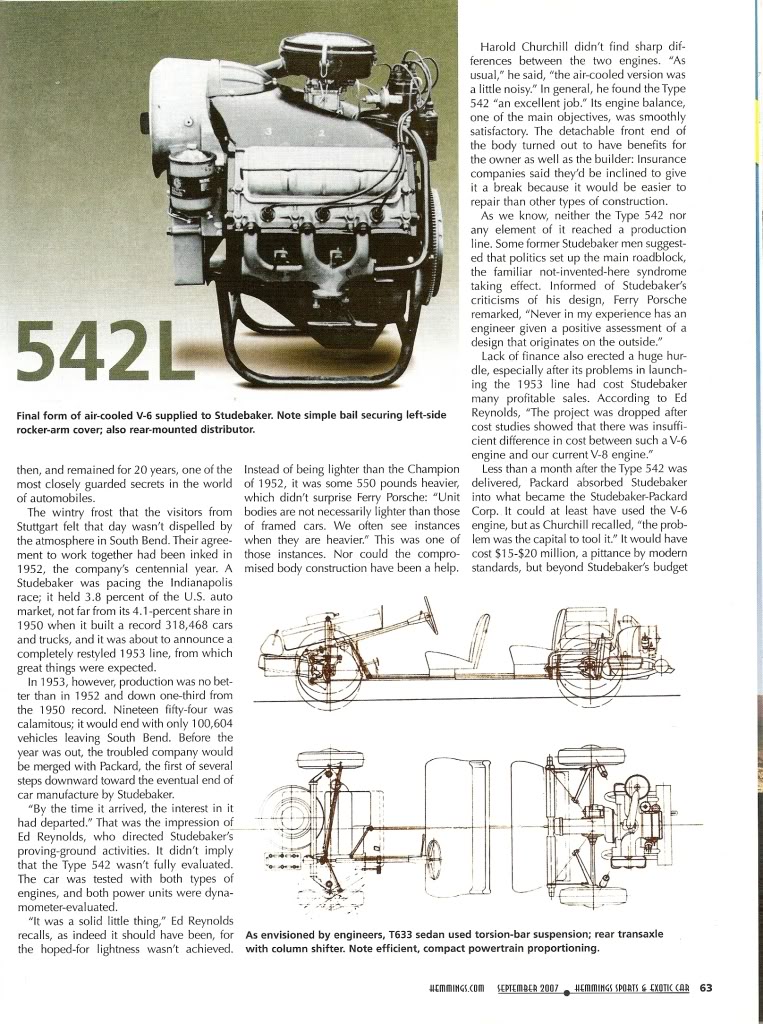
Porsche proposed a 6V rear engine four door as shown in picture below. It was to have a 2,82 m wheelbase, independent suspension and was to try two different cooling systems, one air-cooled, another composite air-water, named internally the 542L ( L from Luft=Air in German) and the 542W (W from Wasser=water in German) 90×80 mm
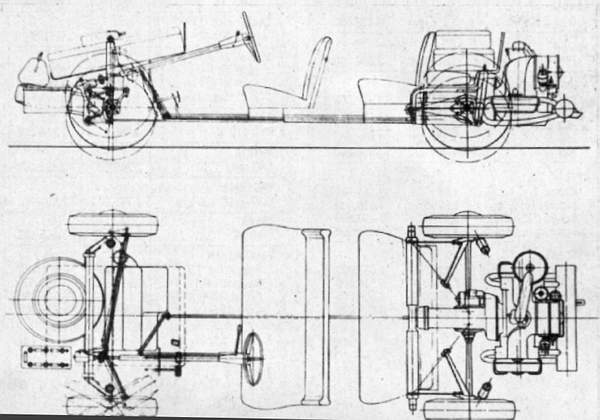
Studebaker – Porsche Project 542. Karl Rabe was the chief engineer.
These were rated as follows:
The air cooled version weighted 220KG, and had an output of 98 HP at 3700 rpm.
The water cooled version weighed 206 KG had an output 106 HP at 3500 rpm.

Above: The air and water cooled engine.
Below: The final water-cooled engine.


Above: A Studebaker sketch for a small car. Note rear air intake fins.

They both were tested in Europe and Porsche traveled to USA in 1954 with four prototypes, two of each engine type. When he arrived, Studebaker had been bought by Packard and the new firm was not interested in the project.
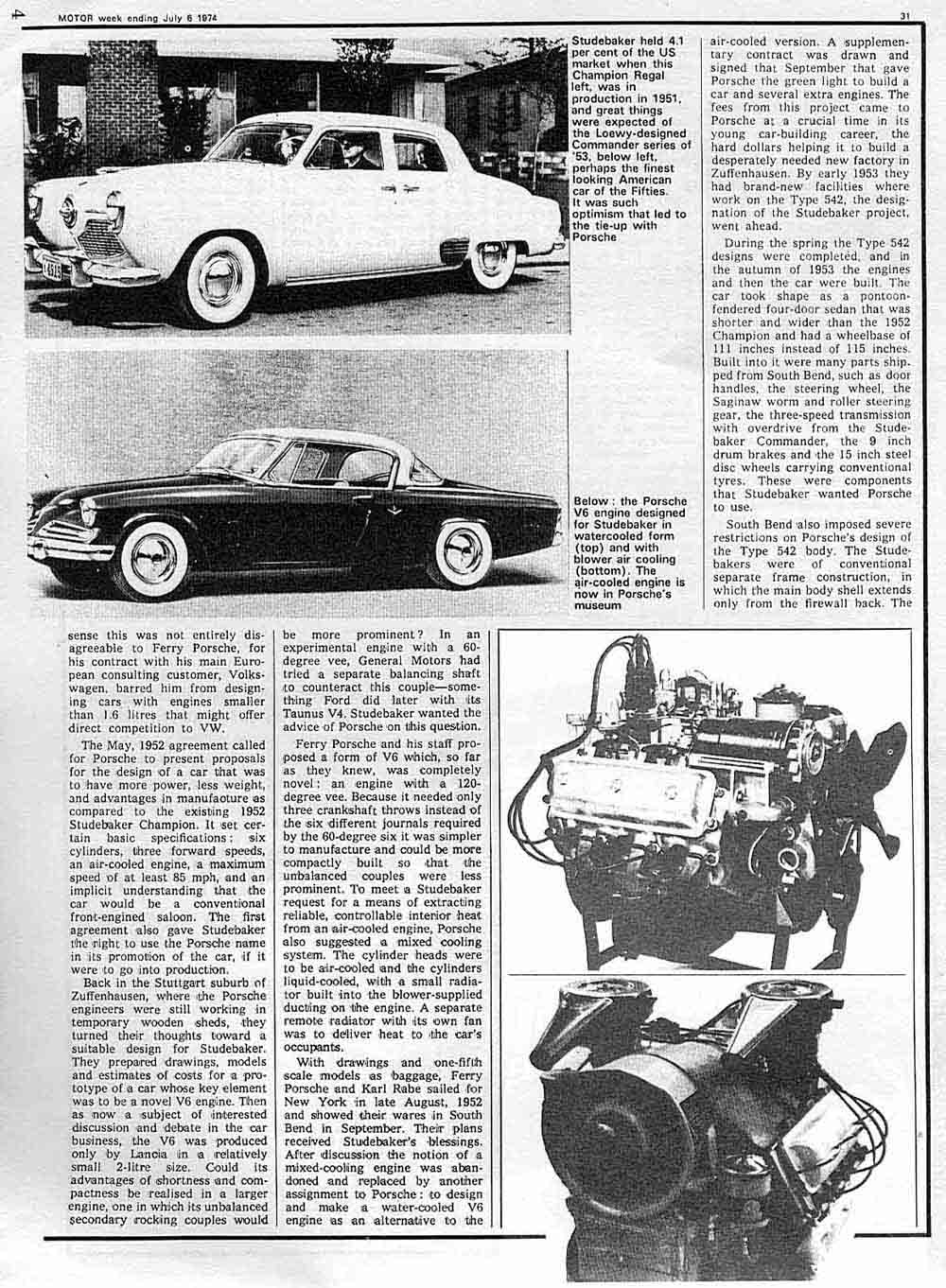
Turning Wheels, February 1977
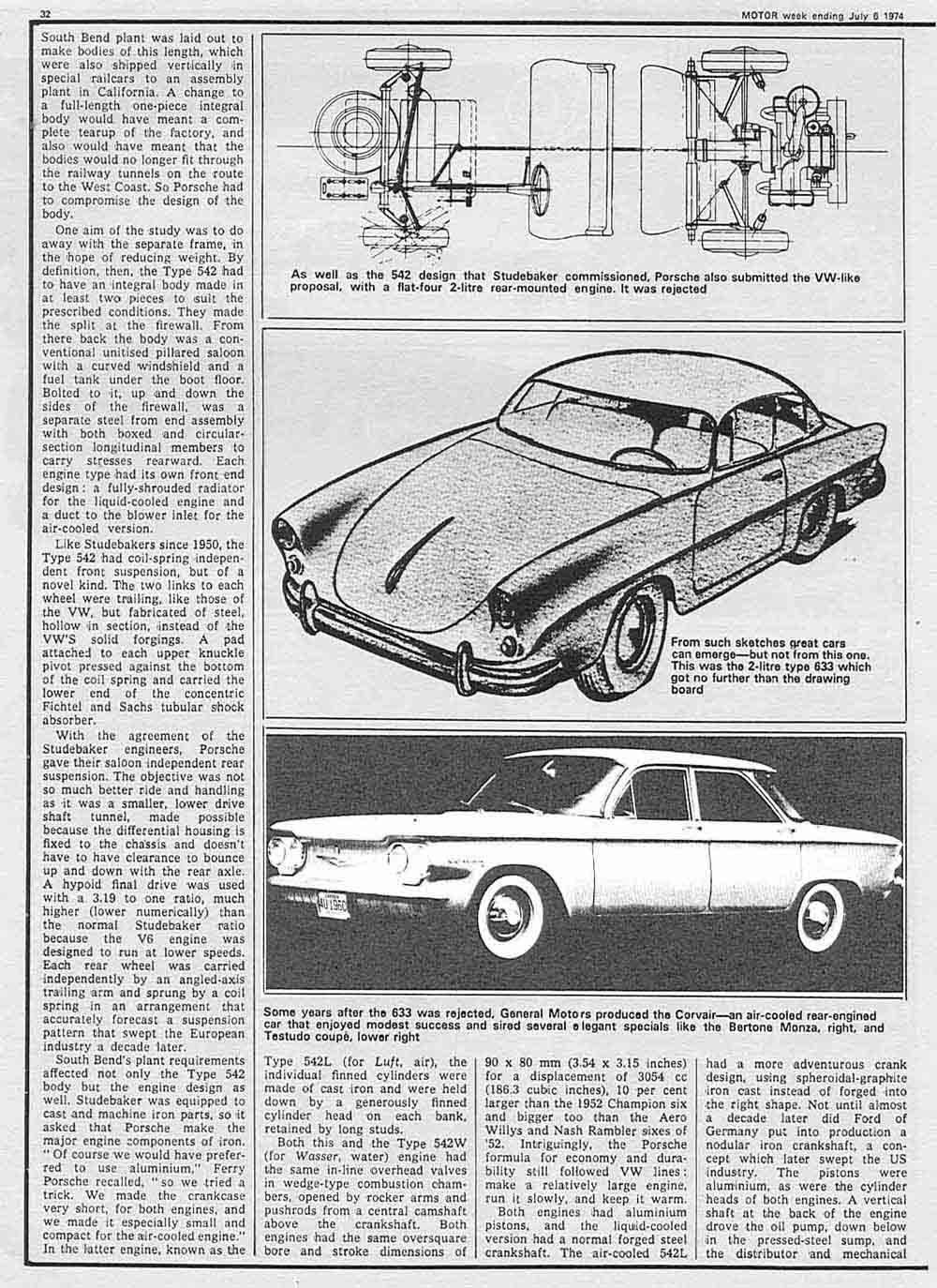
Turning Wheels, February 1977
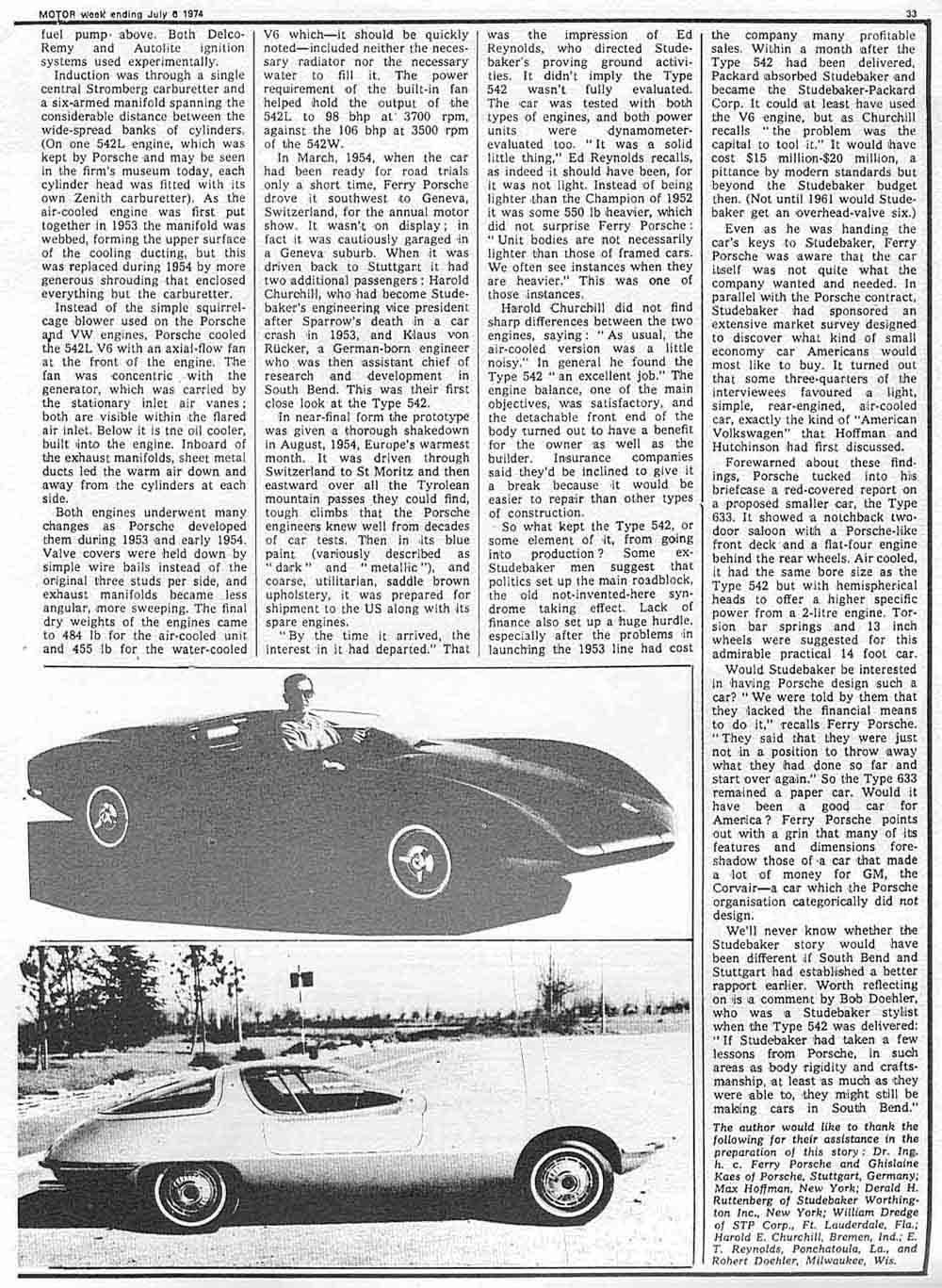
Turning Wheels, February 1977
That was the end of the Studebaker/Porsche.
Porsche also proposed a compact car much like the “square-back” Volkswagen that was built in the latter 1960s. It, too, failed to spark much interest in South Bend and that the end of the fruitless relationship between Porsche and Studebaker. |
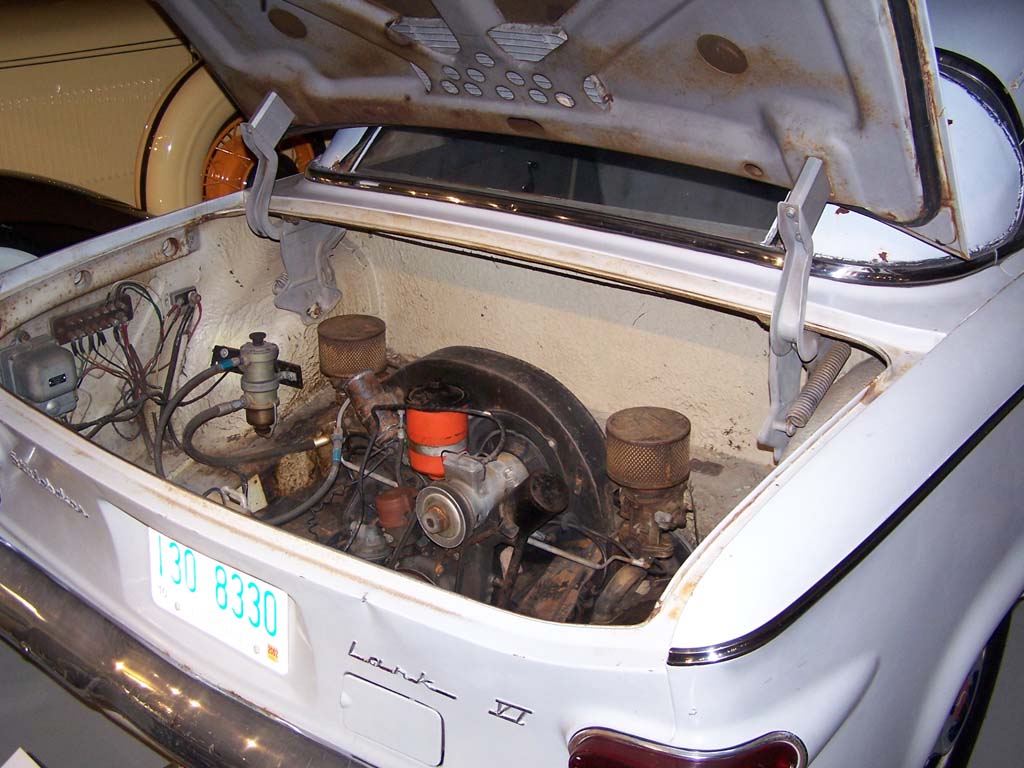
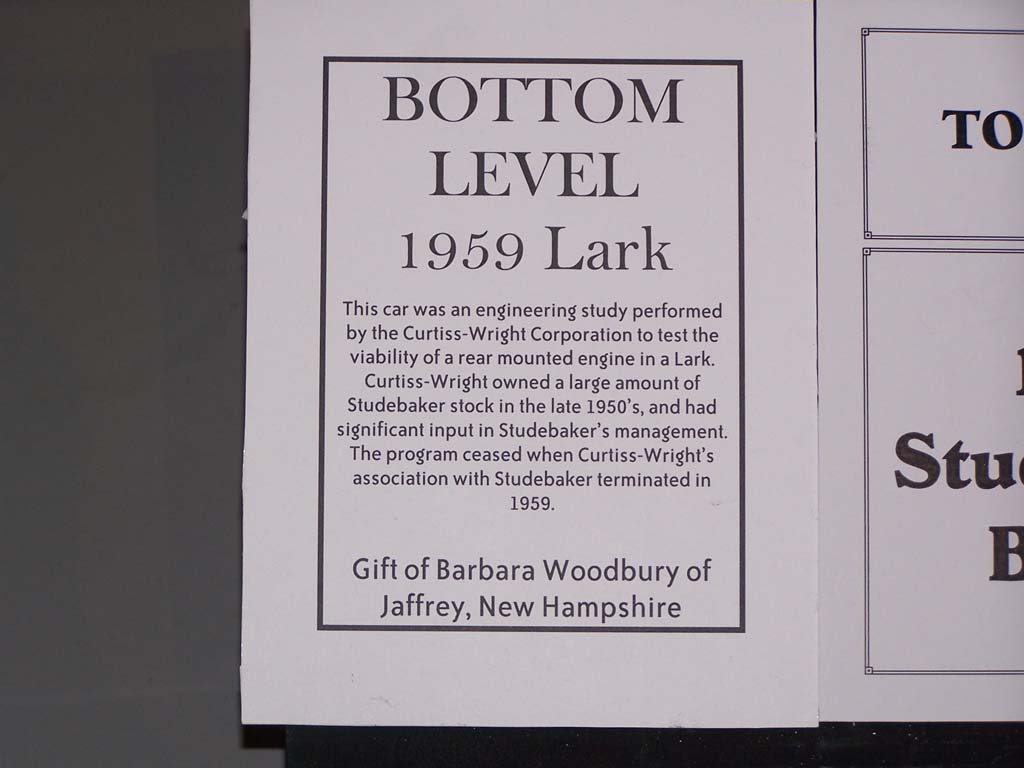
Shortly after this episode, Studebaker entered into agreements with aircraft manufacturer Curtiss-Wright over a variety of management and manufacturing issues, one upshot of which was that Curtiss-Wright would take over management of Studebaker for a period of time. In 1959 Curtiss-Wright engineers, for reasons known only to them, bought a Studebaker Lark from a dealer, removed the entire drive train and installed a 1953 Porsche boxer engine, suspension and transaxle in the rear of the car.
Whatever their reasons for cobbling together this prototype, the project went nowhere, Curtiss-Wright soon divorced itself from Studebaker and the pride of South Bend continued down the road to extinction.
| An excerpt from “www.studegarage.com/porsche.htm” ( Link below)In February, 1959 Curtis-Wright bought a new Lark with a Champ 6 engine from a local dealer and modified it. A used engine from a 1953 Porsche was rebuilt by Porsche and installed along with the torsion-bar rear suspension and transaxle. Wheels and gear reduction boxes from a VW bus were used to optimize the drive line. This engine was placed in what had been the trunk of the Lark after removing the Champ 6 and automatic transmission from the front of the car. In addition, since Curtis-Wright had taken out a license to build Wankel rotary engines, an adapter was prepared to install a small Wankel engine in place of the Porsche engine. This car may have been the prototype for the sub-compact touted two years later.Before the car could be fully tested and the rotary engine installed, the relationship between Curtis-Wright and Studebaker ended. The Lark was sold to a local New Jersey garage, then quickly resold twice more to car collectors. The car still survives and has occasionally appeared at car shows in New England. It retains the 1500 cc, 70 hp Porsche engine in the trunk. While the horsepower rating is less than the Champ 6 it replaced, the much lower weight of the Porsche engine and transmission help, but it is not a high-performance car. The engine produces peak horsepower at 5,000 rpm.
Images from the Studebaker Museum, May 2007 |

Studebaker’s that never were
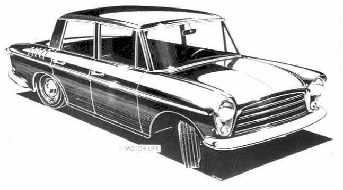 In March, 1961 Studebaker released a sketch of a sub-compact car planned for future introduction. It called for a four-cylinder, air-cooled, rear engine of 65-75 horsepower. Wheelbase was about 100 inches, much shorter than the Lark of the time. Seating was for four or five passengers. Studebaker hoped to get the car to market by the fall of 1962 at a price under $2000. The car never made it to production, but there was more to it than just an artist’s sketch. It was known as a Porsche Type 633, the result of an association with Porsche that started in 1952. In March, 1961 Studebaker released a sketch of a sub-compact car planned for future introduction. It called for a four-cylinder, air-cooled, rear engine of 65-75 horsepower. Wheelbase was about 100 inches, much shorter than the Lark of the time. Seating was for four or five passengers. Studebaker hoped to get the car to market by the fall of 1962 at a price under $2000. The car never made it to production, but there was more to it than just an artist’s sketch. It was known as a Porsche Type 633, the result of an association with Porsche that started in 1952. Porsche built a car for Studebaker in August, 1952 with a 120-degree V-6 engine . This was the Porsche Type 542, also known as the Z-87 car at Studebaker. Though it was looked at then, it didn’t get serious review until 1956 when Studebaker’s director of experimental engineering tested the car and reported on it. The director’s name: John Z. DeLorean, who later went on to other cars and other activities. He didn’t like the Porsche effort and compared it unfavorably to the comfort and ride of the 1956 Champion and Commander. Interestingly, this appears to have been the only 4-door Porsche until the Cayenne SUV was introduced for 2003.In later years, a Lark was modified to have a Porsche engine and transaxle installed in the trunk area. Curtis-Wright Corporation owned nearly half of the Studebaker stock in the late 1950’s and took over management of the company. Development efforts were conducted at their New Jersey facility.
|

(A detailed discussion of Porsche’s involvement with Studebaker can be found here.)
More added here
Source: Studebaker/Porsche Project http://oldcarandtruckpictures.com/Studebaker/TheEnd.html
Karl Ludvigsen outlined in SIA #24, September-October 1974. Studebaker’s first involvement with Porsche came earlier in the 1950s, in an earlier attempt to build a compact car. Porsche’s engineers came up with several designs and even whipped up a prototype car and a pair of prototype engines. The exact connection between that prototype and the later experimental car, however, remains unknown.


While the American firm struggled on, the project had supplied a good deal of funding to Porsche when they needed it most. While Studebaker and Packard were closing factories, Porsche was building new ones. Studebaker-Packard did manage to get a piece of the late 1950s imported car market eventually though – they became the American importers of Mercedes-Benz and Auto Union before exiting the auto industry all together in the mid 1960s. (Imagine what Max Hoffman must have thought.) The rest, as they say, is history.
Much research credit must be given to Karl Ludvigsen’s articles on this topic from the mid-1970s.






 Porsche Everyday Dedeporsches Blog