|
|
||
|
||
 |
||
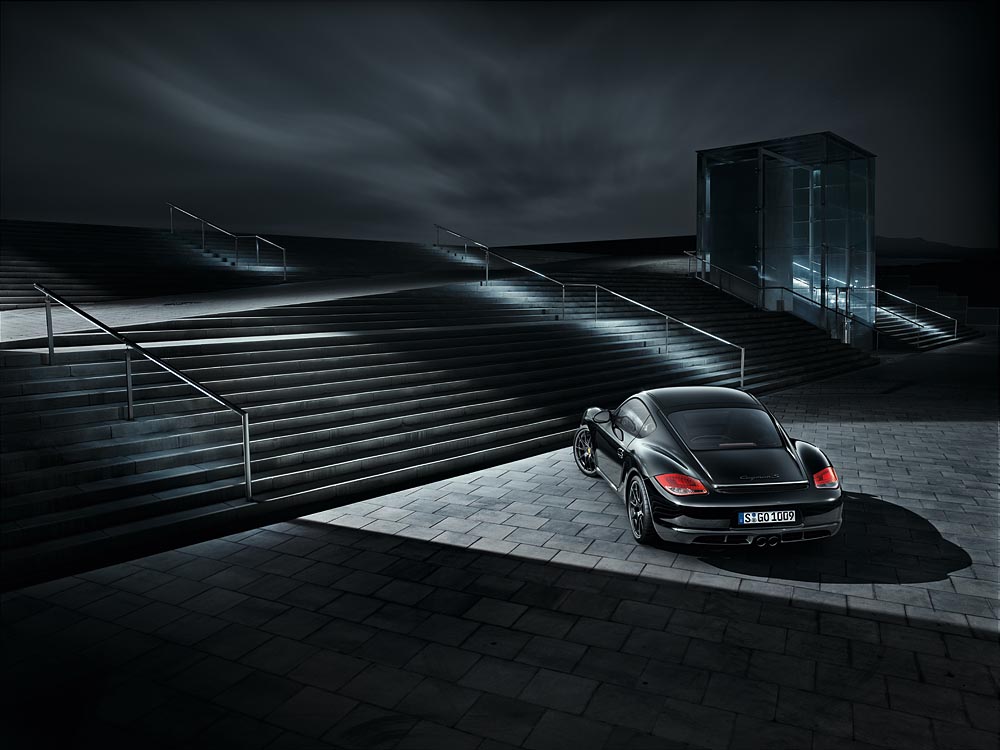
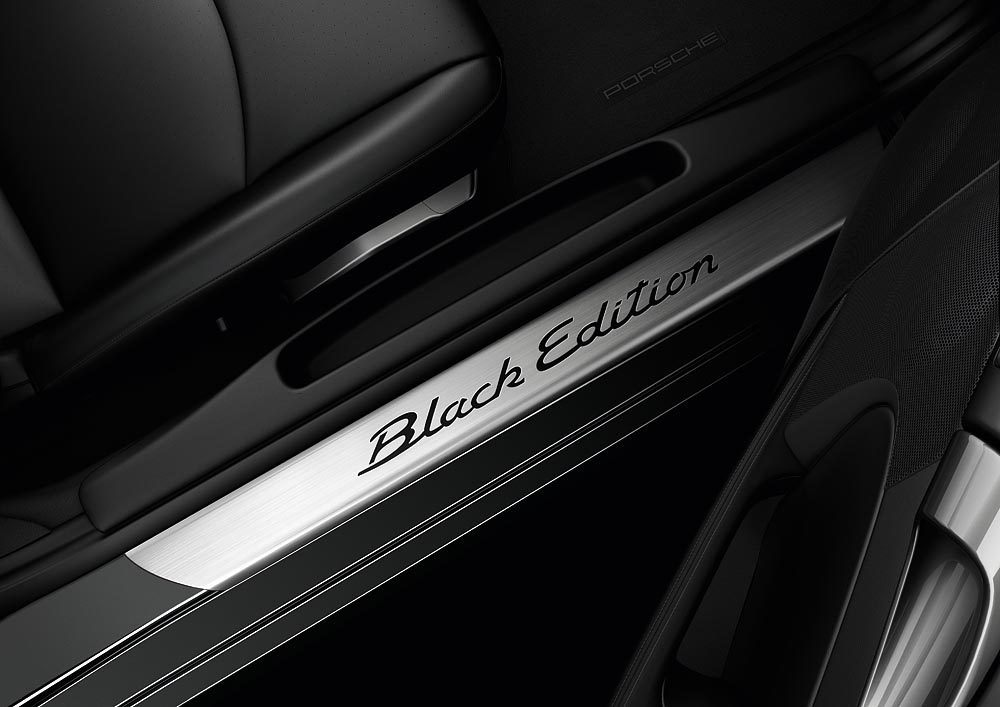
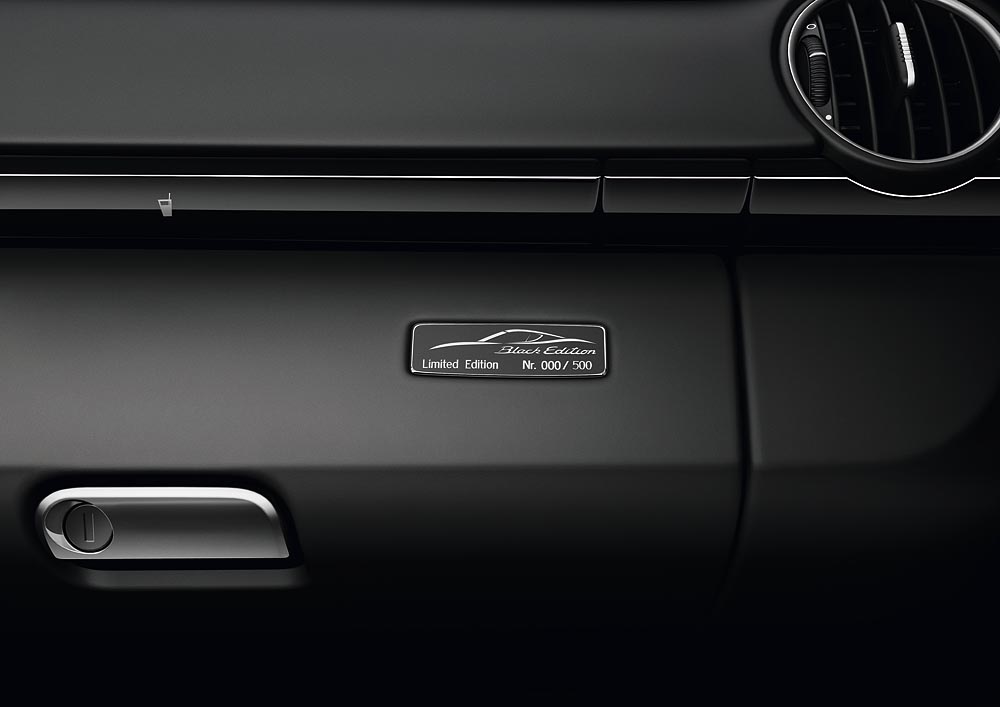
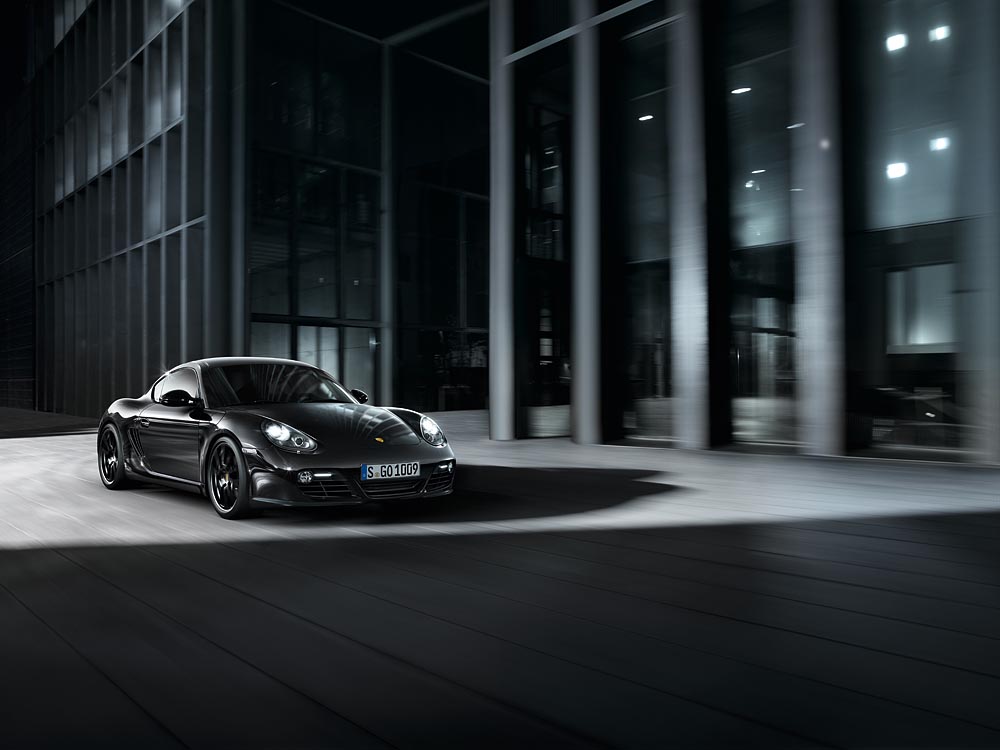
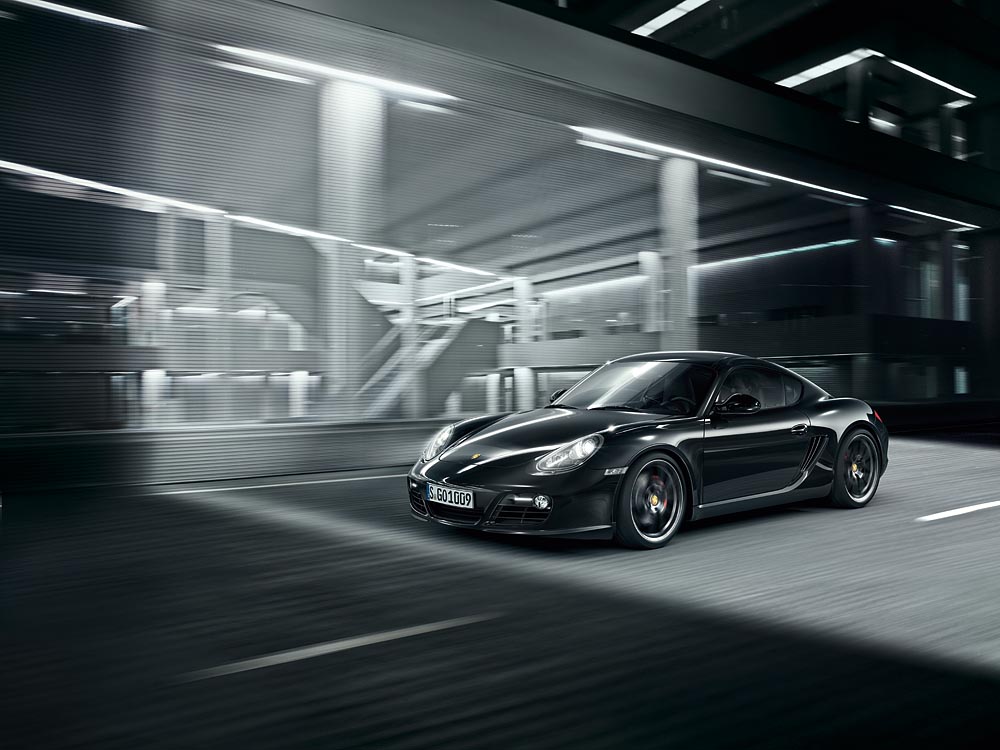
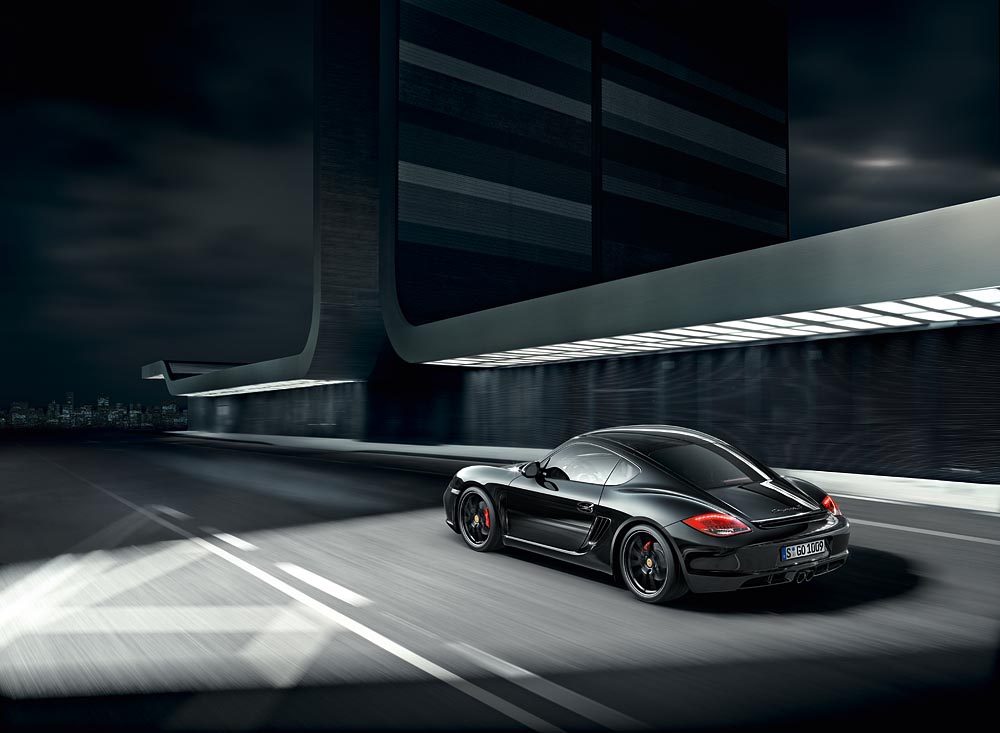
Exclusive special edition of the Porsche mid-engine coupéCayman S Black Edition with more power and comprehensive equipment package
Stuttgart. The next step up from the Cayman S is known as the Cayman S Black Edition: Starting in July 2011, Dr. Ing. h.c. F. Porsche AG, Stuttgart, is bringing the mid-engine coupé to market in a special edition limited to 500 units boasting even better performance and especially lavish equipment specification. |
Tag Archives: Porsche
PORSCHE VIDEO: Cayman S Black Edition with more power and comprehensive equipment package
Clever Porsche Owner Saves his Porsche from Kentucky Flood Waters!!

The owner of what appears to be a rare “Fly Yellow” colored 964 Porsche 911 saved his car from the flood waters encroaching his or her property near Louisville, Kentucky.
This owner has their Priorities right !!

A Porsche sports car sat high and dry in rising flood waters as it floated on a cushion tethered to a home along the Ohio River in Oldham County, near Louisville, April 26, 2011. (PHOTO CREDITS: AP Photo/The Courier-Journal, Pat McDonogh) PAT MCDONOGH | ASSOCIATED PRESS ….Read more: http://www.kentucky.com/2011/04/26/1720246/flooding-storms-in-kentucky.html#ixzz1LPiaYzaK
I posted these photos on my Facebook page earlier, after I read the latest news on the Kentucky Flooding. I was hoping to find more information from my fellow Porsche friends.
Is this a...Porsche Club of America member in Louisville Kentucky? Sure would like to know who the owner could be. I am sure something will be said about this at PCA National Headquarters. I did hear some rumors who the owner might be…but not confirmed yet.
Don’t think the owners had time to drive it anywhere, and I think that’s the garage door behind the car?….this Porsche owner definitely was prepared and outsmarted the flood waters…..That is some creative thinking!
If it’s the area I’m thinking of, the water probably came up too high for him to drive it away before he realized he needed to do something with it. Looks like a inflatable Boat lift he used by Air-Dock. Works in any water depth. …………………………………….. Whatever floats your boat! VERSATILE * SIMPLE * AFFORDABLE

The guy is the ultimate Boy Scout…..!!!
What would you do if your PORSCHE was trapped and about to be washed away?
Leave your comment’s below………..

I would definitely vote for the “Porsche Enthusiast of the Year” award!!!
UPDATE May-4-2011 9:06 PM: According to the local PCA chatboard, where this Porsche is located, the owners efforts, while heroic, didn’t save this Porsche. We’re waiting to hear back from the owner or someone close to them to verify, but that’s what’s being reported on the PCA chat service. We really hope it’s not true…
UPDATE May-6-2011: The rumors were wrong! The floating Porsche 964 survived. Read the interview with the owner of the floating Porsche for more pictures and details.
We Interview the “Floating Porsche” Owner and Learn its Fate
PORSCHE: “125 years of the car” birthday procession kicks off on the Porscheplatz
Summer 2011: Germany celebrates cars
Automobilsommer 2011
Germany – birthplace of the inventors of the automobile and home to chief brands in the four wheels market, such as Mercedes-Benz, BMW, Audi, Volkswagen and Porsche, of course – is celebrating the 125° anniversary of this mean of transportation with a series of events in several cities. The hub of celebrations will be the region of Baden-Württemberg and its capital, Stuttgart.
FOR PORSCHE: “125 years of the car” birthday procession kicks off on the Porscheplatz
Porsche classic cars on the streets of Stuttgart
Stuttgart. On Sunday 8 May 2011, Dr. Ing. h.c. F. Porsche AG, Stuttgart, will be teaming up with Mercedes-Benz and Audi, two other car brands also based in Baden-Württemberg, to stage a car procession through Stuttgart. 125 vehicles, contemporary witnesses all, will bring the history of the three carmakers to life – in some cases with well-known drivers at the wheel.
The Zuffenhausen sports car manufacturer will be putting 45 current and historic vehicles from more than six decades of Porsche history on the start line.
The “125 years of the car” procession will get under way at 11.00 a.m. at the Porsche museum, which will be offering visitors free admission on the day.
Matthias Müller, Chairman of the Board of Management of Porsche AG, will head the birthday procession in a Porsche 911 Turbo S – together with his Mercedes-Benz and Audi opposite numbers.
Dr. Wolfgang Porsche, Chairman of the Supervisory Board of Porsche Automobil Holding SE, will be driving the first Porsche prototype, the Type 356 “No. 1”, developed by his father Ferry Porsche in 1948.

Ferry Porsche with the Porsche Type 356 “Nr. 1”
Current and former Porsche AG works and racing drivers will also be taking part in the drive through the town. For example, racing legend Hans Hermann will be piloting the Porsche 917 KH on the streets of Stuttgart, the same car he and Richard Attwood drove in the 1970 Le Mans 24 Hours when they won the first ever overall victory for the Zuffenhausen company.
 Le Mans winner car 917 KH with Hans Herrmann and Richard Attwood.
The three times winning Porsche 908/03 Spyder is being withdrawn from the Porsche museum’s exhibition for Porsche works driver Marc Lieb.

Porsche 908/03 Spyder – 970 2997cc 350PS
Finally, the 612 hp (450 kW) Carrera GT high performance sports car, once limited to 1,270 units, will be driven by double world rally champion Walter Röhrl.
In addition to a “police presence”, the car procession will also give an outing to the Swabian sense of humour. Stuttgart “Tatort” (Crime Scene Investigation) Inspector Richy Müller will be switching on the blue lights on the Porsche 356 C Cabriolet. In the Sixties, this classic car was used by the Württemberg motorway police.
Police Interceptor, German style: A 1956 Porsche 356C 1600SC Cabriolet.
And cabaret artist Christof Sonntag will be behind the wheel of a Porsche 911 Targa (Type 964).
The destination of the procession that will start at Zuffenhausen’s Porscheplatz is the Schlossplatz in the centre of Stuttgart. Here there will be an opportunity on Sunday afternoon to admire all the participating vehicles at close quarters.

Porsche will also be showcasing itself on the Schlossplatz as part of an innovation exhibition true to its “Porsche Intelligent Performance” philosophy: more power with lower consumption, increased efficiency and reduced CO2 emissions.
Three modern day Porsche vehicles await the visitor there, providing an impressive demonstration of alternative driveline technologies: the Porsche Boxster E, the Porsche Cayenne S Hybrid and the Porsche 911 GT3 R.

SOURCE: PORSCHE AG DATABASE
(photos courtesy of Porsche AG)
VIDEO: Porsche lines up with an even more efficient 911 GT3 R Hybrid – Nürburgring
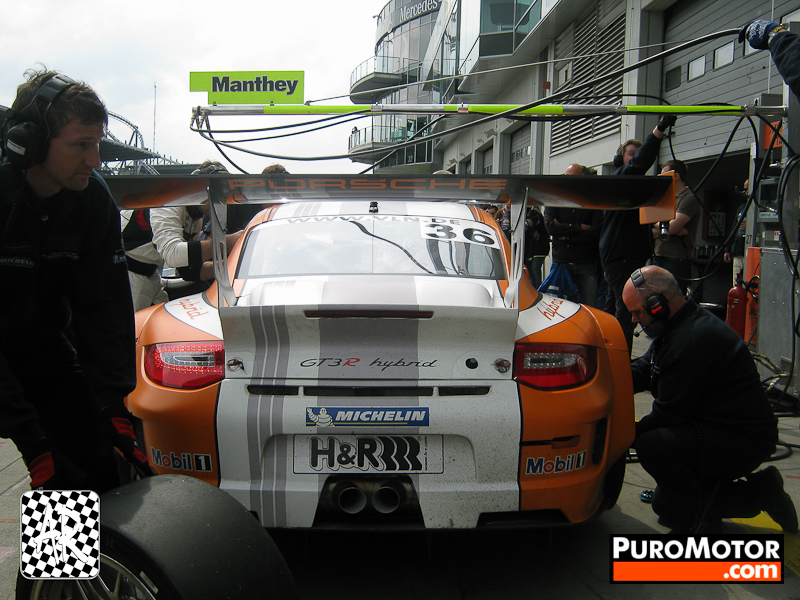
Porsche Hybrid GT3 R beim freien Training der VLN auf der Nordschleife 29.04.2011
Stuttgart. The development of the Porsche 911 GT3 R Hybrid 2.0 is running at full revs.
This Saturday, April 30th, the further-developed version of the innovative Hybrid race car contests round two of the Nürburgring Long Distance Championship (VLN).
Another test under race conditions is planned at the fourth VLN round on 28 May.
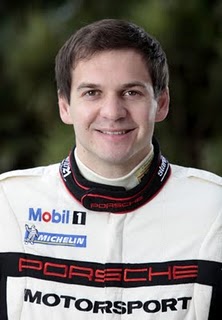
At the race debut of the modified version of the 911 GT3 R Hybrid on 30th April, Porsche works drivers Joerg Bergmeister (Germany),
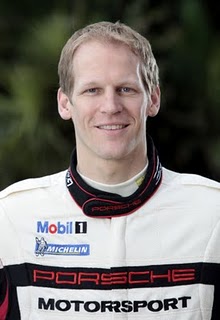
Comentario: Joerg Bergmeister/Porsche Hibrido.
Foto: AmigosRacing
Marco Holzer (Germany)
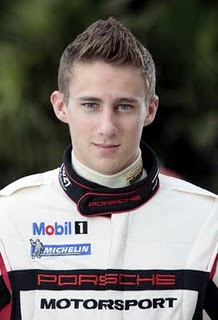
Comentario: Marco Holzer – Johan Koning.
and Patrick Long (USA) share driving duties in the orange and white ‘race lab’.
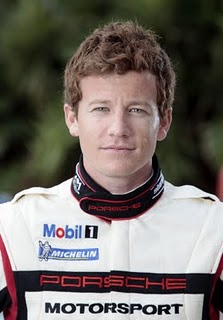
At the second race meeting in late May, Holzer and Long join forces with Richard Lietz (Austria) to pilot the Hybrid-911.
24h Nürburgring, Nürburgring 24 hour race
Porsche takes up the Nürburgring 24 hour race on 25 June with a further developed version of the Porsche 911 GT3 R Hybrid.
So, what’s been done with this latest Porsche 911 Hybrid race car?
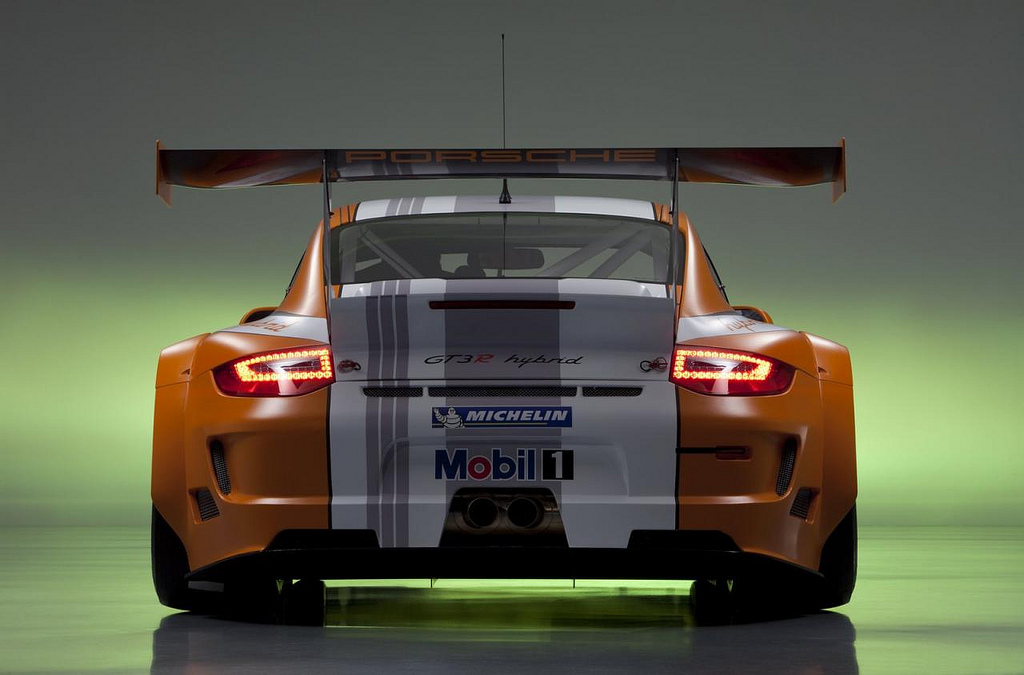
Priority of the development was given to the improvement of efficiency through the targeted optimisation of hybrid components, which also resulted in a 20 percent weight reduction. Version 2.0 of the 911 GT3 R Hybrid is intended to achieve the same lap times as its predecessor but with less fuel consumption.
The general layout of the hybrid was adopted from the 2010 model. A portal axle with two electric motors drives the front wheels and supplements the four-litre, depending on the balance of performance classification approximately 470 hp, six-cylinder boxer engine at the rear. The output of both electric motors has increased from 60 to 75 kilowatts each. For seconds at a time, pilots now have almost an additional 200 hp at their disposal with the 911 GT3 R Hybrid 2.0.
Depending on the programming, this power is automatically activated through use of the throttle pedal. Moreover, pilots can manually call up this extra power, for instance when overtaking.
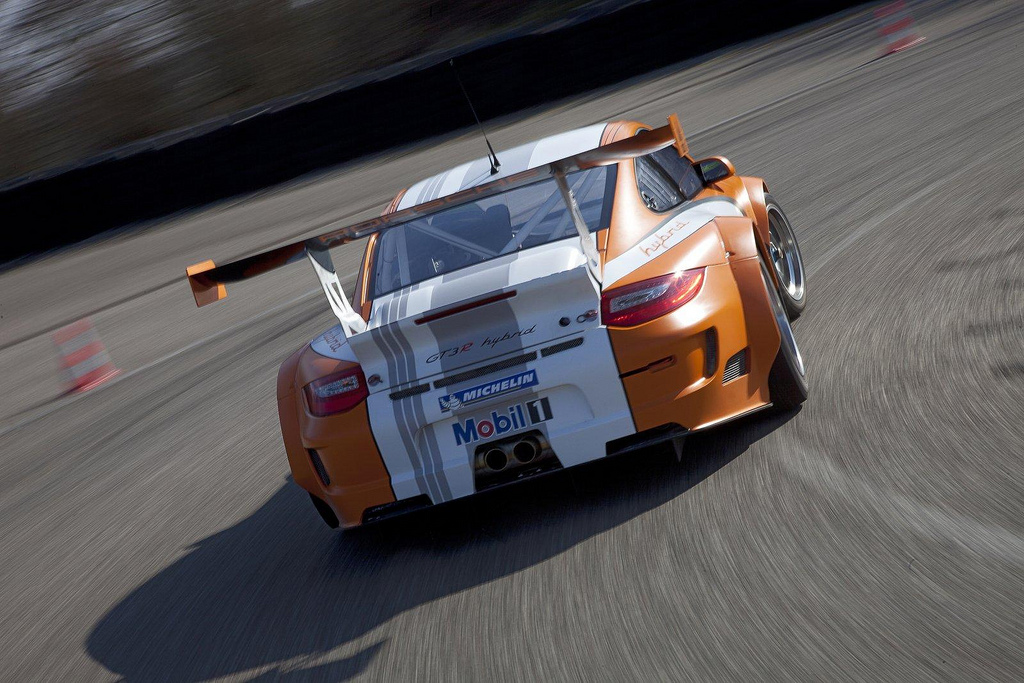
The electric flywheel accumulator, with its rotor spinning up to 40,000 rpm and stor-ing energy mechanically as rotational energy, is now housed with the other hybrid components in a carbon fibre safety cell on the passenger’s side.
At first glance, the new GT3 R Hybrid is clearly distinguishable from the 2010 model. Thanks to the optimisation of the hybrid system’s high voltage components, the large louvres in front of the rear fenders were no longer necessary. This reduces drag and also lowers fuel consumption. All in all, the weight of the vehicle decreased from 1,350 to 1,300 kilograms.
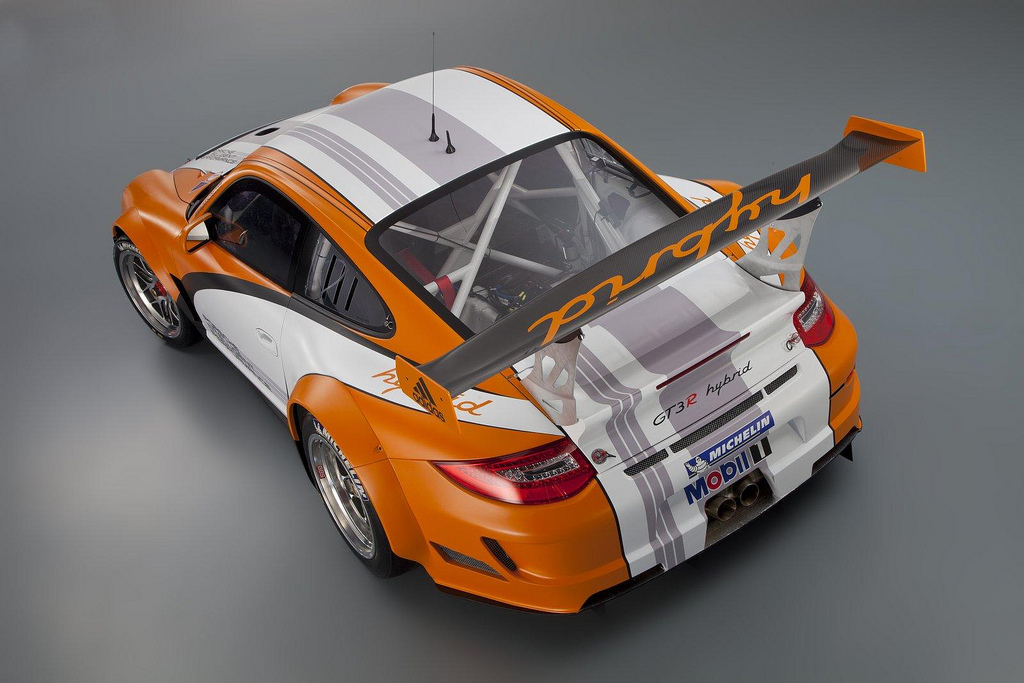
“We’ve collected a great deal of information from our races on the Nürburgring, at the ALMS race at Road Atlanta in the USA, as well as from the ILMC race on China’s Zhuhai circuit, which was an invaluable help for the further development of our racing laboratory,” says Hartmut Kristen, head of Porsche motorsport.
“The emphasis of our work was on improving efficiency. That means we want to keep the lap times consis-tent with 2010 but use less energy, hence less fuel. In this way, we support future developments of road-going, sporting hybrid vehicles.”
The cockpit of the 911 GT3 R Hybrid has also been completely revised. Most of the displays and controls have moved to the steering wheel. Drivers can operate the rest of the functions via backlit buttons now situated on the centre console.
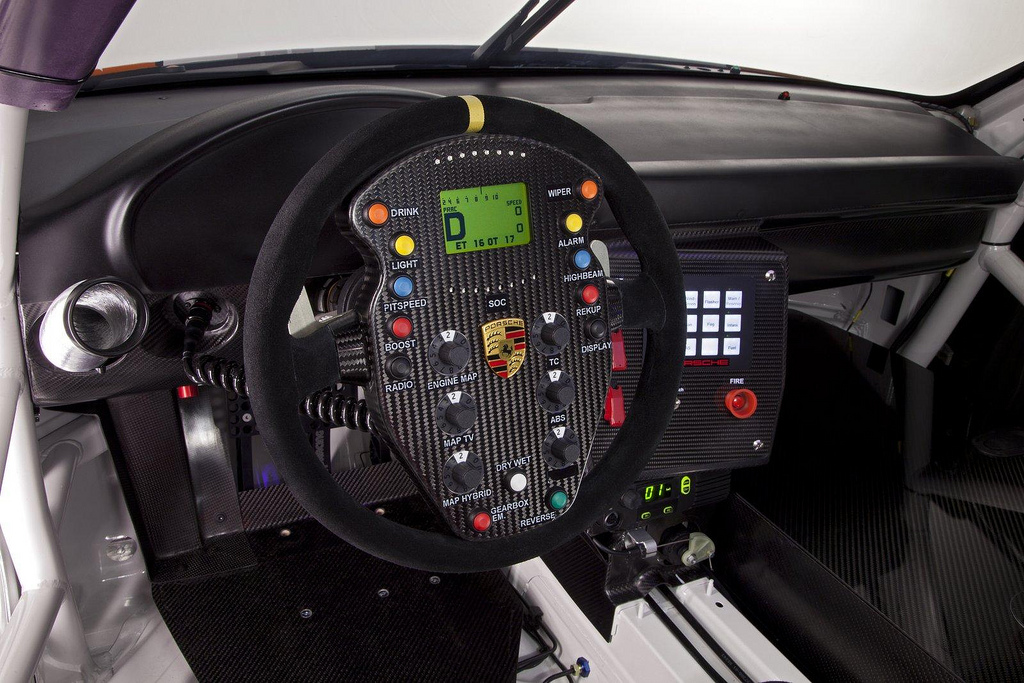
Priority was placed on the ergonomics and the clear layout for pilots – particularly in darkness.
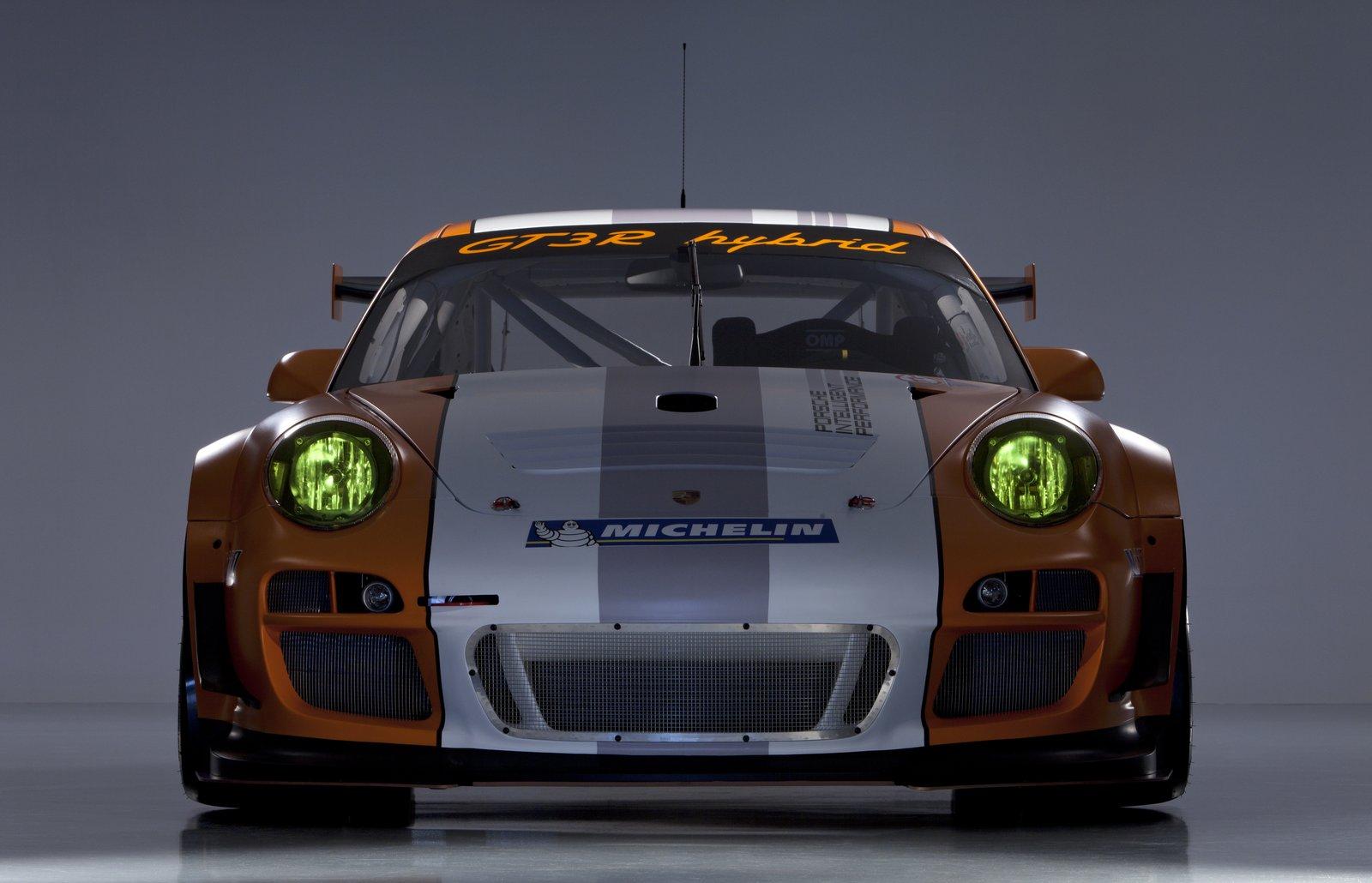
The new 911 GT3 R Hybrid is a perfect example of the ‘Porsche Intelligent Performance’ philosophy, a principle found in every Porsche: More power on less fuel, more efficiency and lower CO2 emissions – on the race track and on the road.
Source: Porsche
PORSCHE: 80 years of Porsche Designs – Porsche Engineering – Pioneering Technology and Trailblazing Innovations

Porsche Museum special exhibition
“Porsche Engineering – 80 years of Porsche design” Webspecial
For the Porsche Museum in Stuttgart-Zuffenhausen, the 80th anniversary of the Porsche engineering office founded in 1931 is one of the central themes of 2011.
From 7 July to 28 August 2011, the special exhibition “Porsche Engineering – 80 years of Porsche design” will be paying tribute to the most important and interesting third-party client developments of the past eight decades.
On display will be approximately 20 special exhibits extending from the development of entire vehicles via engines and gearboxes to remarkable industrial projects of the present day.
The ten third-party client vehicle developments include a 1931 vintage Wanderer saloon, the legendary Auto Union Grand Prix racing car and the Audi Sport Quattro S1 with the Porsche Doppelkupplungsgetriebe (PDK) driven by Walter Röhrl.
The Porsche Museum is open Tuesday to Sunday from 9:00 a.m. to 6:00p.m.
For further information please visit www.porsche.com/museum

On 25 April 1931 Ferdinand Porsche founded an engineering office called “Dr. Ing. h.c. F. Porsche Limited, construction and consulting for engine and automobile manufacturing” (Dr. Ing. h.c. F. Porsche Gesellschaft mit beschränkter Haftung, Konstruktion und Beratung für Motoren- und Fahrzeugbau). Porsche Engineering, contract development by Porsche, thus dates back to the oldest predecessor company of today’s Porsche AG and for more than 80 years has developed customised solutions on behalf of automotive manufacturers and suppliers from the automotive industry, but also for other industrial companies from around the world.
Discover the milestones of Porsche history and join Porsche in taking on the challenges of the future.


Stuttgart. Dr. Ing. h.c. F. Porsche AG, Stuttgart, has been the leading manufacturer of premium sports cars for more than six decades. However, the historic roots of the Porsche brand go back much further than that. When Ferry Porsche built the legendary Type 356 in 1948, he and his engineers were able to look back on a wealth of comprehensive technological experience.
Back on 25th April 1931, Ferdinand Porsche founded and registered a design bureau named “Dr. Ing. h.c. F. Porsche Gesellschaft mit beschränkter Haftung, Konstruktion und Beratung für Motoren- und Fahrzeugbau” in Stuttgart.
Since then, the Porsche company has experienced many highs and lows and has grown from a small design bureau to a world famous manufacturer of sports and racing cars. This success story is based on decades of development experience, stretching far beyond just building sports cars. Over an 80 year period, Porsche has built up a reputation as one of the best known and multi-faceted engineering service providers in the world. The tradition of customer development started by Ferdinand Porsche in 1931 is still successfully continued today by Porsche Engineering Group GmbH, based in Weissach.
Porsche Engineering carries out development work on behalf of car manufacturers and suppliers, as well as companies from other sectors, combining the skills of Porsche as a series manufacturer, technology company and engineering service provider and making these available to third parties.
The 80th anniversary of the founding of the Porsche design bureau in 1931 is one of this year’s central themes for the Porsche Museum in Stuttgart-Zuffenhausen. From 21st June to 11th September 2011 the special exhibition entitled “Porsche Engineering – 80 Years of Porsche Designs” will honour the most important and interesting customer developments from the last eight decades. It will display around 20 special examples ranging from whole vehicle developments, through engines and gearboxes to extraordinary industrial projects in the present. The ten vehicle customer developments on display include a Wanderer Limousine from 1931, the legendary Auto Union Grand Prix racing car and the Audi Sport Quattro S1 with Porsche dual clutch gearbox (PDK). The Porsche Museum is open from Tuesday to Sunday, from 9 am to 6 pm. Further information is available on the internet from www.porsche.com/museum.
80 years of Porsche designs

Discover the history of Porsche customer growth in the Webspecial.
For more than six decades, Dr. Ing. h.c. V. Porsche AG, Stuttgart, has enjoyed a reputation as a leading manufacturer of sporty premium cars. But the Porsche brand has much deeper historical roots. When Ferry Porsche built the legendary Type 356 in 1948, he and his engineers were able to draw on a comprehensive trove of technical experience.As long ago as 25 April 1931, Ferdinand Porsche had established an engineering office in Stuttgart under the name “Dr. Ing. h.c. F. Porsche Gesellschaft mit beschränkter Haftung, Konstruktion und Beratung für Motoren- und Fahrzeugbau“, (“Dr. Ing. h.c. F. Porsche Ltd., Design and Consultancy Company for Engine and Vehicle Production”) and had it entered in the trade register.
Since then, the Porsche company has experienced many ups and downs and grown from a small engineering office into a manufacturer of sports and racing cars that is known throughout the world. This success story is based also on decades of development experience extending far beyond sports car construction. Over an eighty-year period, Porsche has acquired the reputation as one of the world’s most illustrious and versatile engineering service providers. The tradition begun by Ferdinand Porsche in 1931 of third-party client development has been successfully carried on to this very day by the Porsche Engineering Group GmbH with its headquarters in Weissach. Porsche Engineering develops on behalf of automotive manufacturers and suppliers but also for companies from other sectors, bundling the know-how of the manufacturer, technology company and engineering service provider that is Porsche and making this available to third parties.
Ferdinand Porsche the automotive designer
The name Porsche has been associated with pioneering innovations in automotive engineering since the beginning of the last century. Ferdinand Porsche had been busy designing and developing his first cars as far back as 1896. The first fruit of this endeavour was an electric vehicle known as the “Lohner-Porsche” driven by steered wheel hub motors that caused a sensation at the Paris World Exhibition in 1900. This was soon followed by ever more impressive proof of just how innovative Ferdinand Porsche was. A racing car boasting four wheel hub electric motors became the world’s first all-wheel drive passenger car, brilliant also for having four-wheel brakes. No less visionary was Ferdinand Porsche’s next idea: Again in 1900 he combined his battery-powered wheel hub drive with a petrol engine – the principle of the serial hybrid drive had been born.
With this first functional, full-hybrid car in the world, the “Semper Vivus” (“always alive”), Ferdinand Porsche had entered uncharted territory. In this vehicle, two generators twinned with petrol engines formed a single charging unit, simultaneously supplying electricity to wheel hub motors and batteries. As a full hybrid concept, the “Semper Vivus” was also able to cover longer distances purely on battery power until the combustion engine had to be engaged as a charging station. To save weight and create space for a petrol engine, Ferdinand Porsche used a comparatively small battery in the “Semper Vivus” with a mere 44 cells. In the middle of the vehicle he installed two water cooled 3.5 hp (2.6 kW) DeDion Bouton petrol engines for generating electricity, driving two generators, each producing 2.5 hp (1.84 kW). Both engines operated independently of one another, each delivering 20 amps with a voltage of 90 volts. The electricity generated by the dynamos initially flowed to the wheel hub motors, with the surplus power being forwarded to the batteries. An additional special side effect was that it was possible to use the generators as electric starter motors for the petrol engines by reversing the direction of rotation. Starting as far back as 1901 as the Lohner-Porsche “Mixte” and from 1906 onward as the “Mercedes Electrique”, Ferdinand Porsche brought his hybrid drive to the start of volume production.
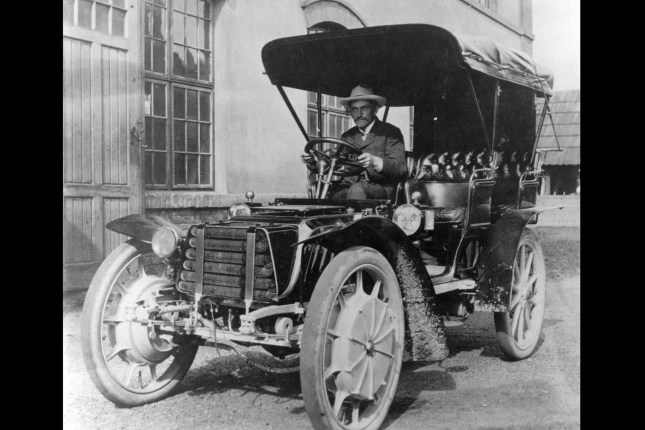 Ferdinand Porsche in the Lohner-Porsche
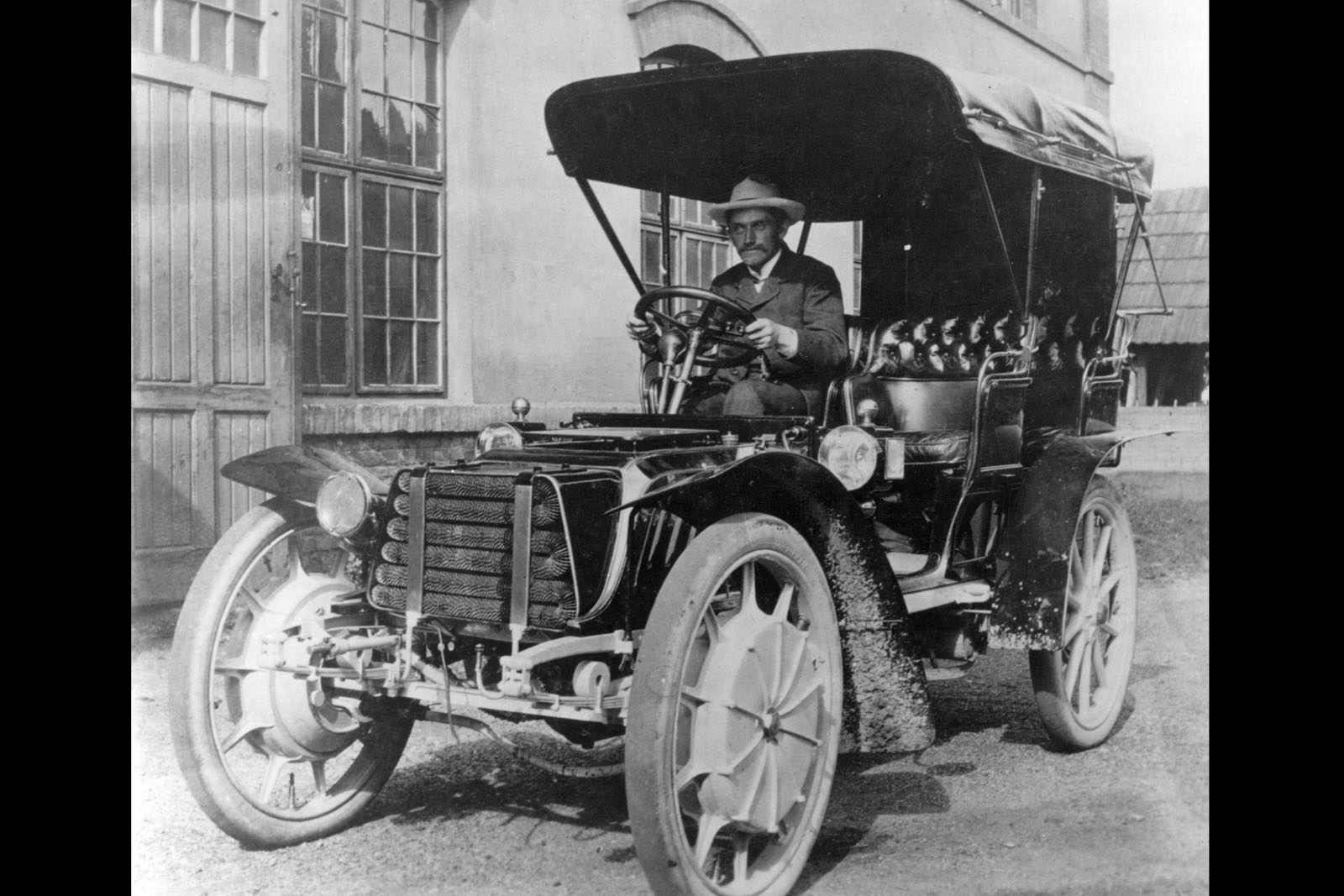
This was followed in 1906 by the next step in Ferdinand Porsche’s career. At the tender age of only 31 he landed the position of Technical Director at Austro Daimler in Wiener Neustadt, giving him product responsibility for one of Europe’s leading automotive companies. One of the greatest successes of this era was the so-called “Prinz-Heinrich Car”, in which the Austro-Daimler works team won the first three places in the 1910 running of the highly regarded Prinz-Heinrich Race. In the guise of the Austro-Daimler “Sascha”, he developed a small car which, thanks to its excellent power-to-weight ratio prevailed against its larger displacement competitors in the 1922 Targa Florio, notching up no fewer than 43 racing victories in total.
In 1923 Ferdinand Porsche moved to the Daimler engine company in Stuttgart-Untertürkheim as Technical Director. There, in addition to the Type 8/38 midsized model and the first eight cylinder engine Mercedes-Benz, the “Nürburg” Type 460, it was first and foremost the supercharged sports and racing cars that further consolidated his worldwide reputation as an automotive designer. The sports and racing cars developed under his guidance with the abbreviations “S” (Sport), “SS” (Super Sport) and “SSK” (Super Sport Kurz, or short) ranked among the most coveted cars of their time. In January 1929 he left Daimler-Benz AG. Following a short interlude at the Austrian Steyr works, at the end of 1930 he returned to Stuttgart and opened an engineering office.
Ferdinand Porsche at the office
The founding of the Porsche engineering office
The “Dr. Ing. h.c. F. Porsche Gesellschaft mit beschränkter Haftung, Konstruktion und Beratung für Motoren- und Fahrzeugbau“ was entered in the Stuttgart trade register on 25 April 1921, at the height of the world economic crisis. In addition to Ferdinand Porsche, who contributed 24,000 Reichsmarks to the limited company’s share capital, his son-in-law Anton Piëch and Adolf Rosenberger also invested 3,000 Reichsmarks each as executive partners. From the outset, the work undertaken by the initial twelve strong team around Ferdinand Porsche spanned the entire gamut of motor vehicle technology. Legendary cars such as the Auto Union Grand Prix racing car or the Volkswagen “Beetle” were to emerge from this Stuttgart engineering office in the years that followed. Porsche’s workplace progressed to be one of the most important seedbeds of automotive technology, at the same time preparing the ground for mass car ownership in Germany.
As early as 1931, Porsche designed a six cylinder average mid-size saloon for the Chemnitz car manufacturer Wanderer as well as a new in-line eight cylinder engine. This was followed by a swing axle for the Horch-Werke in Zwickau and an air-cooled five-cylinder radial engine designed for the Phänomen-Werke in Zittau, intended for use in trucks. In addition, the engineering office developed a small car for Zündapp GmbH, which with its rear-engine, rigid tubular backbone chassis and transmission mounted forward of the rear axle was to prove to be decisive for the Volkswagen that came later. The torsion bar suspension patented on 10 August 1931 and used in international automotive manufacturing over many decades is also held to be a milestone in automotive history.
In the spring of 1933, Ferdinand Porsche was commissioned by Auto Union in Saxony to develop the Grand Prix racing car. The moment the contract was signed, the Porsche team led by senior engineer Karl Rabe began work on the Auto Union P racing car (P for Porsche), configured as a mid-engined vehicle. The first test drives took place as early as November 1933 and in the very first racing season in 1934 this vehicle set three world records and won three international Grand Prix races in addition to several hill climb races. Between 1934 and 1939, with drivers such as Bernd Rosemeyer, Hans Stuck or Tazio Nuvolari, the constantly refined Auto Union racing car became one of the most successful pre-war era racing cars . Its technical mid-engine concept proved to be a trendsetter for all modern racing cars and is used to this very day in Formula One.
In addition to developing racing cars, the engineering office had been equally hard at work since 1933 on the design of a low-cost small car commissioned by the NSU works – an idea that was also exercising other car designers such as Belá Barényi or Hans Ledwinka against the backdrop of the world economic crisis. When Ferdinand Porsche began work on designing the Type 32 compact car, this was already the seventh small car design of his career. A number of prototypes of this vehicle type were built, which with the air-cooled, flat-four, rear-mounted engine and Porsche torsion bar suspension exhibited distinct similarities with the later Volkswagen Beetle. The “Memorandum on the construction of a German people’s car” (Volkswagen) that he presented to the Reich Transport Ministry on 17 January 1943 was to prove critical to the breakthrough of the small car concept. Shortly thereafter, on 22 June 1934, he received the official order from the RDA, the “Reichsverband der Deutschen Automobilindustrie” (German Reich Automobile Industry Association) to design and build Volkswagen prototypes that were assembled in the garage of his Porsche villa in the north of Stuttgart in 1935.
Ferdinand Porsche and Auto Union GP
Contrary to the initial idea of having the Volkswagen built jointly by Germany’s car manufacturers, the Reich government decided in 1936 to build an independent Volkswagen plant, the planning of which was entrusted to Dr Ferdinand Porsche. Since the incorporation of the “Gesellschaft zur Vorbereitung des Deutschen Volkswagens mbH” (Gezuvor) in May 1937, a company established to pave the way for the construction of the German “people’s car”, Porsche, as one of three Managing Directors, was officially responsible for technology and the planning of the future Volkswagen plant and, accompanied by his son Ferry, travelled to the United States of America to find out about modern production methods.
In addition to the Volkswagen project, the Porsche engineering office, located in the Zuffenhausen district of Stuttgart since 1938, was working on numerous other development contracts from the automotive industry. For Daimler-Benz AG work included the development of technical engine components for the Mercedes “silver arrows” between 1937 and 1939 as well as the design of the Type 80 high-speed car for an attempt on the land speed record. The Type 110 compact agricultural tractor with an air-cooled two cylinder engine, developed for the “Deutsche Arbeitsfront” (German Labour Front) (DAF), was the model for the later “People’s Tractor” and the Porsche diesel tractor produced after the Second World War.
In 1938 the Volkswagen works awarded the Porsche engineering office the contract to develop a racing car based on the Volkswagen Type 60, which was to take its place on the grid for a planned long distance race from Berlin to Rome as a promotional stunt for the “KdF car” (“Strength through Joy” car). By the spring of 1939, the Porsche engineers had developed three sports car coupés under the in-house designation Type 64, for the “Non-stop speed endurance test” scheduled for September. As much of the more than 1500 kilometre long race was to be on the new motorways, particular attention was lavished on the vehicle’s aerodynamics. With a sleek streamlined aluminium body, shrouded wheel wells and a modified VW horizontally opposed engine, the would-be record-breaking car, weighing a mere 600 kg, topped 140 km/h (87 mph). When the outbreak of the Second World War prevented the race from being held, the Porsche engineering office used the completed sports cars as fast touring cars, achieving average speeds in excess of 130 km/h (81 mph) on long business trips.
After the outbreak of the Second World War, other types of vehicle were spun off from the Volkswagen for military use. In addition to the Type 81 “VW Kastenwagen” the company, trading as Porsche KG since the end of 1937, developed the Type 62 “KdF off-road vehicle”, the Type 82, known as the “VW Kübelwagen” and the all-wheel drive Type 87 and Type 166 “VW Schwimmwagen” amphibious vehicle, among others. At the end of 1939, the Army’s Armaments Office also awarded the Porsche engineering office the development contract for a medium tank, the design of which however was temporarily shelved owing to the need for heavier types of tank. Initially employed by the Armaments Ministry as a consultant, Ferdinand Porsche headed the Tank Commission from 1941 to 1943. In 1942 Ferdinand Porsche received the contract to design a super heavy tank, the Type 205 “Maus” (Mouse), of which only two prototypes were ever built, however, and never saw action. During the war, development of the military derivatives of the Volkswagen as well as various tank prototypes – including the involvement of prisoners of war employed as forced labourers – took place predominantly in Stuttgart-Zuffenhausen. With the intensification in bombing raids, the Porsche KG engineering office, classified as important to the war effort, was relocated in autumn 1944 from Stuttgart to Gmünd in Carinthia, Austria.
New beginning with third-party client development and sports car construction
With the war over, the Porsche engineering office in its new home in Austria strove to attract new contracts from the automotive sector. But initially it was water turbines, cable winches, ski lifts, mowing bars and various types of tractor based on the “People’s Tractor” that were developed and for the first time also sold under the Porsche name. The most important customer in the early post-war years was the Italian company Cisitalia, whose car enthusiast owner Piero Dusio awarded numerous design contracts at the end of 1946. In addition to a tractor and water turbine, Dusio ordered a mid-engine sports car with hydraulic torque converter and a Grand Prix racing car. The upshot was the Type 360 “Cisitalia” completed in 1948, which technically was far ahead of its time on many counts. Unlike the front-engine Formula One racing cars of the post war year, which for the most part still featured rigid axles, the Type 360 was designed with a mid-engine layout. The suspension featured double trailing arms on the front axle, the rear axle being configured as a double-joint swing axle with torsion bar suspension. In terms of drive train, the single-seater featured a 385 hp (283 kW) 12-cylinder engine with compressor, achieving a maximum engine speed of 10,600 rpm. The 1.5 litre boxer engine’s four camshafts were driven by bevel shafts. The synchronised five-speed transmission – as with the gear change on a motorbike – could be operated with just two gearshift levels via a dog clutch. Thanks to the experience with the Auto Union P-racing car, there was an awareness of the traction problems with the narrow racing tyres that were customary at the time. Power transmission was therefore by means of all-wheel drive that could be activated by the driver if required. But financial difficulties affecting the client Cisitalia prevented the Type 360 from taking part in Grand Prix races.
In July 1947, independent design work began on the Type 356 “VW sports car”. The design concepts became reality in the first half of 1948 under the in-house design number 356 based on earlier designs such as the Volkswagen or Type 64 “Berlin-Rome car”. Once the chassis had completed its maiden drive in February, the finished prototype with the chassis number 356-001 received one-off approval by the State Government of Carinthia. The Porsche sports car brand had been born. Production of the rear-engined coupé and convertible versions of the Porsche Type 356/2 started in the second half of 1948. Series production of this sports car began after the return to Stuttgart in 1950, approximately 78,000 vehicles being built by 1965. The successor model, the Porsche 911, finally helped the company to make the breakthrough as one of the technically and stylistically leading sports car manufacturers in the world.
From the Weissach Engineering Office to the Weissach Development Centre
Despite the successful entry into vehicle manufacturing, third-party client development commissions remained a firm fixture in the then Porsche KG’s service portfolio. The most important client right into the 1970s was Volkswagen AG, with whom there had been an extensive cooperation agreement. Numerous detailed improvements were devised for the VW “Beetle”, which was produced in Wolfsburg in exchange for payment to Porsche of a licence fee of approximately DM 5 per vehicle. Porsche was also involved in developing the successor models for the successful Beetle. The Stuttgart-based company developed numerous prototypes on behalf of the Volkswagen Group, which were to prove groundbreaking for the Wolfsburg Group’s passenger vehicle programme. The best-known contract developments were the VW Porsche 914 unveiled in the autumn of 1969 and the Porsche 924 built in response to Volkswagen development contract EA 425.
In addition to the numerous orders for the Volkswagen Group, Porsche’s third party client development engineers developed numerous other innovations for domestic and foreign clients in the 1950s and 1960s. Porsche developed the amphibious all-wheel-drive Type 597 Jagdwagen vehicle in response to a Bundeswehr invitation to tender. Although the Jagdwagen proved to be technically superior, the contract was awarded to car and motorcycle manufacturer DKW for labour market reasons. Overseas customers as well, such as the Studebaker Corporation, put their faith in Porsche KG’s experience. Between 1952 and 1954, the Stuttgart-based sports car manufacturer developed a four-door saloon with self-supporting body and modern ponton design for the American carmaker.
In 1971, Porsche’s Development Division with its Construction, Testing and Design Departments relocated to the newly constructed Development Centre in Weissach, 25 kilometres to the north-west of Stuttgart-Zuffenhausen. Ferry Porsche had already had a so-called “skid pad” built there 10 years earlier, which had been used ever since for conducting suspension tests. In addition to a large test track, the 1970s and 1980s saw the building of high-spec installations such as wind tunnel, crash facility, emissions testing centre and a wealth of engine test rigs that are available for third-party contracts and in-house developments alike. The Development Centre spanned virtually all areas of civil and military engine technology. Large orders from the German Army were also handled as were future automotive studies for the Federal Ministry of Research and Technology. The client portfolio was recruited from virtually the whole of the world’s automotive industry, which drew on Porsche’s know-how for its own vehicle programmes, from detailed technical solutions to entire vehicles.
Industrial projects and series development
Breaking new ground is a tradition with Porsche’s third-party client development. For example, in the early 80s, Weissach engineers and aircraft manufacturer Airbus joined forces to design a cockpit layout for wide-bodied aircraft, setting a trend by using displays in place of the conventional analog instruments. The project sought to achieve discernible improvements for the pilots’ working environment through optimised styling.
Another major project was the “TAG Turbo made by Porsche” engine developed for the British McLaren International racing team, with the aim of causing a sensation at the very pinnacle of motor sport. Unveiled in the summer of 1983, the 1.5 litre, six-cylinder turbocharged engine dominated Formula One, with 25 Grand Prix victories and three world championship titles between 1984 and 1986. The secret of the Formula One high-performance engine’s success lay in marrying the turbocharger technology with an electronic engine management system. As a consequence, the racing car’s fuel consumption was particularly economical, which critically influenced the racing strategy
A milestone in the development of vehicles for industry was the beginning of the tie-in with Linde Material Handling, which continues successfully to this very day. Having already designed slewing gears and chain drives for Linde, in the 1980s the sports car manufacturer Porsche was retained to design a new generation of forklift trucks. In addition to the functional design of the machine, the Porsche engineers paid particular attention to developing a new ergonomically designed driver workstation concept. The symbiosis of technology and aesthetics also proved beneficial to sales: Sales of the stylistically distinctive Linde forklift trucks increased by approximately 15 per cent in the mid-1980s. In addition to steering axles and lifting masts for every conceivable forklift truck weight class, an electric forklift truck model line was also jointly developed with Porsche to the point of market launch. The Porsche styling of Linde’s conveyor systems has since become an award-winning trademark. For example, the Linde T20 pallet truck received the coveted “Red Dot Award for Product Design” from the prestigious North Rhine Westphalia design centre.
Linde forklift truck
But Porsche Engineering also regularly worked for other carmakers. From 1990 onwards, Porsche’s third-party client development team worked for Daimler-Benz AG on the design and test aspects of a W 124 production saloon fitted with the 5 litre, V8 four-valve M 119 engine. The result was impressive performance. With the four-speed automatic transmission fitted as standard, the Mercedes-Benz 500 E reached the 100 km/h mark (62 mph) in only 5.9 seconds with the top speed electronically limited to 250 km/h (156 mph). In the process, the contract far exceeded the usual development activities. Series production together with the assembly of the body shell and final assembly took place at Porsche’s Zuffenhausen works. The Daimler-Benz works in Sindelfingen were responsible for the paint finish and delivery. Production of the Mercedes-Benz 500 E kicked off in the spring of 1990. The sales success of the speedy GT saloon testified to the successful outcome of the collaboration: 10,479 units had been built by April 1995.
In the early 1990s, Porsche’s third-party client development department entered into a joint venture with Audi to develop a high-performance sport estate car, which caused a sensation. The Audi Avant RS2 unveiled in the autumn of 1993 came into being in Weissach based on the 315 hp (232 kW) variant of the all-wheel drive Audi Avant S2. This borrowed numerous Porsche components, such as for example wheel hubs, high-performance brakes and rims. Exterior parts such as fog lights and indicators as well as the exterior mirrors also came from the Porsche 911 of the then current 993 model series. The Audi Avant RS2 was built at Porsche’s Zuffenhausen works between October 1993 and July 1994. The “Porsche estate car in Audi clothing” – as “Auto Bild” magazine put it – enjoyed keen customer interest. The planned production run of 2000 vehicles was exceeded by 895 units.
In 2001, under the development name “Revolution Engine”, Porsche Engineering started work as a development partner on developing a new V2 engine for the American motorbike manufacturer Harley-Davidson’s “V-Rod” model. Against the backdrop of a collaborative relationship stretching back to the 1970s, Porsche engineers designed a water-cooled, 1131 cc power unit based on a racing engine which delighted discerning Harley-Davidson customers with its performance and engine sound in equal measure.
Harley Davidson V Rod
Into the future with tradition and innovation
Today, as in the past, Porsche Engineering is grappling with the engineering challenges of the future. Be it the conspicuous expertise in the electromobility arena that Porsche Engineering displayed in the Boxster E research project in 2011 or in the development of the Seabob production water sport sled, experience in the lightweight construction and downsizing arenas but also thinking outside the box with the development of a premium outdoor grill in 2008 – Porsche Engineering’s engineers dedicate themselves to each project with the same commitment to ultimate quality, innovative concepts and customised solutions.
Nowadays, all development projects for clients worldwide are controlled by the Porsche Engineering Group GmbH (PEG) founded in 2001 and headquartered in Weissach. Thanks to Porsche’s own distinctive development network, PEG is able to call on the services of its subsidiaries Porsche Engineering Services GmbH in Bietigheim and Porsche Engineering Services s.r.o. in Prague. By networking all its locations and sharing information closely between project teams, PEG offers interface competency and lateral thinking, ensuring that client projects are delivered consistently and productively and without a hitch.
The combined expertise of Porsche Engineering’s engineers and the comprehensive resources at the Weissach Development Centre’s disposal are behind innovative services to the highest quality standards.But the public only gets to see the tip of the iceberg. Thanks to draconian confidentiality, Porsche Engineering protects its clients’ product strategies and brand identities with the greatest care at all times. Only very few projects are known of, and only with the clients’ explicit consent. Because Porsche’s third-party client development will only succeed if a customer returns. This maxim prevails to this day – as it has for more than 80 years.
Credits: Porsche AG and Porsche Cars North America, Inc.
Porsche 911 GT3 RS 4.0: Biggest 911 Engine Ever Offered
Power, efficiency, performance. Porsche has risen in every discipline. Porsche ambition is high, but the result clearly illustrates why they build sports cars – because there is only one direction: forwards.
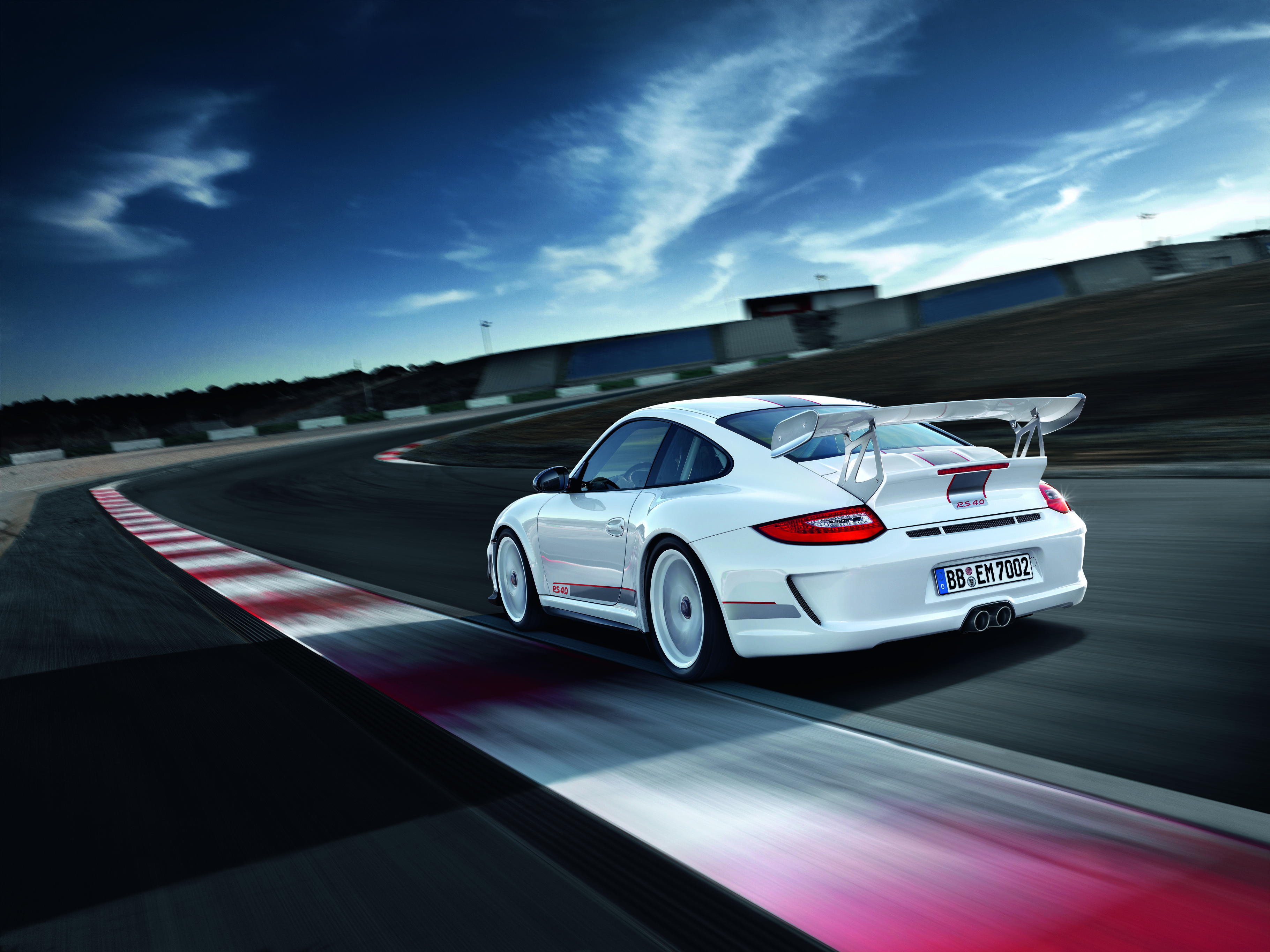
ATLANTA – April 28, 2011 — The 911 GT3 RS, one of Porsche’s most popular, coveted and successful track-inspired production cars, has been given a final, thrilling injection of thoroughbred motorsport technology resulting in the 2011 Porsche 911 GT3 RS 4.0. Limited to 600 vehicles worldwide, the 911 GT3 RS 4.0 brings together in a sports car the attributes that have made the Porsche 911 GT3 a consistent winner on the race track.
The motorsport-derived 4.0-liter engine, already the highest displacement 911 engine ever, also features the highest per-liter output — 125 horsepower (hp) per liter — from a naturally aspirated Porsche flat-six engine.
The engine uses forged pistons, the connecting rods are fashioned from titanium, and the crankshaft has been lifted unchanged from the 911 GT3 RSR race car. It achieves its maximum power of 500 hp at 8,250 rpm. Maximum torque of 339 ft/lbs is reached at 5,750 rpm.
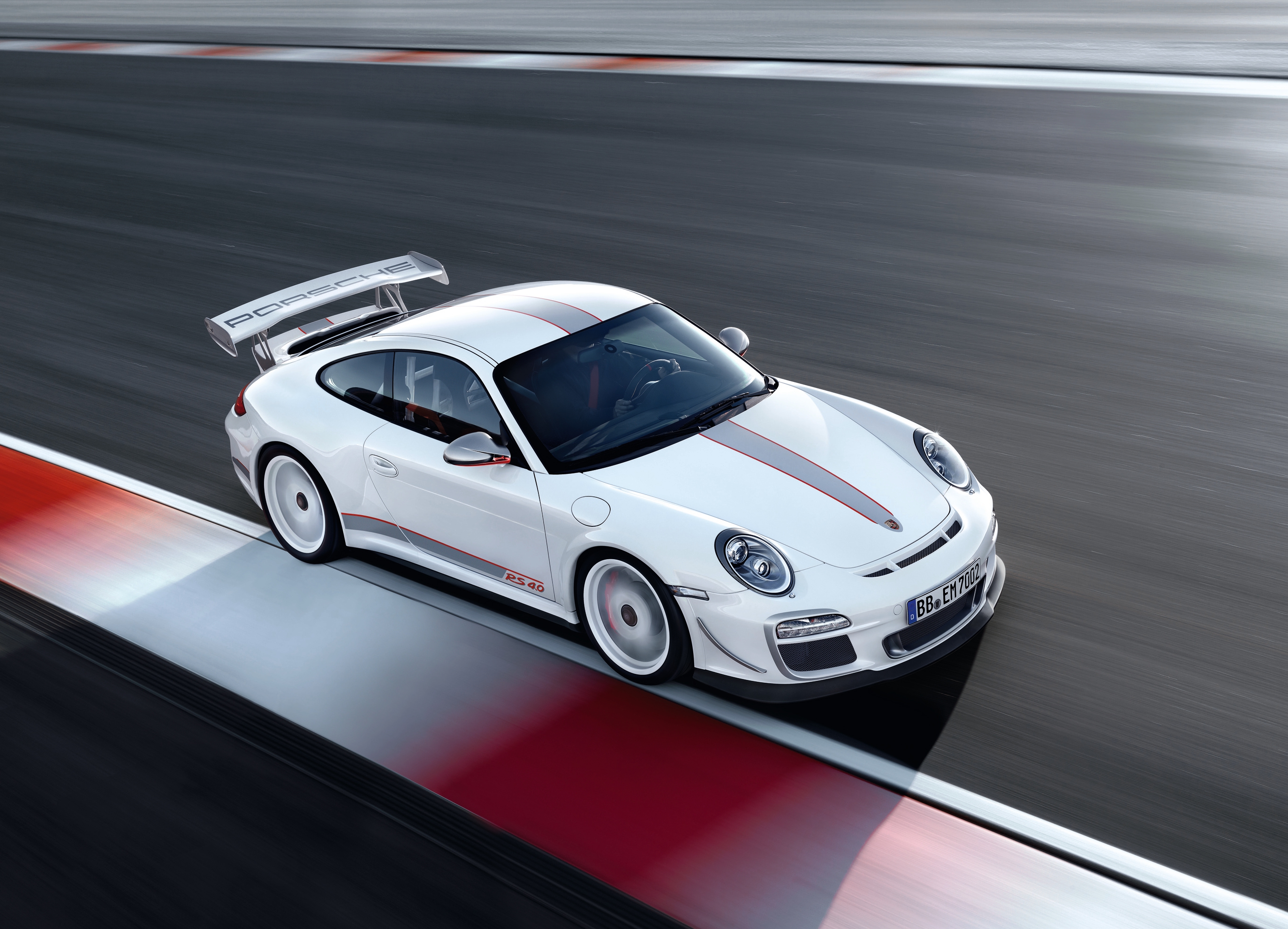
The 911 GT3 RS 4.0 offers truly impressive performance, lapping the famed Nürburgring-Nordschleife in 7 minutes and 27 seconds.

Available exclusively with a six-speed manual transmission, the 911 GT3 RS 4.0 sprints from 0 to 60 mph in only 3.8 seconds, and with its gearing designed for the race circuit it reaches the 124 mph mark on the race track in under 12 seconds. The 911 GT3 RS 4.0’s outstanding driving dynamics come from numerous, meticulously coordinated details. In addition to using suspension components typically encountered in motor racing, weight reduction is also of supreme importance.
Equipped as standard with lightweight components such as light but strong carbon fiber sport bucket seats, …………………..
![[x]](https://i0.wp.com/files.porsche.com/filestore.aspx/zoom.jpg)
…………….carbon fiber front fenders and luggage compartment lid, and weight-optimized carpets, the two-seater’s ready-for-action weight is just 2,998 lbs with a full fuel tank.
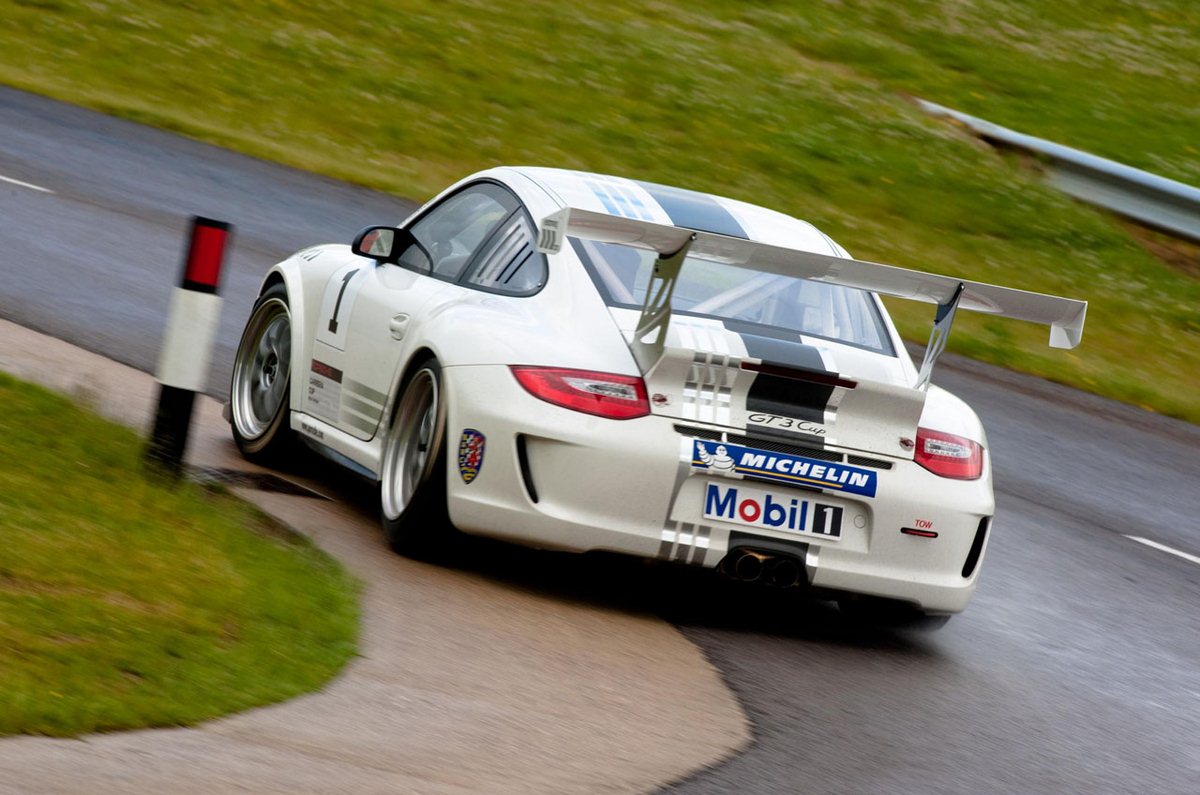
The 911 GT3 RS 4.0’s power-to-weight ratio is 5.99 lbs/hp. This limited edition 911 is painted Carrara White as standard and emphasizes its proximity to motor racing by its dynamic appearance.
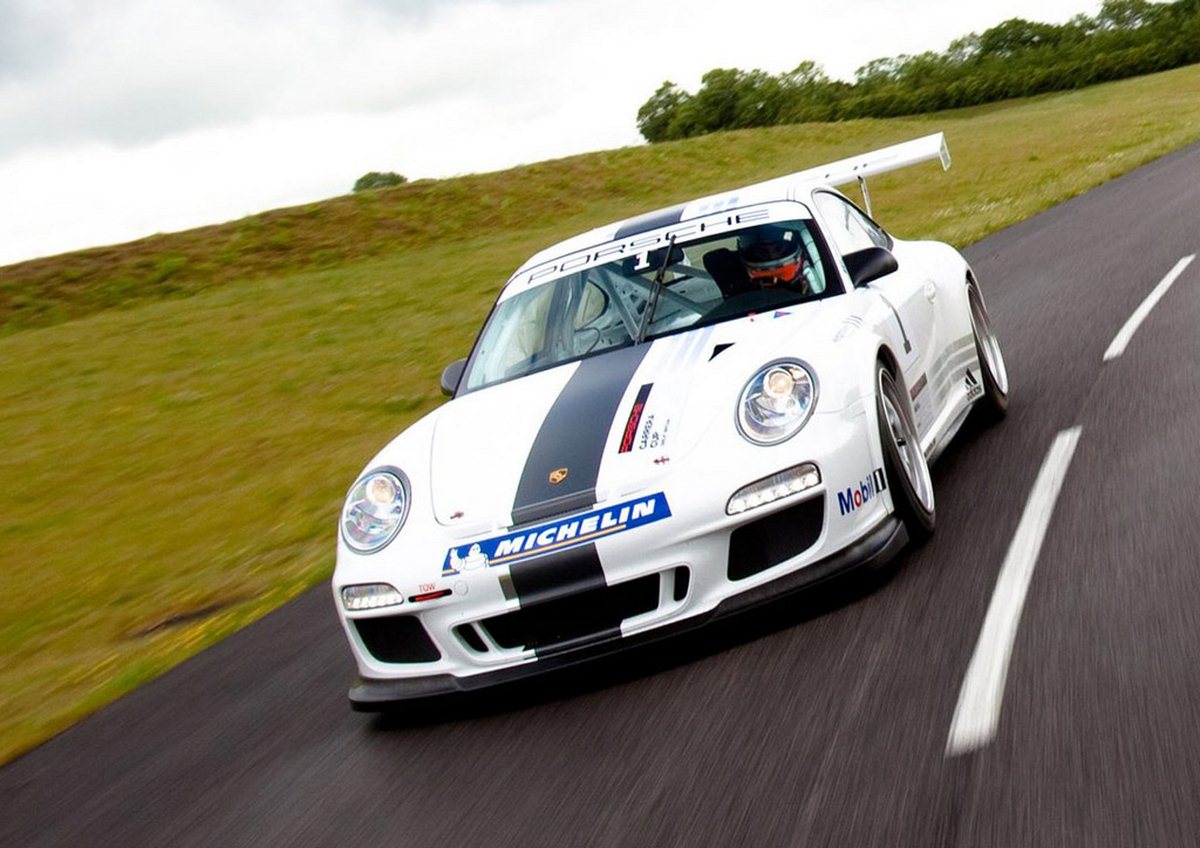
Signature characteristics are the wide track, the low vehicle position, the large rear wing with side plates, central twin tailpipe, and the aerodynamically optimized body. Air deflection vanes mounted on either side of the front bumper – called ‘flics’ or dive planes – make their first appearance on a production Porsche. They create increased downforce on the front axle, and together with the steeply inclined rear wing, provide aerodynamics on par with its performance capabilities.
As a result, at the 193 mph top track speed, aerodynamic forces exert an additional 426 lbs of downforce, thus pushing the 911 GT3 RS 4.0 onto the road. With a manufacturer’s suggested retail price starting at $185,000 (excluding destination), the new Porsche 911 GT3 RS 4.0 goes on sale in the United States in late 2011.
Chris Harris has an exclusive interview with Andreas Preuninger about the new Porsche 911 GT3 RS 4.0. Read the full story at www.evo.co.uk
The UK list price is yet to be confirmed, but Porsche has advised that £128,000 is likely to be the figure. There are only 600 cars being built, and fewer than 50 will come to the UK.
____________________________________________________________________________________
About Porsche Cars North America Porsche Cars North America, Inc.
(PCNA), based in Atlanta, Ga. is the exclusive U.S. importer of Porsche sports cars, the Cayenne SUV and Panamera Gran Turismo. Established in 1984, it is a wholly-owned subsidiary of Porsche AG, which is headquartered in Stuttgart, Germany, and employs approximately 220 people who provide parts, service, marketing and training for 196 dealers. They, in turn, work to provide Porsche customers a best-in-class experience that is in keeping with the brand’s 63-year history and leadership in the advancement of vehicle performance, safety and efficiency. At the core of this success is Porsche’s proud racing heritage that boasts some 30,000 motorsport wins to date. Note:
Photos by Porsche Press Database
For more information please visit http://www.porsche.com/rs
Porsche Race Car Classic Announces 2012 Porsche Turbo Raffle

April 24, 2011 — Porsche Race Car Classic organizers announced today that they will raffle a 2012 Porsche Turbo Cabriolet to help raise funds to support lung cancer research. This is one fast car with 500hp, a 0-60 time of 3.6 seconds, and a top speed of 194 mph.
A maximum of 3,000 raffle tickets will be sold at $100 each with no limit to the number that may be purchased per person. “We deeply appreciate Porsche Cars North America for providing this opportunity for people to show their support of Lung Cancer Research as proceeds from the raffle will go directly to the *Bonnie J. Addario Lung Cancer Foundation,” said event organizer Steve Heinrichs. “And a chance to win the best open-top sports car in the world is enticing to say the least,” he added.
The drawing will be held at the Porsche Race Car Classic event on October 16, 2011 at Quail Lodge in Carmel, California. The winner will be announced the same day. The winner will get a choice of color and certain options and need not be present to win. Go to www.porscheracecarclassic.com for details and to download a raffle ticket form.

About the Porsche Race Car Classic
The Porsche Race Car Classic will be a once-in-a-lifetime gathering of race cars from Porsche’s break-out era of 1950-1965 — the cars that made Porsche the most revered name in racing. Rarely-seen cars from the stables of the Porsche AG Museum, Ingram Collection, Collier Collection, Ranson Webster Collection, Dr. Julio Palmaz Collection, and Seinfeld Collection will join scores of purpose-built and production race cars with significant race history on the grassy fields of the Quail Lodge Resort in Carmel, California on October 16, 2011.
More than 3,500 people are expected including special guests and celebrities. Attendees will enjoy gourmet specialties and wine from leading vintners while they celebrate Porsche’s iconic race cars and the pilots who drove them into history. All net proceeds will go directly to UCSF Thoracic Oncology Program and the Bonnie J. Addario Lung Cancer Foundation to aid their in fight to Drive Lung Cancer off the Planet.
* The 2012 Porsche Turbo Cabriolet Raffle is solely for the benefit of the Bonnie J. Addario Lung Cancer Foundation.
* * *
Official Rules:
1. Raffle ticket entries (“entries”) will be sold only using the official “Bonnie J. Addario Lung Cancer Foundation (“BJALCF”) Raffle Form” for a 2012 Porsche 911 Turbo Cabriolet. Entries may not be assigned, transferred or sold either before or after the drawing. The odds of winning will depend upon the total number of entries sold.
2. The price of each entry is US$100.00. No raffle ticket entries will be mailed to purchasers, however, entries will be confirmed via email. There is no limit to the number of entries a member may purchase, but a maximum of 3,000 entries will be sold.
3. No person under the age of 18 may purchase an entry or receive any prize.
4. An entry purchaser does not have to be present at the drawing to be eligible to win a prize.
5. Entry purchases may be made by Paypal, cash, check , Visa, MasterCard, or American Express. All payments for entries must be made in US funds.
6. The winner will be notified by certified mail, and the winner’s name will be announced at the Porsche Race Car Classic on October 16, 2011. The winner’s name will also be posted on the BJALCF website at www.LungCancerFoundation.org and at the PRCC website at www.PorscheRaceCarClassic.com.
7. No entries will be sold after October 1, 2011. Requests for entries received after October 1, 2011, or after 3,000 entries have been sold, will not be included in the drawing and will be returned. Entry requests will be subject to acceptance by BJALCF.
8. The raffle is subject to the sale of a minimum of 1,500 entries. If fewer than 1,500 entries are sold, the raffle will be cancelled and all purchases of entries will be refunded. Subject to the foregoing, all purchases of entries are final upon acceptance by BJALCF and there will be no refunds except as noted above.
9. The name of the winner will be posted on the BJALCF website at www.LungCancerFoundation.org and at the PRCC website at www.PorscheRaceCarClassic.com. For the name of the winner, you may also send a self-addressed, stamped envelope to Bonnie J. Addario Lung Cancer Foundation, 1100 Industrial Road, #1, San Carlos, CA after October 31, 2011.
10. The car being offered as a prize will be a US specification car and will be available for pick-up at a US located authorized Porsche Dealership after it has been ordered and built. The winner will be responsible for all licensing, registration, taxes, fees, duties, insurance and other costs as well as transportation to and from the dealership. BJALCF and PRCC specifically disclaim any and all express or implied warranties, including warranties of merchantability and fitness for a particular purpose, regarding the raffle car.
11. Unless prohibited by law, the winner may substitute a cash prize in the amount of US$75,000 in lieu of taking possession of the car. Any election to take the cash prize must be made within ninety (90) days after the drawing by delivering written notice of such election to BJALCF.
12. The winner is responsible for all applicable local, state and federal taxes including all sales, use, luxury, income and other applicable taxes. All prizes will be subject to applicable Federal and other applicable tax withholding at the then applicable rate in accordance with the requirements of Federal and any other applicable law. Our understanding is that entries are not considered contributions to BJALCF and therefore are not tax deductable by entry purchasers.
13. All requests for entries must be submitted on an official entry form which is available on the BJALCF website at www.LungCancerFoundation.org, the PRCC website at www.PorscheRaceCarClassic.com, and contained in BJALCF promotional materials. Entry forms may be reproduced. All entry forms must be submitted by hand to a BJALCF representative or by mail or other delivery method to Bonnie J. Addario Lung Cancer Foundation, 1100 Industrial Road, #1, San Carlos, CA 94070.
14. The winner will be selected at a random drawing from all eligible entries to be conducted at the Porsche Race Car Classic on October 16, 2011. The winning entry will be drawn from a container in which all eligible raffle ticket entry stubs purchased for the drawing will be mixed. Each entry will have an equal chance of being drawn.
15. This offer is void where prohibited by law.
16. BJALCF employees and Board members and PRCC organizers as well as persons living in the same households as such employees, Board members and organizers and, immediate family members (spouses, children, siblings and parents) of such employees, Board Members and organizers are not eligible to enter or to win prizes.
17. Acceptance of a prize constitutes permission for BJALCF and PRCC to use the winner’s name, regional affiliation, likeness and photograph in any BJALCF and PRCC publicity worldwide in all media including the Internet without additional compensation unless prohibited by law.
18. By participating in the raffle, participants agree to be bound by these Official Rules.
19. This raffle is sponsored by the Bonnie J. Addario Lung Cancer Foundation, 1100 Industrial Road, #1, San Carlos, CA 94070. The entire net proceeds (at least 90% of the gross proceeds) of the raffle shall be devoted exclusively to benefit of or provide support for the beneficial or charitable purposes of the Bonnie J. Addario Lung Cancer Foundation.
Contacts:
Erin Simon
Event Planner / Sponsorship Opportunities
415-999-9123
erin@simonevents.com
http://www.PorscheRaceCarClassic.com
Steve Heinrichs
Event Producer
775-691-2217
rstephen356@aol.com
Bruce Sweetman
Media Coordinator
615-579-4508
sweetmanb@juno.com
Carolyn Clary-Macy
Car Coordinator / Sponsorship Opportunities
415-885-7278
carolyn.clary-macy@ucsfmedctr.org
Event Website/Tickets: http://www.PorscheRaceCarClassic.com
Facebook: Porsche Race Car Classic
Twitter: http://twitter.com/DriveLungCancer
Linked In: Porsche Race Car Classic


New York 2011: Facebook Porsche 911 GT3 R Hybrid is easy to ‘Like’
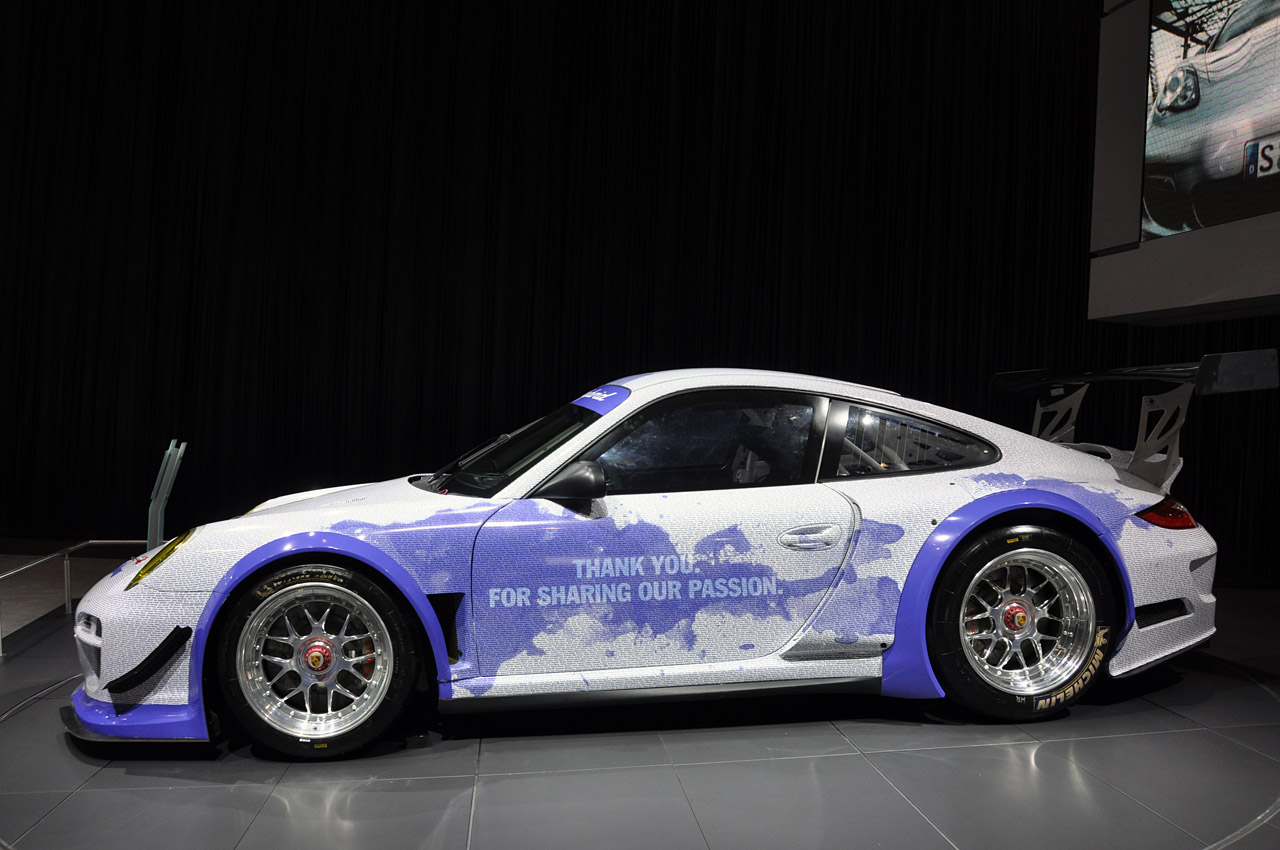
Photos copyright ©2011 Drew Phillips / AOL
To commemorate its social media milestone of surpassing one million fans on Facebook, Porsche has created this special edition of the 911 GT3 R Hybrid complete with the signatures of over 27,000 Porsche fans. The car makes its North American debut this week at the New York Auto Show before it goes on display inside the Porsche Museum in Stuttgart.
Photos copyright ©2011 Drew Phillips / AOL
Porsche’s hybrid racer develops 480 hp from its 4.0-litre flat-six engine and is matched with two 80-hp electric motors. The German automaker recently tested the hybrid system’s capability during the 2010 24 Hours of Nürburgring, and Porsche firmly believes that hybrid performance cars like this foreshadow the future of racing.
Thank you – A 1,000,000 times – Porsche
Porsche has achieved yet another milestone, the fastest 1,000,000 facebook fans in automotive history! This is the gift Porsche had prepared for their Facebook fans.
Porsche currently has over 1,504,488 fans on Facebook.
Credits: SOURCE
Porsche Reveals New Panamera Models at New York International Auto Show

NEW YORK — April 20, 2011 – Marking a North American premiere at the New York International Auto Show, Porsche today showed two new versions of its highly acclaimed Panamera four-door sports sedan, including the company’s most fuel-efficient car ever — the 2012 Panamera S Hybrid — and its highest-performance Panamera ever, the 2012 Panamera Turbo S.
“Today we are unveiling two new, dynamic and high-performance Panamera models,” said Detlev von Platen, Porsche Cars North America’s President and CEO. “One is a highly advanced hybrid and the other is a car that raises the bar higher than ever in the premium sports sedan segment.”
Powerful New Panamera Turbo S is Revealed
With its new four-door Panamera Turbo S, Porsche is establishing a new benchmark for its competitors by delivering ultra high performance and efficiency, sports-car-like driving dynamics, and first-class comfort in a purely Porsche package.
The power under the hood of the new top-of-the-line Panamera is based on the proven twin-turbocharged 4.8-liter V8 engine in the Panamera Turbo. In the Turbo S this powerplant generates 550 horsepower, 50 more than that of the Panamera Turbo. The torque is also increased significantly over the Turbo from 516 lb-ft to 553 lb-ft. Even more torque — 590 lb-ft — is generated temporarily by the “Sport” and “Sport Plus” overboost mode of the standard Sport Chrono Package Turbo.
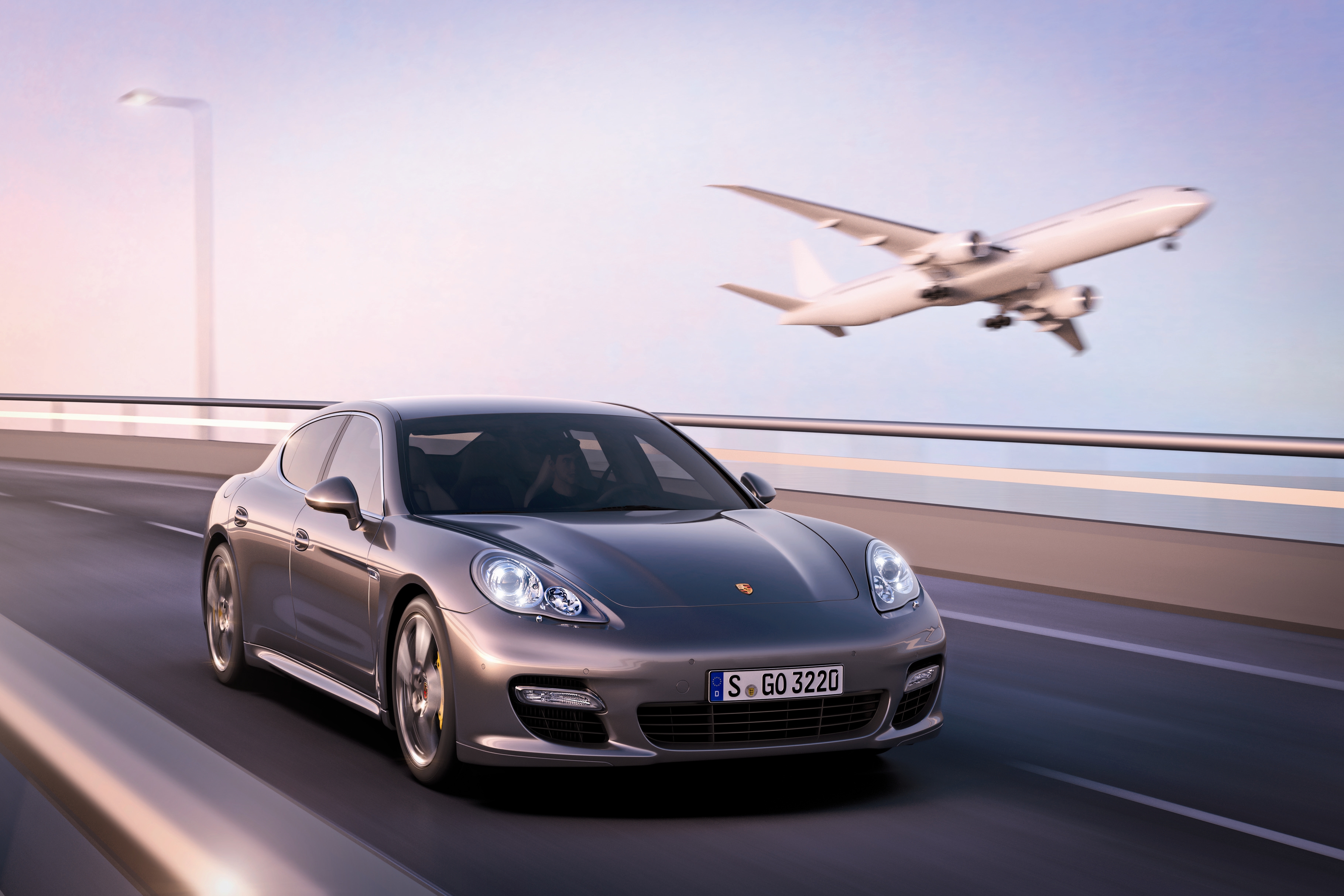
The increase in power in the Panamera Turbo S is the result of a quicker, more responsive turbo response and modified engine control unit. With the help of Launch Control, the newest Panamera can reach 60 mph in just 3.6 seconds. The top-track speed is 190 mph. And despite this increased performance, fuel consumption is expected to remain comparable to the Panamera Turbo that delivers an EPA estimated rating of 15 mpg city/23 mpg highway. Official EPA fuel economy estimates for the Panamera Turbo S will become available prior to the car’s on-sale date later this spring.
Even for a world-class luxury car, the Panamera Turbo S offers an extraordinarily high level of features. In keeping with its sporty concept, it comes equipped with the most important driving-dynamic control systems. For example, Porsche Dynamic Chassis Control (PDCC) is an active anti-roll system that significantly reduces lateral body movement during corning, which enhances stability, handling and overall occupant comfort. Porsche Torque Vectoring Plus (PTV Plus) is also standard and works to help ensure superior traction and higher-performance cornering by applying a variable torque split to the rear wheels in combination with an electronically controlled rear differential lock. Also standard is Porsche’s advanced speed-sensitive Servotronic® steering system, a sports exhaust system, and the Sport Chrono Package Turbo that further tunes the engine and suspension at the touch of the “Sport Plus” button.
While the sporting character of the new Panamera Turbo S is most apparent behind the wheel, the car’s exterior tastefully exudes its high-performance ambitions. The new 20-inch Turbo II wheels with increased rear axle track width, side skirts from the Porsche Exclusive range, and the adaptive four-way extending rear spoiler express the car’s elite performance abilities. Inside, the fusion of exclusivity and sportiness is conveyed in the interior by the standard bi-color leather finish. A new combination of black/cream is offered exclusively for the new Panamera Turbo S with Agate Grey/cream also being added as an exclusive option later this year. Agate Gray Metallic will also be an exclusive exterior color.
The new Porsche Panamera Turbo S will have a base MSRP of $173,200 (excluding destination).
Porsche Expands its Hybrid Lineup with the Panamera S Hybrid
The debut of the Panamera S Hybrid adds another important chapter to the Porsche Intelligent Performance philosophy of committing to build new cars that strive to deliver sportier performance with more fuel efficiency and lower emissions. Without sacrificing high-performance or luxury and comfort, this new Panamera model produces 380 horsepower with fuel consumption of only 6.8 L/100 km on the New European Driving Cycle (NEDC), making it the most fuel efficient Porsche of all time.
Official EPA fuel economy estimates for the U.S. will be available closer to the car’s on-sale date late this year.
As you would expect from Porsche, the Panamera S Hybrid sets new standards in terms of performance as well as hybrid efficiencies. It accelerates from 0 to 60 mph in just 5.7 seconds and has a top track speed of 167 mph (270 km/h). Its range in purely electric mode is approximately one mile, with electric-only acceleration possible up to just over 50 mph (85 km/h).
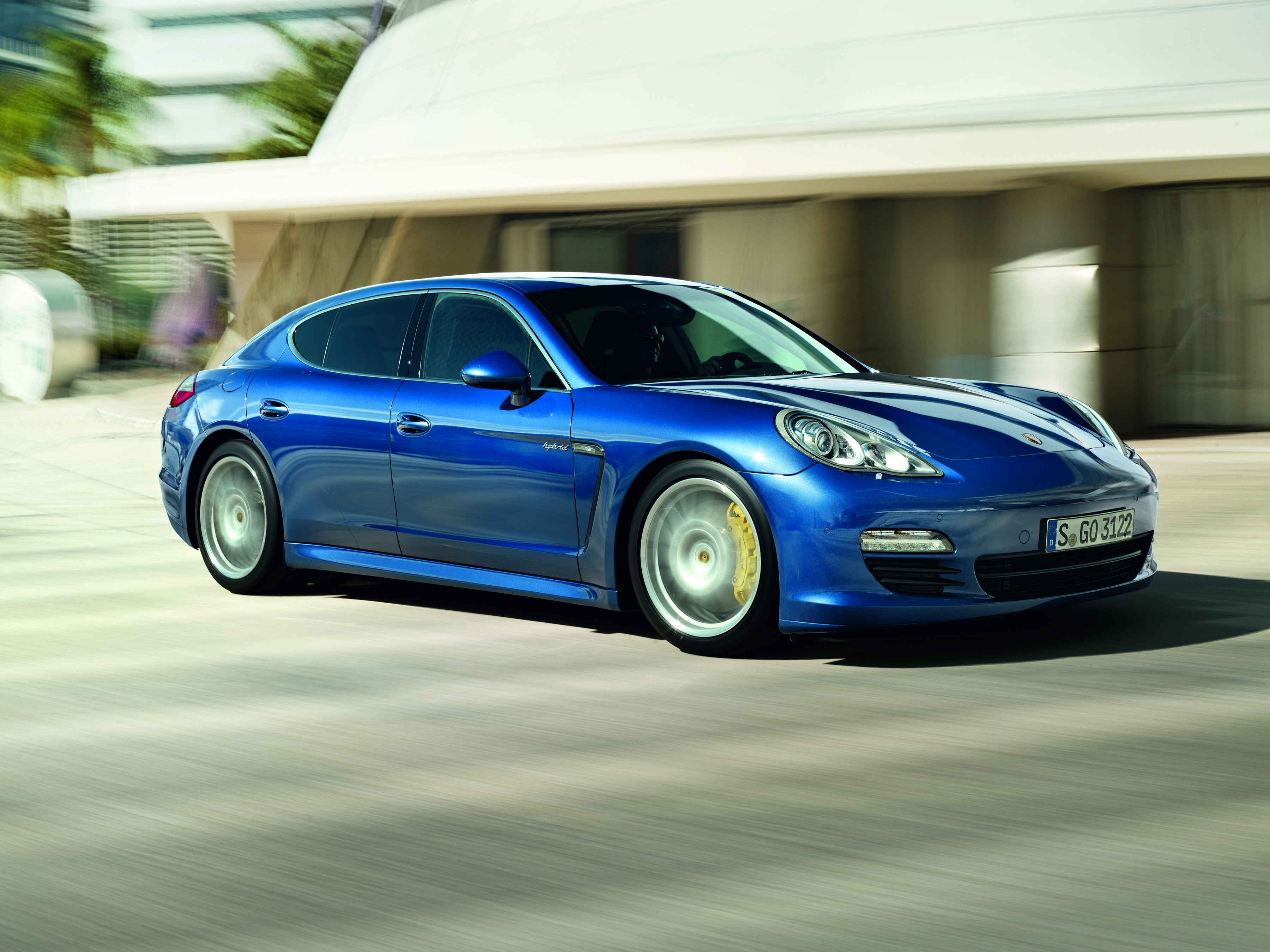
The Porsche parallel full hybrid system also reduces consumption at high speeds thanks to its ‘sailing’ or coasting mode. When the driver lifts off the accelerator at normal highway cruising speeds, the gasoline engine is completely switched off and disengaged from the drivetrain by a decoupling clutch. This eliminates the combustion engine’s drag forces and braking effect in the interest of lower resistance, fuel consumption and emissions. As soon as the driver presses the accelerator, to pass another vehicle for example, the gasoline engine smoothly starts within fractions of a second and engine rpms are increased to match the current vehicle speed. It does this seamlessly thanks to the Hybrid Manager, which also helps the Panamera S Hybrid accelerate dynamically in gears at higher speeds.
The Panamera S Hybrid employs a 3.0-liter supercharged V6 engine that delivers 333 horsepower. It is supported by a 47-horsepower (34 kW) electric motor. Depending on driving conditions, either drive unit can operate independently or together to drive the rear wheels. The electric motor, which also serves as the car’s generator and starter, combines with the decoupling clutch to form the compact hybrid module located between the combustion engine and the transmission. The electric motor is connected to a nickel metal hydride (NiMh) battery that stores electric energy recovered from braking and other driving situations. The transmission is the same eight-speed Tiptronic S fitted in the Cayenne models, with a wide range of gear ratios.
The Panamera S Hybrid has an even higher level of standard equipment than the V8 Panamera S that includes Adaptive Air Suspension with the Porsche Active Suspension Management (PASM) adaptive shock absorber system, Servotronic® variable-assist power steering and a host of other features. This new model also features an innovative display that provides the driver with relevant information about the status of the vehicle’s hybrid drive systems.
The Panamera S Hybrid will go on sale in the United States later in 2011 at a base suggested retail price of $95,000 (excluding destination).
World’s First Hybrid is Incredibly Recreated
In 1900, history came to life when Professor Ferdinand Porsche built the first functional hybrid car. Aptly called Semper Vivus, which means “Always Alive” this historic car has been resurrected 111 years later by Porsche as a tribute to this acclaimed engineer’s visionary thinking.
The fully functional Semper Vivus replica, based on original drawings and exhaustive research, is a collaborative effort between Porsche Engineering and Karosseriebau Drescher, a coachbuilding company based in Hinterzarten in the state of Baden-Württemberg, Germany. Its masterful design impresses onlookers to this very day, and for the first time in the United States it is on display at the New York Auto Show press day on April 20.
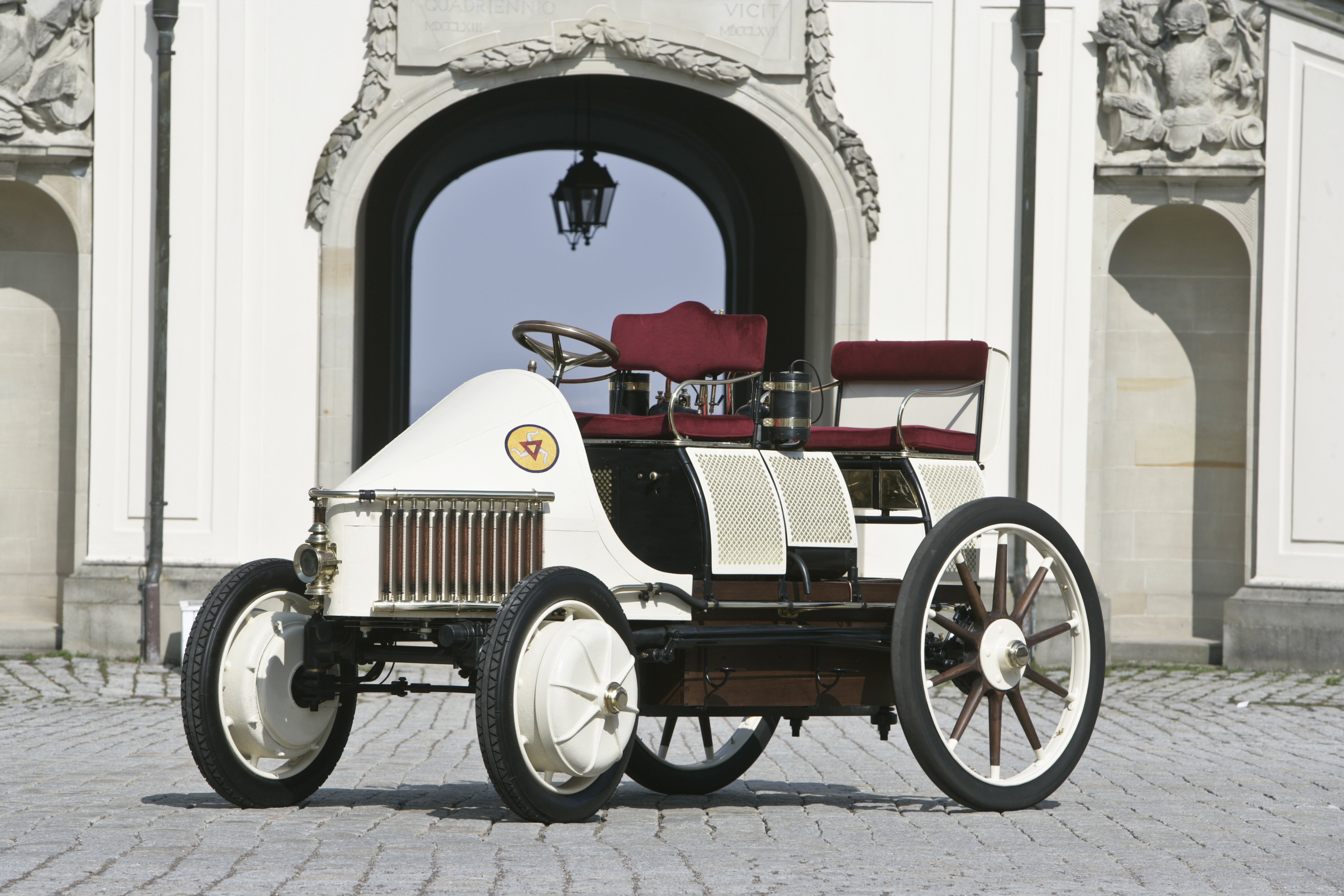
In November 2007 the Porsche Museum embarked on one of the most interesting and challenging projects in its history: the construction of a faithful replica of the 1900 Lohner-Porsche Semper Vivus. Even 111 years after its invention, building the world’s first functioning hybrid car was a great challenge for all. Ultimately it was not just about an extreme attention to visual details but also achieving the same driving performance as the original.
The Porsche Museum entrusted the workmanship to a team of experts led by coachbuilder Hubert Drescher, who had already proven his competence in numerous difficult restoration projects. As with a number of racing car projects, the aluminum body of the Porsche Type 64 museum exhibit originates from the Hinterzarten coachbuilder workshop, as well.
Exhaustive research in various archives the across Europe was the first step. The outcome was a handful of black-and-white photos and an original technical drawing serving as the project’s foundation. As with Prof. Porsche, the Semper Vivus replica initially began as a blank sheet of paper.
This meant that in addition to a good deal of imagination, the project required extensive research and calculations in order to be faithfully recreate an accurate and working likeness of the electric wheel-hub motor. Since no specifications or other helpful records had survived, experts initially created ready reckoners and design drawings on graph paper in the time-honored fashion. This involved the painstaking study and laborious measurement of photos and drawings. As there was no functioning wheel hub motor in existence, technical details such as performance and range had to be resurrected and calculated from scratch.
The replica car’s genius rivals what it took to build the original. What can be seen now took three years to build and ingenious engineering and craftsmanship, as well as a treasure hunt for original parts, including some for the combustion engine.
Today, Prof. Porsche’s innovative spirit lives on at Porsche, as a priceless historical creation and as an inspiration for the company’s commitment to developing new and ever-more advanced hybrid systems.
About Porsche Cars North America
Porsche Cars North America, Inc. (PCNA), based in Atlanta, Ga. is the exclusive U.S. importer of Porsche sports cars, the Cayenne SUV and Panamera Gran Turismo. Established in 1984, it is a wholly-owned subsidiary of Porsche AG, which is headquartered in Stuttgart, Germany, and employs approximately 220 people who provide parts, service, marketing and training for 196 dealers. They, in turn, work to provide Porsche customers a best-in-class experience that is in keeping with the brand’s 63-year history and leadership in the advancement of vehicle performance, safety and efficiency. At the core of this success is Porsche’s proud racing heritage that boasts some 30,000 motorsport wins to date.
SOURCE: Porsche AG / Porsche Cars North America, Inc.
Follow Porsche: facebook.com/Porsche twitter.com/Porsche
PORSCHE: Prof. Ferdinand Porsche Created The First Functional Hybrid Car
The name Porsche has been associated with pioneering innovations in automotive engineering since the beginning of the last century. In 1900 Ferdinand Porsche, founding father of the present-day Dr. Ing. h.c. F.Porsche AG, Stuttgart, entered uncharted territory. With the first functional, full-hybrid car in the world, the ‘Semper Vivus’ (‘always alive’), the principle of the serial hybrid drive had been born. In a four year project the Porsche Museum in Stuttgart had the Semper Vivus recreated. 111 years after this ground breaking innovation by Ferdinand Porsche the Semper Vivus will again drive into the limelight of future appearances as part of the Porsche Museum collection in Stuttgart.
Source: Porsche AG

He developed the world’s first hybrid car, advanced electric car, and all-wheel drive car a century ago, and now Porsche brings a recreation of his Semper Vivus to New York
NEW YORK – April 20, 2011 – The name Porsche has been associated with pioneering automotive engineering innovations since the beginning of the last century. In 1900 Prof. Ferdinand Porsche unveiled his Lohner Porsche, an electric car with wheel-hub motors driving the front wheels. Soon after, this car featured all-wheel drive and four-wheel brakes, another world first. A highlight of his early years as an automotive designer was the Lohner-Porsche Semper Vivus that went down in history 111 years ago as the first functional hybrid car.
Video: Fox Car Report @ New York
Porsche’s Semper Vivus (Always Alive) recreation is a tribute to Prof. Porsche’s visionary invention. The fully functional Semper Vivus replica, based on original drawings and exhaustive research, is a collaborative effort between Porsche Engineering and Karosseriebau Drescher, a coachbuilding company based in Hinterzarten in the state of Baden-Württemberg, Germany. This faithful replica, whose visionary design impresses to this very day, is on display at the New York Auto Show press day on April 20.
Source & Credits: Porsche
The history of the Lohner-Porsche Semper Vivus
Prof. Ferdinand Porsche was busy designing and developing his cars as early as 1896. The first fruit of his endeavors was an electric vehicle known as the Lohner-Porsche. It was driven by steered wheel-hub motors, and it caused a sensation at the Paris World Exhibition in 1900. This was soon followed by an even more impressive example of Prof. Porsche innovative spirit. A racing car boasting four wheel-hub electric motors became the world’s first all-wheel drive passenger car and marked the automotive engineering debut of four-wheel brakes. No less visionary was Prof. Porsche’s next idea; in 1900 he combined his battery-powered wheel hub drive with a petrol engine, thus creating the serial hybrid drive principle.

Prof. Porsche had entered uncharted territory with the Semper Vivus, the world’s first functional, full-hybrid car. In this vehicle, two generators paired with petrol engines formed a single charging unit, simultaneously supplying electricity to wheel-hub motors and batteries. In autumn 1900, Prof. Porsche set to work on a first prototype with petrol-electric hybrid drive. Presumably he based the world’s full hybrid car on a conversion of his electric racing vehicle from the Semmering-Bergrennen race. To this end he combined his electrical wheel-hub motors with two combustion engines and no mechanical connection whatsoever to a drive axle. Instead, they each drove an electric generator supplying both the wheel-hub motors and accumulators with electricity. This was the birth of serial hybrid drive. As a full hybrid concept, the Semper Vivus was also able to cover longer distances purely on battery power until the combustion engine had to be engaged to recharge the batteries.
To save weight and create room for a petrol engine, Prof. Porsche swapped the original 74-cell accumulator in his electromobiles for a smaller battery with only 44 cells. In the middle of the vehicle he installed two water-cooled 3.5 PS (2.6 kW) DeDion Bouton petrol engines — driving two generators to create electricity — each producing 2.5 hp (1.84 kW). Both engines operated independently, each delivering 20 amperes with a voltage of 90 volts. The electricity generated by the dynamos initially flowed to the wheel-hub motors, with the surplus power being sent on to the batteries. An added bonus was that it was also possible to use the generators as electric starter motors for the petrol engines by reversing the direction of rotation.
In practice, Prof. Porsche still had to contend with the principal problem of his wheel-hub cars – the vehicle’s heavy weight. Although the Semper Vivus hybrid car’s total weight was only 70 kg more than the original version, the 1,200 kg prototype was a challenge for the pneumatic tires’ soft rubber mix. In other respects as well the hybrid concept was still a long way away from being ready for series production. With its bodiless chassis, exposed petrol engines and unsprung rear axle, the Semper Vivus may have impressed visitors to the Paris Motor Show in 1901 but potential car buyers must have felt the bare-bones prototype was not for them. The interaction of engine, batteries and control system also still needed a lot of development and in addition to the ambitious control technology, a constant problem was dirt being thrown up and fouling of the accumulators. Yet the hybrid concept pointed to new possibilities that Prof. Porsche resolutely set about turning into reality.
The road to the Lohner-Porsche Mixte

In 1901 Prof. Porsche developed the revised concept of his ‘petrol-electric hybrid car’ into a variant that was ready for series production under the Lohner-Porsche Mixte name (borrowing the French term ‘voitures mixtes’). With a four-cylinder, front-mounted engine, this model mirrored the Mercedes vehicle concept just recently designed by Wilhelm Maybach but with its two wheel-hub motors still conforming to the concept of a serial hybrid car. Prof. Porsche was now using a powerful 5.5-liter, 25-hp (18 kW) four-cylinder engine from the Austrian Daimler engine company as an electrical generator. The engine was connected by a driveshaft to the electric generator located under the seat, with control handled by a primary controller next to the steering wheel.
To solve his vehicles’ weight problems, Prof. Porsche was constantly reducing battery size while also attempting to design a dust-proof battery housing. While the Lohner-Porsche Mixte was only able to drive a few kilometers on electric power alone because of the reduced battery capacity, the unladen weight of the four-seat touring car including body fell to around 1,200 kg. In normal driving mode the petrol engine and generator ran at a constant speed, feeding the wheel-hub motors and battery with electricity at a constant voltage. In addition to his drive concept’s high-level of efficiency, the car offered other advantages as well. By reversing the polarity, the generator could be used as an electric starter motor, eliminating the need for the strenuous and hazardous hand cranking of the engine.

Before the end of 1901, Ludwig Lohner and Prof. Ferdinand Porsche had pulled off a respectable result by selling five Lohner-Porsche Mixte cars. With a selling price of approximately 14,000 Krone each, this made the cars very exclusive commodities. The purchaser of this initial series was Emil Jellinek, the well-known general agent of the Daimler engine company in Stuttgart-Untertürkheim and the inspiration behind the first Mercedes (named after his daughter) only the year before. Despite this contact, a cooperation agreement to supply Mercedes engines failed to materialize and only seven Lohner-Porsches with Daimler engines were built. From 1903 onwards, petrol engines from Panhard & Levassor were used because the large French automotive manufacturer had acquired the license rights for France, Great Britain and Italy from Ludwig Lohner.
At about the same time, Prof. Porsche again significantly modified his cars’ drive concepts. For the weight reasons and to reduce production costs he dispensed with the purely electric driving capability and shrunk the battery to a minimum for initiating the starter motor. He replaced the missing energy storage unit with another innovation. The generator, designed as a stationary armature machine, was fitted with an electro-mechanical speed regulator patented as a “device for automatically regulating electric generators.” Prof. Porsche also ushered in a further development in wheel-hub motor technology. A redesigned hub casing allowed the kingpins to be relocated closer to the center of the wheel. This steering geometry, patented in May 1902, significantly reduced the effect of road impacts and the effort needed to turn the steering wheel. To reduce the unsprung mass of the wheels, Prof. Porsche also reduced the diameter of his wheel-hub motors, which he compensated for by using wider windings.
In April 1902, having incorporated these improvements, Prof. Porsche took his place on the starting grid for the Exelberg race. His two-seat Mixte racing car was not only visually impressive due to its modern proportions but impressive on the track, as well. His Lohner-Porsche seemed to cope effortlessly with even the steepest gradients of the 4.2-km gravel road leading up to the Exelberg, and it emerged as the victor in the large car class. Porsche received additional high-profile publicity in the autumn of 1902 when he chauffeured Austrian Archduke Franz Ferdinand in the Lohner-Porsche during a military maneuver. The aristocratic passenger seems to have liked the vehicle with its elegant touring body. Soon after, Prof. Porsche received a thank you letter testifying “just how satisfied in every respect his Imperial Majesty” was after the ride.
Despite these impressive demonstrations, sales of the Mixte production variants remained far lower than expectations. With only 11 hybrid cars sold, the return on investment was not on par with the enormous technical development costs between 1900 and 1905. The main problem was undoubtedly the high sales price. Depending on design and equipment, a Lohner-Porsche Mixte cost between 14,400 and 34,028 Krone, in some cases making it almost twice as expensive as comparable, conventionally powered motor vehicles. This was compounded by the high maintenance cost of the complex drive system that was unable to keep pace with the ever increasing reliability of normal petrol cars. Pure electric vehicles, however, were economically more successful. Approximately 65 Lohner-Porsche electric cars were sold during the first five years of series production to the end of 1905.
The reincarnation of the Semper Vivus
In November 2007 the Porsche Museum embarked on one of the most interesting and challenging projects in its history: the construction of a faithful replica of the 1900 Lohner-Porsche Semper Vivus. Even 111 years after its invention, building the world’s first functioning hybrid car was a great challenge for all. Ultimately it was not just about an extreme attention to visual details but also achieving the same performance as the original. The Porsche Museum entrusted the workmanship to a team of experts led by coachbuilder Hubert Drescher, who had already proven his competence in numerous difficult restoration projects. As with a number of racing car projects, the aluminum body of the Porsche Type 64 museum exhibit originates from the Hinterzarten coachbuilder workshop, as well.

Exhaustive research in various archives the across Europe was the first step. The outcome was a handful of black-and-white photos and an original technical drawing serving as the project’s foundation. As with Prof. Porsche, the Semper Vivus replica initially began as a blank sheet of paper. This meant that in addition to a good deal of imagination, the project required extensive research and calculations in order to be faithfully recreate an accurate and working likeness of the electric wheel-hub motor. Since no specifications or other helpful records had survived, experts initially created ready reckoners and design drawings on graph paper in the time-honored fashion. This involved the painstaking study and laborious measurement of photos and drawings. As there was no functioning wheel hub motor in existence, technical details such as performance and range had to be resurrected and calculated from scratch.
When it came to selecting materials, coachbuilder Drescher took his inspiration, among other sources, from coaches and carriages from the dawn of the 20th Century. This required the assistance of experienced suppliers who were entrusted with the manufacturing of the special materials. The fully functioning Semper Vivus replica, which took approximately three years to build, does not solely include replica components. For example, it was possible to fit some original components including combustion engines.
Today, Prof. Ferdinand Porsche’s innovative spirit lives on at Porsche AG’s Research and Development Center in Weissach, Germany where the company is applying its engineering strength to develop various hybrid systems. Porsche’s first production hybrid, the 2011 Cayenne S Hybrid SUV, is on sale in many markets including the United States. Its parallel full hybrid system will be adapted for use in the Panamera S Hybrid that goes on sale later this year with a U.S. MSRP of $95,000 (excluding destination). Porsche engineers are busy developing its 911 GT3 R Hybrid racecar for further competition while continuing work on the 918 Spyder plug-in hybrid super sports car the company first showed at the Geneva Auto Show in 2010.
Semper Vivus Facts and Figures
| Year | Units |
|---|---|
| Engine: | 2x Single cylinder De-Dion-Bouton combustion engine |
| Output: | 2.5 hp (1.85 kW) per cylinder |
| Electric motor output: | 2.7 hp (2 kW) per wheel |
| Top speed: | 35 km/h (22 mph) |
| Range: | 200 km (124 miles) |
| Overall width: | 1,880 mm |
| Overall length: | 3,390 mm |
| Overall height: | 1,850 mm |
| Total weight: | 1.7 tons |
| Front wheel weight (single): | 272 kg (with wheel hub motor) |
| Track width front: | 1,350 mm |
| Track width rear: | 1,540 mm |
| Wheelbase: | 2,310 mm |
| Ground clearance: | 250 mm |

About Porsche Cars North America
Porsche Cars North America, Inc. (PCNA), based in Atlanta, Ga. is the exclusive U.S. importer of Porsche sports cars, the Cayenne SUV and Panamera Gran Turismo. Established in 1984, it is a wholly-owned subsidiary of Porsche AG, which is headquartered in Stuttgart, Germany, and employs approximately 220 people who provide parts, service, marketing and training for 196 dealers. They, in turn, work to provide Porsche customers a best-in-class experience that is in keeping with the brand’s 63-year history and leadership in the advancement of vehicle performance, safety and efficiency. At the core of this success is Porsche’s proud racing heritage that boasts some 30,000 motorsport wins to date.
Source & Credits: Porsche Press Database
Contact: Porsche Cars North America, Inc.
Porsche Factory Driver Patrick Long @ New York – Gearing up, cooking up for New York Int’l Auto show

Tonight–Race car driver Patrick Long and Top Chef Angelo Sosa will cook up a storm
in New York City
Photos by Porsche Cars North America
Watch as Porsche Factory Driver Patrick Long and Chef Sosa take the Porsche Cayenne S Hybrid through New York City to Union Square Market to prepare for an evening of Healthy Intelligent Performance.
Livestream
Poggenpohl Event
Healthy Intelligent Performance w/Top Chef Angelo Sosa and Porsche Race
Car Driver/Les Mans Champion Patrick Long
Wednesday, April 20th 2011
7:30 – 9 PM EST
Join in on a live-streamed demonstration and Q&A with Chef Angelo Sosa and Patrick Long. They’ll be talking performance foods and how race car drivers train their bodies to perform as well as their cars.
To submit questions in advance, email pr@porsche.us.
Check below for documents related to the demonstration and Q&A including
Chef Sosa’s recipes  Chef Sosa Recipes and details on Patrick’s training regimen
The original recipes below were developed by Chef Angelo Sosa exclusively for Porsche Cars North America and the Porsche Healthy Intelligent Performance event.
BREAKFAST
HIGH-PERFORMER’S MILKSHAKE
5 OZ. WHEATIES
3 PC. CARDAMOM
1 PC. STAR ANISE
16 OZ. SOY MILK
2 T. AGAVE NECTAR
METHOD: INFUSE WITH SOME SPICES STAR ANISE, CARDAMOM AND WHEATIES
WITH THE SOY MILK. BRING THE MILK TO A SIMMER, ADD ALL THE INGREDIENTS
AND LET IT STEEP AS IF IT WAS A TEA. REMOVE THE SPICES AND BLEND THE
LIQUID MIXTURE, AND CHILL AND SERVE.
“MODERN BAGEL”
½ LB. CREAM CHEESE
½ LB. SMOKED SALMON
4 OZ. MILK
1 TSP. SALT
GARNISH: CAPERS, DILL
METHOD: BLEND ALL INGREDIENTS TOGETHER IN VITA PREP AND PLACE INTO SIS
WHIP CREAM GUN—AERATE SALMON MOUSSE ONTO MINI BAGELS, GARNISH WITH
CAPER AND DILL PLUCHES
PICKLED BEETS WITH CURRIED HONEY
1 LB. BEETS, BABY
1 OZ. EVOO
½ OZ. THYME
1 T. SALT
2 OZ. WATER
more recipes here…Chef Sosa Recipes
Angelo Sosa Bio
“As a chef, I’m loyal to my classic training, but with a passion for innovation. I love extracting and blending flavors and taking the ordinary to new heights.”
Poggenpohl presents first Porsche Design kitchen
A new kitchen especially designed for men – Miele exclusive supplier of
appliances Poggenpohl presents first Porsche Design kitchen
ebay Porsche Auction of the Day: 1989 Porsche 953 Rothmans Rally Tribute
Another fantastic ebay auction
You asked for it. You got it. You wanted an all-wheel-drive Rothmans Rally Car and here it is.

“Ferris Buellers Day Off” Movie House & a Rothmans Porsche 911 Rally Tribute Car by jeremycliff, on Flickr
There’s some serious lust for Porsches–especially those with a more esoteric flare. Its a clone/tribute of the Rothmans Porsche 953 rally cars that ran around Africa in the early eighties. Very nicely put together and going for a fraction of the cost of a real deal version.
If you remember July of 2010 when the 2-wheel-drive 1980 Rothmans Rally Car sold to GoPro for upwards of $70,000 on eBay. Although that car was stunning in everyway the owner knew he needed something more. He searched the country high and low for the perfect donor and finally found an accident free, perfectly maintained, weekend driver, pilot owned, all original with every factory option 1989 1/2 Porsche 964 C4.
This is how the car started… a gorgeous, perfectly maintained 1989 Porsche 964 Carrera 4

1989 Porsche 911/964 by jeremycliff, on Flickr
Short description from the eBay ad…
Meet AWD Paris…
She is an absolutely stunning freshly completed Porsche 911 Paris, Alger, Dakar Winning 953 Off Road Rally Tribute Car that has been painstakingly built over last year. She was built as a tribute to the winning Porsche 953 raced from Paris to Dakar in 1984 Piloted by Rene Metge and Dominique Lemoyne. Paris originally started life as a 1989 1/2 Porsche 964 Carrera 4 in PERFECT condition and is perfectly street legal and plated and titled in Illinois.
There is only three (3) of these factory cars, two (2) owned by Porsche and one in private hands. Although this is a reproduction, most observers will swear this is the real deal…

Porsche 911 Paris/Dakar Rally Tribute by jeremycliff, on Flickr
Over the last couple months Jeremy Cliff has been shooting and prepping photos and video of “Paris”, this Rothmans Porsche 911 Tribute Car, the time has finally come to put the car up for sale and release the photos. Jeremy wanted to do something very different and have a unique location wise…. I’m sure most of you will recognize it, but for those that do not the “house” location is actually the house that was used in the famous 1986 movie Ferris Bueller’s Day Off. What better spot to shoot a historic vehicle then in a historic location?
The car is currently for sale on eBay and can be found here:
Porsche : 911 | eBay
Check out the video below of the car in action!

Rothmans 911 Rally Tribute & a RUF by jeremycliff, on Flickr

“Ferris Buellers Day Off” Movie House & a Rothmans Porsche 911 Rally Tribute Car by jeremycliff, on Flickr

“Ferris Buellers Day Off” Movie House & a Rothmans Porsche 911 Rally Tribute Car by jeremycliff, on Flickr

“Ferris Buellers Day Off” Movie House & a Rothmans Porsche 911 Rally Tribute Car by jeremycliff, on Flickr

“Ferris Buellers Day Off” Movie House & a Rothmans Porsche 911 Rally Tribute Car by jeremycliff, on Flickr

“Ferris Buellers Day Off” Movie House & a Rothmans Porsche 911 Rally Tribute Car by jeremycliff, on Flickr
Some pictures at the shop

Porsche 911 Paris/Dakar Rally Tribute by jeremycliff, on Flickr

Porsche 911 Rally Tribute Car by jeremycliff, on Flickr

Porsche 911 Rally Tribute Car by jeremycliff, on Flickr

Porsche 911 Rally Tribute Car by jeremycliff, on Flickr
This is how the car started… a gorgeous, perfectly maintained 1989 Porsche 964 Carrera 4
1989 Porsche 911/964 by jeremycliff, on Flickr

1989 Porsche 911/964 by jeremycliff, on Flickr

1989 Porsche 911/964 by jeremycliff, on Flickr
Car was built with the intention of being a daily driver or a weekend warrior which means it has some very key options.
-Cruise Control
-Sunroof
-Climate Control
-Power Mirrors
-Power Locks
-Power Windows
-Differential Lock
-ABS
-Every factory option available.
Details on Paris
Tires- Michelin ZEL 70’s 16/65-15 mounted on authentic Porsche rims.
Wing- GT Racing 911/930 Turbo Tail.
Brakes- Upgraded and rebuilt 964 brakes
Suspension- Complete 4 corner KW Clubsport Coilovers (http://blog.kw-suspension.com/archives/4660)
Steering- Power steering with factory Porsche steering rack, modified steering tie rods. Front body tub where tires would rub on tight turns was modified to accommodate lock to lock steering and increased suspension travel.
Roll Bar- Custom fabricated by one of the leading pro-trophy-truck chassis builders in the United States. No expense spared. 1 and 3/4 inch .095 4130 Chro-moly. Roll bar integrates front and rear strut tower braces and winch mounting plate. Custom tube clamps to allow every day easy access.
Winch- Superwinch with remote capabilities and cockpit switch.
External remote plug integrated into front bumper into fairlead.
Lightpod- Removable custom lightpod attached to hood. Four (4) Hella 55 watt motorcycle DOT fog lights internally flush mounted with external milled plastic bezels for adjustment (all stainless steel hardware), aircraft grade stainless steel turn buckles bank.
Oil Cooling- Stainless steel oil lines and AN oil fittings for plumbing oil lines to custom mounted factory Porsche oil cooler with factory oil fan.
Seats- Recaro adjustable racing seats with Schroths 5 point harness
Doors- Fabricated aluminum door panels. RS America door exit straps. Porsche window switch and Porsche leather armrest all incorporated into door panel.
Exhaust- Custom one off Meisterschaft exhaust
Modified aluminum SC bumpers
Custom fabricated aluminum skid plate
Custom fabricated skid plate for oil thermostat
Complete custom paint job by Chicago’s premiere custom shop, Autowerks of Northbrook. (www.e-autowerks.com)
There are TONS more photos on Jeremys Flickr here: 1989 Rothmans Porsche 911 – a set on Flickr…..check out the slideshow here
PORSCHE PROJECT: Recreation of Janis Joplin’s psychedelic painted 1965 Porsche 356c Cabriolet
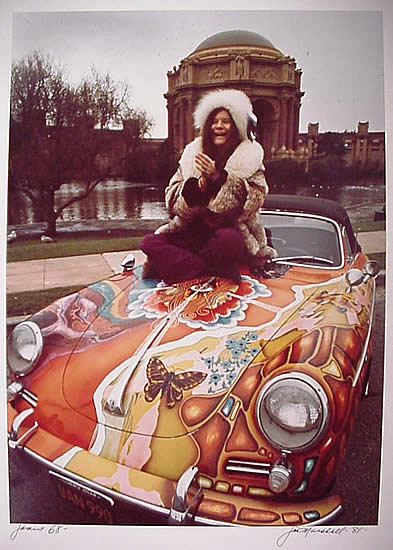
The late 1960’s were a tumultuous time. The Vietnam war, flower children, drug induced psychedelic trips, The Rolling Stones and the first man on the moon were the headlines of the era. For a brief moment in time, until her untimely death on October 4, 1970 at the age of twenty-seven, we were mesmerized by a young female psychedelic rocker with a gravelly voice, outrageous costumes and a penchant for heroin and Southern Comfort—Janis Joplin. Joplin’s car epitomized her flamboyant life style.
In 1968, she bought a used white 1965 Porsche 356C cabriolet from a California car dealer. She decided that the car looked boring. She and her friends thought it would be fun to redo the car with a multi color psychedelic paint job featuring symbols of the time – hallucinogenic mushrooms, flowers, butterflies, astrological signs, peaceful mountain scenes, blood on an American flag, a sketch of Janis and her band, Big Brother and the Holding Company and much more. Band roadie/artist Dave Richards took the ideas, created and painted Janis’ psychedelic Porsche.
Flash forward to 2005.

Project 356: Recreation of Dave Richard’s paint scheme
for Janis Joplin’s 1965 Porsche.
Michigan Porsche Club of America member Vic Rivera was made aware of the 1962 356 Roadster for sale in Milford that been sitting for eight or nine years in 2005.. The tires were flat and the car didn’t run. Vic saw beyond the dust and dirt and purchased the car on the spot. He refurbished the car mechanically and drove it to Porsche events for the next few years. Vic grew up during the rock and roll years of the 1960’s and was a Janis Joplin fan. As a Porsche enthusiast, he was well aware of the famous Joplin psychedelic 356 which was frequently exhibited at the Rock and Roll Hall of Fame in Cleveland.

Since he hadn’t cosmetically restored the 1962 356,
he thought it would be fun to re create the Joplin Porsche.
He was friends with fellow Michigan Porsche Club of America member Nick Moskatow, a former creative designer at General Motors, who worked on the Cadillac CTS-V interior and other projects. Nick had never painted a car; however he was a graphic illustrator and had sketched many vehicles.
In the spring of 2009 Vic discussed his idea for the 356 with Nick and asked if he would be interested in taking on the project. At that time the original Joplin car was at The Henry Ford as part of the Cars and Guitars exhibit. Nick went to Dearborn and in thirty minutes took one hundred pictures of the Joplin car from every conceivable angle.
PAINTING JOPLIN ROADSTER
(see YouTube video link above)
To determine if the project was feasible or folly, Vic and Nick decided to experiment by recreating the hood. Vic bought the paint and supplied the work space in his lower level garage/ shop. Nick brought the tools of his trade — paint brushes, black markers, vinyl tape and tracing paper. He made a drawing and then laid it out on the hood and started to transfer the image to the metal panel. With a black marker, he drew faces and clouds on the hood.

Nick Moskatow, the artist works from a photo to re-create Janis Joplin’s 1965
The next step was to apply the paint.
Nick stopped and asked Vic, “Are you SURE that you want it painted?
”Vic enthusiastically replied, “YES!”
Just to be sure Nick asked Vic five or six more times before he started to paint. Using his photographs and supplemented with pictures found on the Internet,
Nick created an exact duplicate ofJanis’s car.

Nick Moskatow, the artist works from a photo to re-create Janis Joplin’s 1965
He used a paint brush 97% of the time and an air brush for the remainder.
He started the project on July 4, 2009.
Each day, Vic, his wife Lucy and his two daughters excitedly followed Nick progress. The project became a family bonding experience and gave them some insight as to Vic’s passion for Porsches. During the difficult parts.of the project, the Riveras constantly offered Nick encouragement which helped him stay focused with the sometimes tedious work.
Forty eight days later, on September 7, 2009, the project was finished.
Porsche 356 VIC RIVERA’S Joplin Roadster
(see YouTube video link above)
The results were perfect! Vic had a unique show piece and the family and Nick were delighted with the results.

Vic Rivera’s 1962 Porsche 356, painted to resemble Janis Joplin’s 1965 model
Two days later Vic and Nick loaded the replica on a trailer to show the car.
(see YouTube video links below)
Porsche Joplin Roadster at 356 ECH 2009
Porsche Joplin Roadster Enters Concours Field at the 356 ECH 2009

Car owner Vic Rivera and pasenger James Constas drive away from the the 356 Registry East Coast Holiday in West Baden Springs, Indiana..
It was the most photographed vehicle and was selected along with nine other 356’s to be displayed in the Grand Hotel under a large atrium for two days. Vic has shown the car several times at the Porsche Club of America Concours .
JOPLIN Porsche Roadster Photo Shoot
and the real ……Janis Joplin’s psychedelic painted 1965 Porsche 356c Cabriolet made a rare appearance at the Marin Sonoma Concours d’Elegance, on Sunday, May 16th, 2010.
dedesewards | May 18, 2010 |
Janis Joplin’s Story
Janis Joplin’s famous psychedelic Porsche returned to its erstwhile Marin home this last weekend, making a rare local appearance at the Marin Sonoma Concours d’Elegance, Sunday, May 16th, 2010.
In September 1968, the budding rock star paid a Beverly Hills auto dealer $3,500 for the three-year-old sports car. When she bought it, the Porsche was a factory-painted “oyster white.” For a flamboyant singer who wore rose-colored glasses and feather boas, that wouldn’t do. So she got roadie Dave Richards to paint it with swirling psychedelic images, including Mount Tamalpais on one fender and a portrait of her with her band, Big Brother and the Holding Company, on another.
The singer’s 1965 Porsche 356c Cabriolet, which she bought when she was living in Larkspur, is usually enshrined in the Rock an…d Roll Hall of Fame in Cleveland. It came to Marin from the Grammy Museum in Los Angeles, where it was on loan.
“They used regular house paint,” Michael Joplin recalled. “They were just playing around, saying, ‘Hey, let’s make an art car.’ They were having a lot of fun. It was a convertible, and she would drive it around with the top down. People would leave notes for her on it.”
Beneath her carefree image and gaudy facade, though, Joplin was a troubled soul. And in October 1970, she was found dead of a drug overdose in a Los Angeles hotel room. Michael, 10 years younger, was devastated. “I wanted to be just like her,” he said.
After her death, the Porsche ended up in the hands of her manager, Albert Grossman, who lived in Bearsville, N.Y., and let visiting rock musicians drive it when they were in town.
In 1973, the car was returned to the Joplin family.
“It was trashed,” Michael recalled. It had been sitting in a garage for a long time and it wasn’t driveable. I pushed it down the road to a guy who worked on VWs and he got it running.
My sister Laura and I drove it for the next 20 years.”
During that time, the psychedelic paint job was fading as fast as Joplin’s stardom.
“I would drive along and big chips of paint would fly off,” Michael remembered. “It was an old car, and it started falling apart. It always needed something, and we needed to repair it. After much anguish, we decided to take the paint off to save the car.”
It’s hard to imagine now, but a decade after her death, the memory of the electrifying singer of “Piece of My Heart” and “Ball and Chain” was fading fast in the public consciousness.
“Her fame was waning, and the car became more valuable as an antique Porsche than as Janis Jopin’s car,” Michael said. “Ten years after her death she was an old star. It took a while for her to achieve iconic status.”
It was only when the family produced the play “Love, Janis,” that they decided to have the old Porsche restored. In 1994, it was repainted in all its hippie-era glory.
“We were opening the play in Denver, and we thought it would be cool to put the car in the lobby,” Michael recalled. “So we had the Denver Center Theatre Company’s paint shop re-create the design from the hundreds of photographs we had. After that, the Rock and Roll Hall of Fame called, saying, ‘Oh, my God, we have to have that car.'”
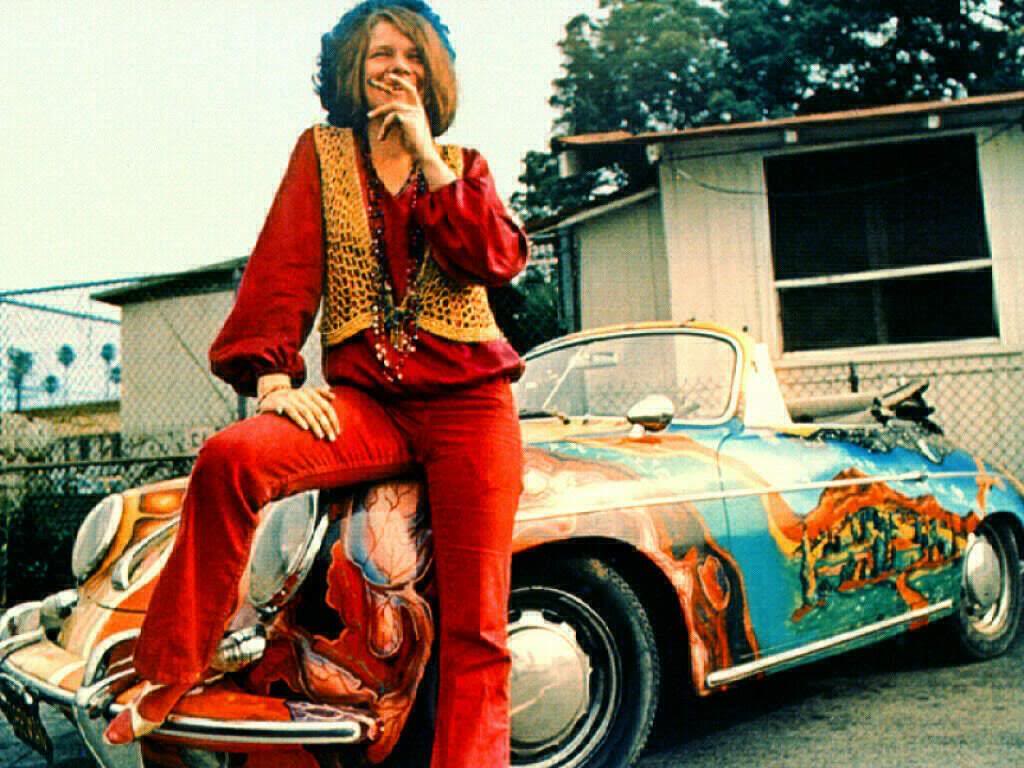
Porsche Everyday: Promotes its Sports Cars From An Entirely New Perspective

New Campaign will Rely Heavily on Owners’ Everyday Stories
Atlanta, March 24, 2011 – For the first time, Porsche is challenging many Americans’ perception of Porsche sports cars and in particular the 911 in a new campaign launching today.
The Engineered for Magic. Everyday campaign, via agency Cramer-Krasselt/Chicago, seeks to show the many dimensions of the iconic Porsche 911 and the brands other storied sports cars through the lens of daily driving.
The magic of Porsche is how thoroughly the cars transform your everyday, routine driving,said David Pryor, vice president of marketing, Porsche Cars North America. It’s not only about the weekend joyride. It’s the only car in the world that combines true sports car exhilaration and the drivability for daily use. This campaign brings this fact to life, painting a bigger picture of the real Porsche value proposition, in some cases through the words and images of owners themselves.
Spanning TV, print, online, mobile, direct mail and a cinema promotion, the campaign drives home the engineering genius that allows these coveted sports cars to be everyday drivers.
When most people think of Porsche, they think magic and the cars certainly are, said Marshall Ross, chief creative officer, Cramer-Krasselt. What is markedly different about this campaign is were not selling the dream-car mystique of Porsche — that’s already a given. The creative challenge here was to tell the truth of the drivability of the car and still make it feel as special as it really is.
Debuting in selected markets tonight during the NCAA Tournament, the TV spot features vignettes of Porsche sports car owners in a number of seemingly everyday scenes: a parent picking up kids at school, a man running a home-improvement-store errand and a mom clearing away snow from the windshield each with titles re-characterizing the car as a school bus, a pickup truck and a snowmobile. In another vignette, as a man fires up the engine after a long day at the office, we see how the car’s incredible, mood-shifting virtues as his getaway car complement the everyday ones.
The closing voiceover says: Engineered for Magic. Everyday.

At the hub of the integrated campaign is a consumer-generated website PorscheEveryday.com where owners can share their own everyday stories.
With a combination of professionally produced videos and images along with owner-submitted content, the site builds a mosaic showcasing the many ways a Porsche is engineered for everyday magic.
For this effort, Porsche has once again reached out to its passionate and active loyalists and enthusiasts to participate and contribute to the story.
Last month, to start things off, Porsche sent 200 Flip video cameras to select owners asking them to contribute videos. The brand has also invited input from all its owners, the Porsche Club of America, dealers and their customers, and the million-plus Facebook fans for everyday stories, photos and videos.
In partnership with the Reelz channel, Porsche will also invite amateur film-makers to submit films that demonstrate daily magic.
Ten filmmakers will be selected to experience daily magic in a Porsche and then make a film about the experience. The winning submission will be shown in cinemas across the country …a first for Porsche and on the Reelz channel.
TV will run on national cable and print will appear in April issues of newspapers and magazines such as The Wall Street Journal, Wired, Fast Company and Condé Nast Traveler with headlines such as Turns small errands into short adventures and Passion should never take a snow day...all ending with Engineered for Magic. Everyday.
Source: Porsche
About Porsche Cars North America
Porsche Cars North America, Inc. (PCNA), based in Atlanta, Ga. is the exclusive U.S. importer of Porsche sports cars, the Cayenne SUV and Panamera Gran Turismo. Established in 1984, it is a wholly-owned subsidiary of Porsche AG, which is headquartered in Stuttgart, Germany, and employs approximately 220 people who provide parts, service, marketing and training for 196 dealers. They, in turn, work to provide Porsche customers a best-in-class experience that is in keeping with the brand’s 63-year history and leadership in the advancement of vehicle performance, safety and efficiency. At the core of this success is Porsches proud racing heritage that boasts some 30,000 motorsport wins to date.
About Cramer-Krasselt
Cramer-Krasselt is the second-largest independent marketing and communications agency in the U.S., with billings nearing $1 billion. An Advertising Age Agency to Watch three of the last four years, C-K has grown by more than 50 percent since 2005. C-K is frequently recognized for its insight-driven creativity spanning advertising, digital, engagement strategies and public relations that helps clients change their category conversation. Headquartered in Chicago with offices in New York, Milwaukee and Phoenix, it represents major brands across virtually every industry, including: Benjamin Moore, Benihana, BRP (Ski-Doo, Sea-Doo, Evinrude), Burlington Coat Factory, Corona Extra, Crocs, Edward Jones, Â Heinz (Ketchup, Smart Ones, Classico, Ore-Ida, Steam Mash), Hilton Hotels Worldwide, Johnsonville Sausage, Porsche, World Kitchen (Pyrex, Corelle) and Zicam. For more information, visit Cramer-Krasselt at www.c-k.com.
Visit the campaign’s new site at: www.PorscheEveryday.com

Contact:
Tony Fouladpour
Porsche Cars North America
770-290-3667
tony.fouladpour@porsche.us
Kristin Fletcher
Cramer-Krasselt
312-616-2371
Kfletcher@c-k.com
German Artist: Bernd Lehmann – Automotive Unique Old Master Etchings
“Bernd Lehmann, born in 1950, is a contemporary painter of beautiful objects. His works speak from within, and in their perfection they rank among the supreme achievements of the etching technique.”
The artist – Atelier-Bernd Lehmann
Bernd Lehmann, born in 1950, is living in Germany in the countryside near Hamburg. He is a freelance artist since 17 years now. Before he worked for several companies in Hamburg and the surroundings as a lithographer. In a very sensitive and empathic way he brings out the deep characters of his illustrations. Their charisma may touch the contemplator’s soul. His style is a composition of realism and impressionism.
The technique
Lehmann sways the mature technology of etching. He cuts his mirrored pictures into a metal surface to create a design in intaglio just like the old masters Rembrandt or Dürer did. He inks the metal plate with one color and puts it with a moistened sheet of paper in a high pressure printing press. The numbers of the crafted impressions are low to keep up the value. Every single print will be finished in a special way and colored as may be necessary. So every print is a genuine original.
HANS HERRMANN-PORSCHE 917 K
The artists reputation
Connoisseurs all over Europe appreciate the impressive quality of his fine etchings. His etchings of flowers and portraits of musicians, poets and other characters of the contemporary history and also views from vintage cars to lighthouses formed his kudos. His works could be seen at the Frankfurt Book Fair, Frankfurt Ambiente, IAA Frankfurt Car Fair and Art Fair Europe.
Hans Herrmann-Le Mans 1970 – Original-Radierung
Lehmann crafted etchings for clients such as Caterpillar, Volkswagen, Porsche, Airbus, Lamborghini, Breitling, Rolls Royce and Bentley
A German philosopher and university professor characterized his works as “truly gorgeous, technically perfect and equally absolutely romantically empathetic.” “His art concentrates the beauty of the moment”, a doctor of literature lauded Lehmanns etchings.
The Dream of Flying
AIRBUS etchings by Bernd Lehmann, focusing on the A380
Source:http://www.bernd-lehmann.de


Bernd Lehmann
Platenkamper Strasse 12
Neuenkirchen-Tewel, 29643
Germany
Tel: +49 5195 933296
Web Site: www.bernd-lehmann.de
Email: blrf@bernd-lehmann.de
Fax: +49 5195 933532
Contact: Bernd Lehmann
Porsche:TruSpeed Motorsports Announces Patrick Long as Pirelli World Challenge Driver
|
 Photo: TruSpeed Motorsports
Costa Mesa, CA – March 23rd, 2011
TruSpeed Motorsports, based in Costa Mesa, Calif., today announced the signing of Patrick Long to race the #45 PrivacyStar Porsche GT3 Cup Car in the 2011 Pirelli World Challenge Championships Series.
After much speculation, Long will first race for TruSpeed starting with the season opener of the WC Series this weekend, March 25-27 on the streets of St. Petersburg, FL.
Rob Morgan, 1996 Rolex 24 Hours of Daytona GTS-1 class winner, runs TruSpeed Motorsports, and will drive the #46 Entrust/TruSpeed Porsche GT3 Cup for the season.
 Photo: TruSpeed Motorsports
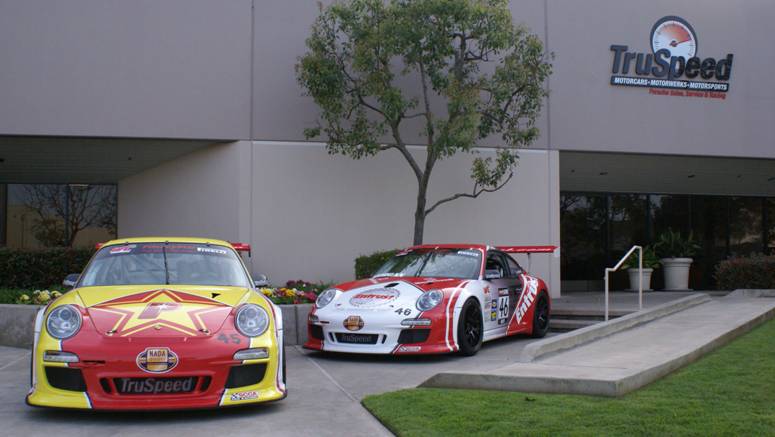
 |
Photo from The FRS Company |
Long said, “I’m excited at the chance to do some sprint racing, in a tough series and with a very strong team. TruSpeed has a great team structure with some awesome people that I have worked with in the past. That was the initial draw for me to this idea, then getting to know Rob and just how passionate he is about his racing made it a no-brainer to sign up with these guys.
I like that Pirelli World Challenge is unique – standing starts, sprint formats, double-header weekends, all that. I will be jumping in Thursday cold turkey, but I love St. Pete’s street circuit and it helps that it’s just down the road from where I’ve been living for the past four years.”
Long will race in all the events except for Miller, which conflicts with his European test schedule. Kelly Collins will take Long’s place at the Utah round of the championship.
Team owner Rob Morgan was elated to announce the hiring of Long. “I’m thrilled to be teaming up with Patrick this season, particularly as a driver. Having him around to help us continue to develop as a team will be fantastic, and I know he’ll push me as a driver. Having someone with his record of success and skill involved will help us grow, both on and off track. I can’t wait to get to work at St. Pete this weekend, and to start building on the successes we’ve had in the past.”
The Pirelli World Challenge Series kicks off this weekend with twin races on the streets of St. Petersburg, Florida, Saturday and Sunday, March 26-27.
For live timing and scoring, visit: http://www.world-challenge.com/event/index.php?ID=126
___________________________________________________________
The Pirelli World Challenge Series GT class features Porsches, Corvettes, Mustangs, Volvos, Vipers, Nissan GT-Rs – and this year, Cadillacs – and will race 12 times over eight events. Venues are
|
||||||||||||||
|
||||||||||||||
|
||||||||||||||
|
||||||||||||||
|
||||||||||||||
|
||||||||||||||
|
||||||||||||||
|


_________________________________________________________________________
TruSpeed Motorsports wishes to thank its 2011 sponsors and partners.
For more information, visit:
PrivacyStar: http://privacystar.com/
Entrust: http://entrust.com
NADA Guide: http://www.nadaguides.com
Merrill Lynch: http://ml.com
TruSpeed Motorsports was founded in 2001 by Rob and Charles Morgan, over the years racing in the Grand-Am Rolex Sports Car Series, the IMSA GT3 Cup Challenge and World Challenge. TruSpeed runs a robust arrive-and-drive and trackday business, as well as a street and race car sales and service facility in Orange County, California.
For information about TruSpeed’s racing, performance car sales and service, visit: http://www.truspeedmotorcars.com
Porsche puts on sale the 918 Spyder super sports car with its innovative plug-in hybrid drive
Starting gun for sales of the Porsche 918 Spyder hybrid super sports car 918 units of exclusive future technology

The latest rendering of Porsche’s plug-in hybrid 918 Spyder super sports car.
Now available for ordering, the 918 Spyder will feature cutting-edge plug-in hybrid technology and stunning performance, forever changing the future of the super sports car
ATLANTA – March 21, 2011 — After outstanding customer response to the concept car first shown at the 2010 Geneva Motor Show, Porsche today announced that dealers around the world will begin taking 918 Spyder customer orders. This is a significant step toward actual production of the company’s next super sports car, a Porsche that marries unique plug-in hybrid technology and outstanding performance in a visually stunning and purely Porsche package. Porsche Press Release
Stuttgart. Today is the day that Dr. Ing. h.c. F. Porsche AG, Stuttgart, puts on sale the 918 Spyder super sports car with its innovative plug-in hybrid drive. Production development is proceeding apace in the wake of the outstanding customer response to the concept car unveiled at the Geneva Motor Show 2010. Thanks to its unique hybrid technology, the 918 Spyder is estimated to consume a mere three litres of fuel per 100 kilometres (94 mpg imp.) based on the New European Driving Cycle (NEDC). Its V8 engine delivers more than 368 kW (500 hp), assisted by two electric motors with a total of at least 160 kW (218 hp). The 918 Spyder is available for immediate order priced from 645,000 Euro – subject to VAT and country-specific charges.
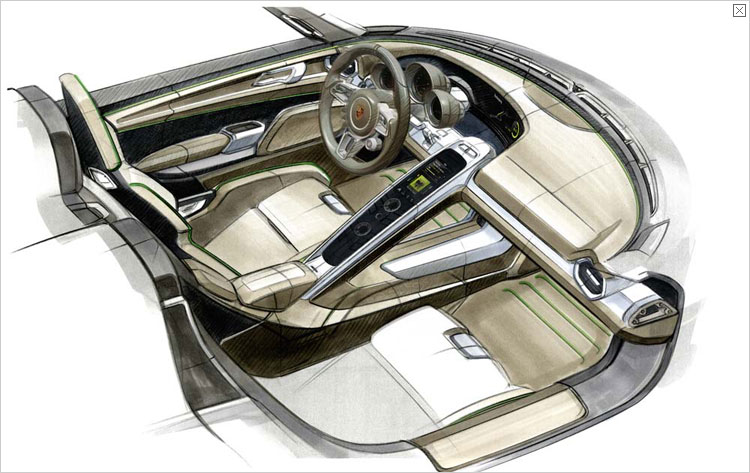
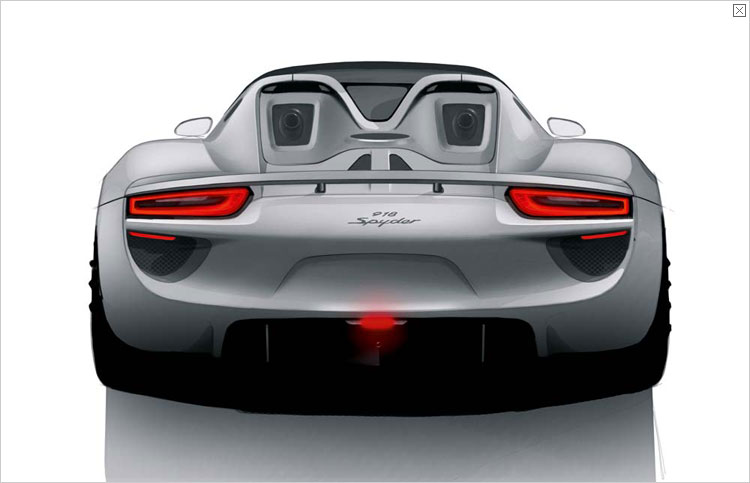
To ensure a 918 Spyder’s exclusivity, the two-seater is limited to no more than 918 units. The earlier a customer orders his vehicle, the earlier it will be delivered, as production is initialized in the same sequence in which orders are received. Production of the 918 Spyder is scheduled to commence on 18 September 2013 – 9/18 in US date convention – in a quasi manufacturing operation at Porsche’s main plant in Stuttgart-Zuffenhausen. Delivery of the initial vehicles will commence in November 2013.
The design’s DNA is derived from the Carrera GT and Porsche 917 sports car as well as the RS Spyder and is very closely modeled on the 2010 concept car. Unlike the concept car, however, the production version of the two-seater, based on a carbon fibre-reinforced plastic monocoque, features a manual roof system with removable roof panels that can be stowed in the front luggage compartment.
The 918 Spyder is driven by a unique type of plug-in hybrid system. It comprises a high-revving V8 engine with a displacement exceeding four litres and output of more than 368 kW (500 hp). The mid-engine power unit is based on the racing engine of the successful Porsche RS Spyder, which provided impressive proof of its efficiency with its multiple victories in the Michelin Green X Challenge in the American Le Mans Series, the Le Mans Series and the 24 Hours of Le Mans. Power transmission to the rear wheels is by means of a compact, seven gear Porsche-Doppelkupplungsgetriebe (PDK). This is complemented by two electric motors – one each on the front and rear axle – with a joint mechanical output of at least 160 kW (218 hp). This configuration offers an innovative, variable all-wheel drive with independent control of the propulsion force on both axles. The energy storage unit is a liquid-cooled lithium-ion battery that can be charged from a conventional domestic power socket, delivering a range in excess of 25 km (16 miles) in the NEDC on purely electric power. The charging time depends on the country-specific mains network, being approximately three hours in Germany, for example. A quick charging option is planned to reduce charging time yet further.
The 918 Spyder’s combined total fuel consumption in the NEDC (ECE-R 101) is anticipated to be 3.0 l/100 km (94 mpg imp.), equating to CO2 emissions of 70 g/km (112 g/mile). Despite that, the super sports car offers performance of the highest order. It accelerates from a standing start to 100 km/h (62 mph) in a maximum of 3.2 seconds and has a top speed of more than 320 km/h (199 mph). That means the Spyder will be able to manage a lap of the Nürburgring Nordschleife in less than seven minutes and 30 seconds – trumping the Porsche Carrera GT, which needs seven minutes and 32 seconds. The top speed on purely electric power is 150 km/h (94 mph).
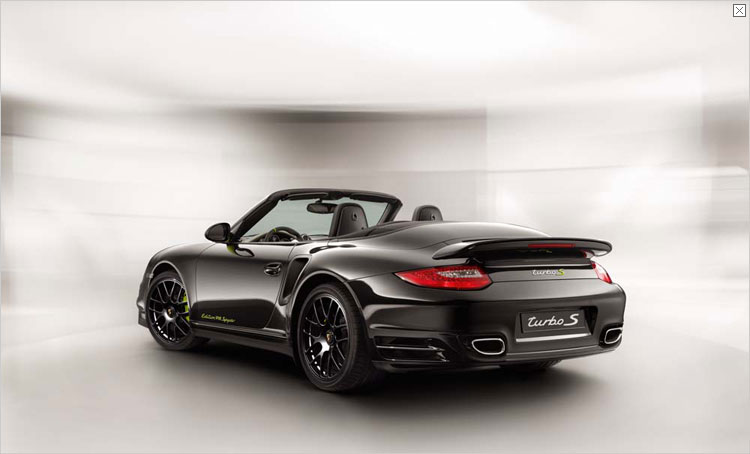
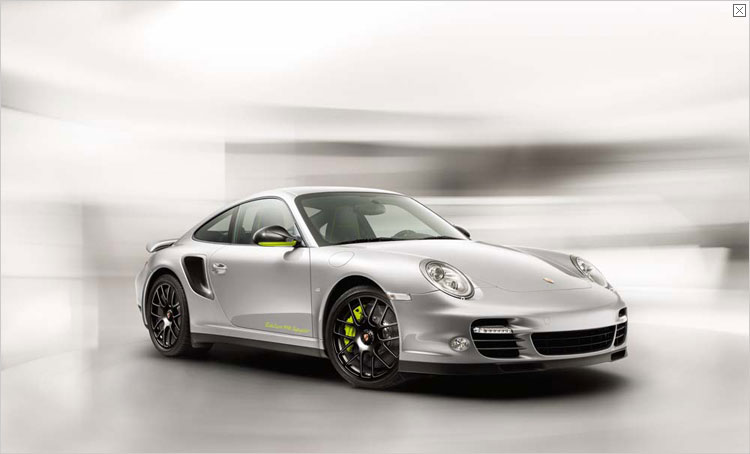
To shorten the time the customer has to wait for the 918 Spyder, Porsche is offering everyone placing an order the exclusive opportunity to acquire a 911 Turbo S “Edition 918 Spyder”, also limited to no more than 918 units. Visually, both inside and out, the special edition is inspired by the 918 Spyder’s characteristic individual features. That includes the distinctive acid green features such as the specific and part-embroidered model logos and seams, the instrument cluster needles, the specific PCM screen and illuminated door entry guards. The limited edition badge on the glove compartment lid bears the same number as the 918 Spyder the customer has ordered. The 911 Turbo S “Edition 918 Spyder” can also be ordered in the same colour.
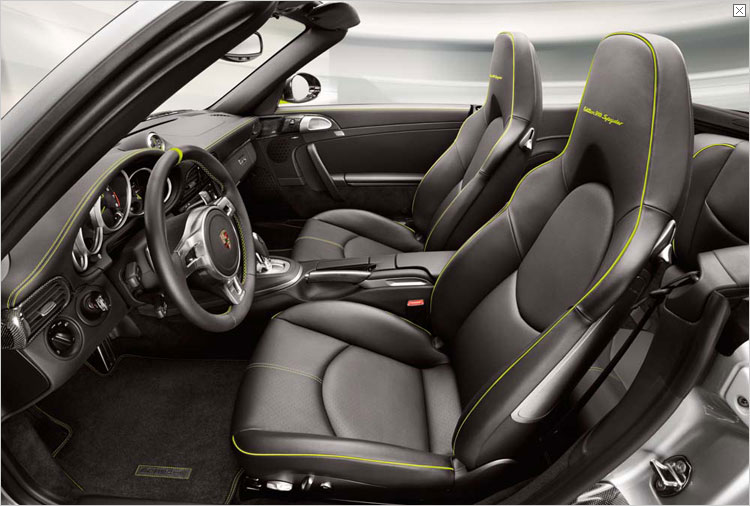
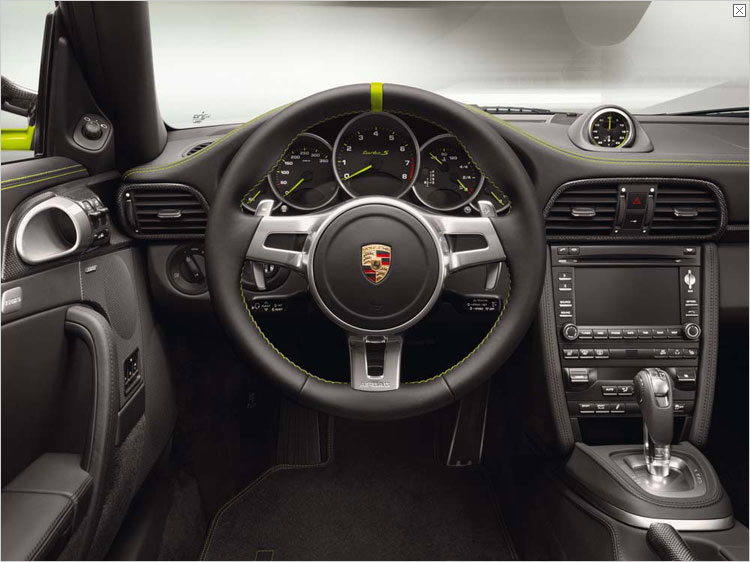
Both the technology and basic equipment of the new 911 Turbo S “Edition 918 Spyder” are based on the 530 hp (295 kW) 911 Turbo S. In the case of the special edition, the already comprehensive standard equipment is complemented in particular by an enhanced leather interior, a special instrumentation version and additional carbon elements both inside and out.
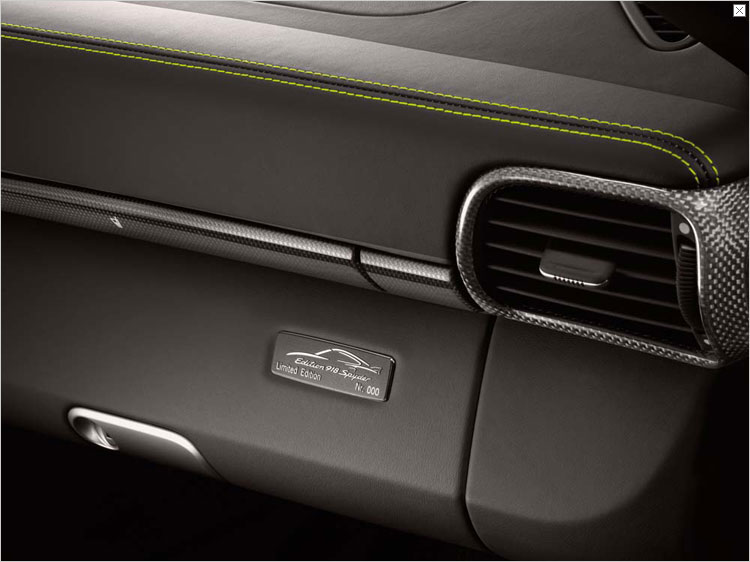
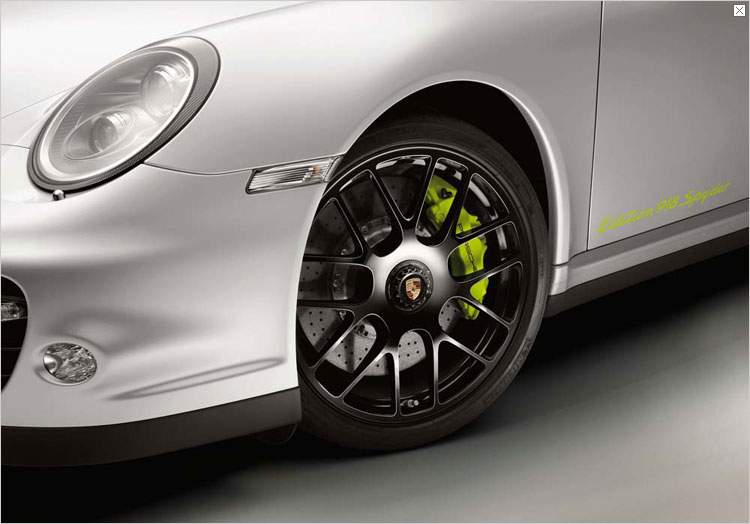
The 911 Turbo S “Edition 918 Spyder” is being offered to coincide with the commencement of sales of the 918 Spyder with deliveries starting in June 2011. The Coupé version of the special edition costs 173,241 Euro in Germany and 184,546 Euro as a Cabriolet – including VAT and country-specific equipment items respectively.
Note: Images of the 918 RSR and the 911 Turbo S “Edition 918 Spyder” from the Porsche press database
How Porsche dealers will order the 918 Spyder – Autoblog
According to Porsche, you can buy a 918 Spyder from any Porsche dealer anywhere in the world, provided they’ve signed a participation agreement with Porsche. Details are few and far between on what that agreement entails. What Porsche is saying, though, is how dealers who sign the agreement will order their cars.
Dealers who want to place an order for a 918 will have to submit an “Allocation Request Form.” Porsche will reply with an “Allocation Response Form,” which tells the dealer whether there’s a car available for them. Once that’s done, the dealer submits an order form, along with a $200,000 down payment. Porsche will respond with a confirmation and an estimated month for production.
The next step is another $200,000 deposit 12 months before the production date. The balance – $445,000 plus shipping, if you’re counting – is due when Porsche says the car is done. Porsche says the car will not be shipped until it has been paid for in full. The reason, apparently, is that it won’t be building any of the hyper-expensive 918s on speculation, and that each car needs to have an owner before it is built.
918 Spyder Program
Porsche 918 Hybrid dealer information
Porsche Rennsport IV Reunion Poster Revealed
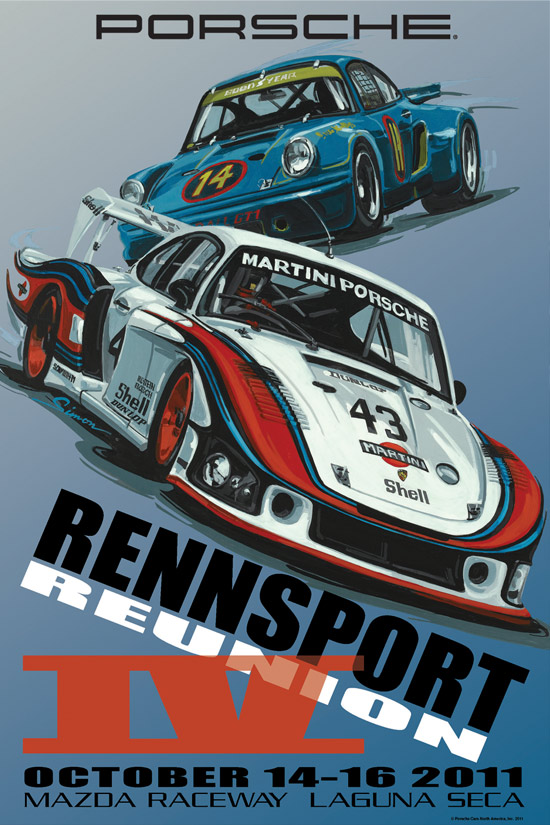 Poster by Dennis Simon Poster by Dennis Simon |
ATLANTA – March 18, 2011. Today, Porsche Cars North America took the veils off of the official Rennsport Reunion IV artwork that will symbolize the world’s greatest gathering of historic and contemporary Porsche race cars and their drivers October 14 to 16, 2011. Because this year’s event will feature as a special highlight the decades-long success story of the 911 race cars the poster depicts two of the most exciting protagonists, the 1981 factory 935 long tail in Martini colors and Al Holbert’s 911 RSR from 1974.
The painting is the works of renowned automotive artist, Dennis Simon (www.centuryofspeed.com ) who created the posters for two of the previous venues. They show off the mighty 917 and 962 in Gulf and Löwenbräu livery (2007) and the three 908s as they cross the finish line of the 1970 24 Hours of Daytona (2004). Both posters are now collectors’ items and the new one will likely be no different.
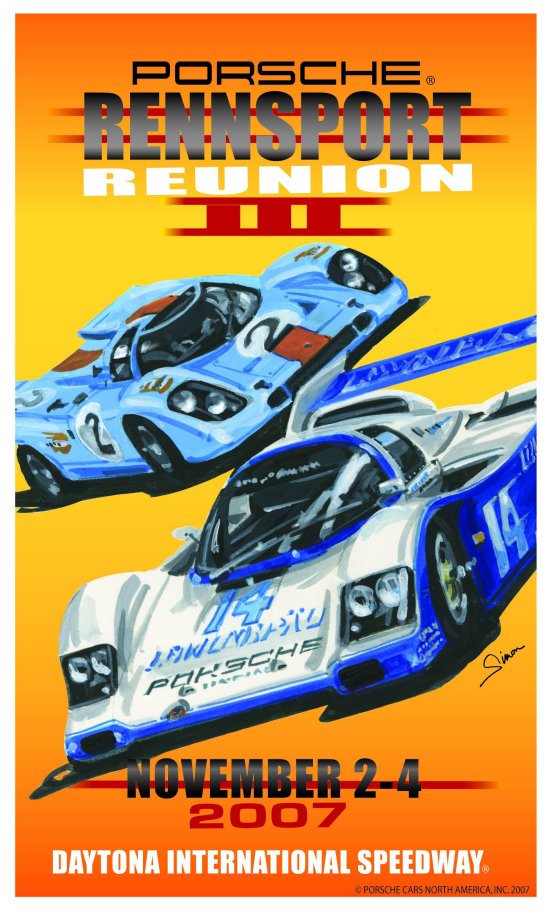
The 917 and 962 in Gulf and Löwenbräu livery (2007)
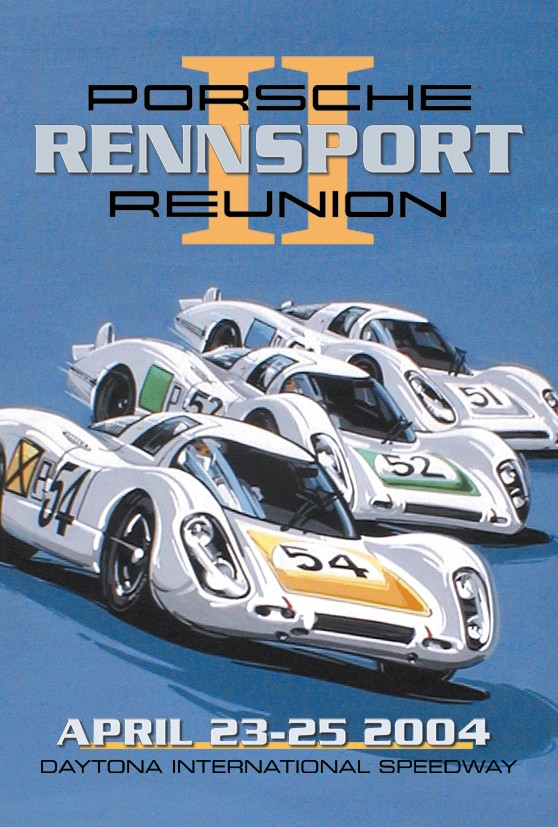
The three 908s as they cross the finish line of the 1970 24 Hours of Daytona (2004)
 Porsche Rennsport 2001 Reunion Poster organized by Porsche Car North American and Brian Redman
Additional details of the Porsche Rennsport Reunion IV along with images from the first three Rennsport Reunions will be published on Porsche’s press web site (www.press.porsche.com) and Mazda Raceway Laguna Seca’s web site (www.mazdaraceway.com), as they become available. Ticket information is available by contacting 800-327-7322 or www.mazdaraceway.com.
Resource: Porsche Cars North America, Inc
About Porsche Cars North America
Porsche Cars North America, Inc. (PCNA), based in Atlanta, Ga., is the exclusive importer of Porsche vehicles in the United States. It is a wholly owned, indirect subsidiary of Dr. Ing. h.c. F. Porsche AG and employs approximately 220 people who provide parts, service, marketing and training for some 196 dealers. From its inception in 1948, Porsche has been a leader in advancing vehicle performance, improving automotive safety and developing ever more fuel efficient technologies in its high-performance models. At the core of this success is Porsche’s proud racing heritage that dates back to its beginnings. Today, with some 30,000 motorsport wins, Porsche is recognized as the most successful marquee in sports car racing. PCNA, which imports the iconic 911 series, the Boxster and Cayman sports cars, the Cayenne SUV and Panamera Gran Turismo strives to maintain a standard of excellence, commitment and distinction synonymous with this historic brand.
“Porsche in Pieces” – Break It Down Episode by National Geographic Channel

Mark your calendars
LA Dismantlers for Porsche
will be featured
Thursday, May 12 @ 7 pm and 10:00 PM on a TV show
on the
National Geographic NATGEO Channel,
called
Break it Down – “Porsche in Pieces”.
Other air dates:
Nat Geo US reair 05/13/2011 01:00
Nat Geo Latin America 04/07/2011 21:00
Nat Geo Asia Taiwan 04/12/2011 21:00
NGC HD Iberia 04/25/2011 23:35
Nat Geo Australia New Zealand 04/26/2011 20:30
Nat Geo France 04/26/2011 20:40
Nat Geo UK Only 04/27/2011 21:00
Nat Geo Japan 05/30/2011 23:00

Los Angeles, California – home to the rich and famous…and their sports cars. Luxury is king here, and some say nothing shows off better than a Porsche. But when those cars crash and burn in accidents, their wreckage comes to “LA Dismantlers for Porsche”.

Photo courtesy of Los Angeles Dismantler for Porsche (LA Porsche)
Here expert teams tear down the totaled remains and pulls out the salvageable parts including the engines, transmissions, and seats, anything that wasnt damaged in the impact.
Now the teams will have three new Porsches to tackle in “Porsche in Pieces”
a 2002 Boxster
a first-generation 911
and a 997 Carrera
Each car has components that customers have back ordered,
so these fresh wrecks will need to come apart now.
National Geographic Channel Porsche In Pieces Credits

Photo courtesy of Los Angeles Dismantler for Porsche (LA Porsche)
Look out for upcoming articles featuring LA Dismantler in Porsche magazines such as
Porsche Club of America’s Panorama magazine and Excellence.


About Los Angeles Dismantler
Los Angeles Dismantler for Porsche 911, Boxster, Cayman, & Cayenne (Panamera soon) Porsches are unlike any other vehicle you will drive and Los Angeles Dismantler is unlike any other wrecking facility you’ll see. The yard is clean and orderly with parts and cars stored in custom built racks. You can find parts even the dealership can’t get a hold of. Los Angeles Dismantler can ship all over the world, call (818) POR-SCHE (767-7243) to get started with your next Porsche project.
Axiom Motorsports – Blog
Axiom Motorsports is an auto shop in the Greater Los Angeles area, near LAX that specializes in the care, repair, restoration and maintanance of air cooled Porsches.
Porsche in Pieces (National Geographic)
http://axiommotorsports.blogspot.com/2011/04/porsche-in-pieces-national-geographic.html
It’s not about us, but we did play a supporting role….In this town, that counts, after all there is no business, like show business.
The lady producer, Denise Prichard, said: you guys are going to be on TV, I was thinking….I should have brought my clown shoes…..Long story short, we have been commissioned to built a turbo engine for this car, Nat Geo was following this car as one of the three they were going to feature on their show.
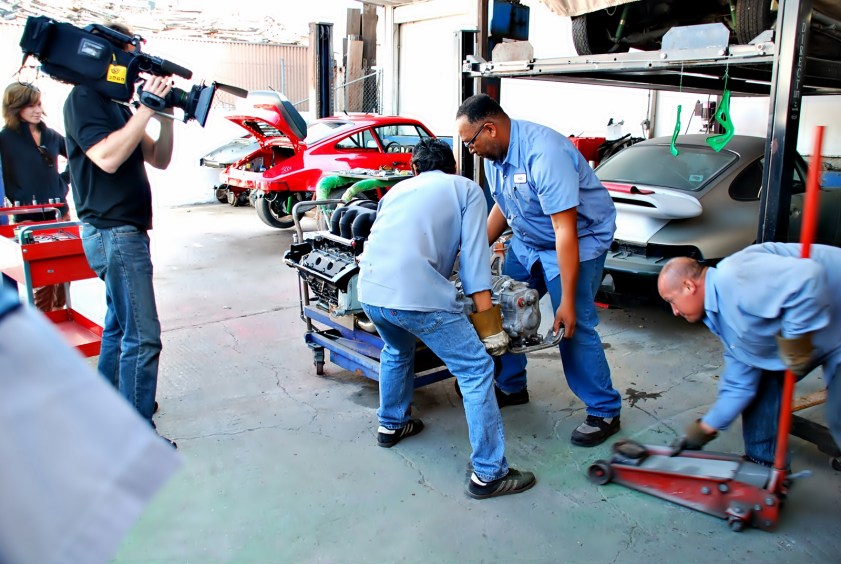
Cut !! again, from the top,……..it was an experience, every move was done three or four times, I think they should make transmission lifting an Olympic sport, after installing that G50 4 times, we felt we deserve some gold , and It is not easy working with a mic taped you chest.
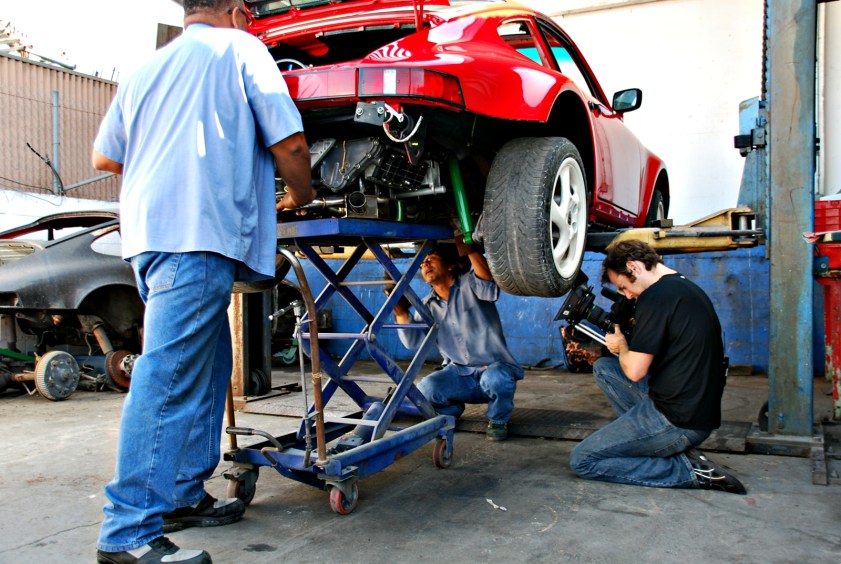
The star of the show is LAPD
Porsche Design Store Opens in San Francisco

Porsche Design Group Comes to San Francisco

Fans of fancy sports cars rejoice!!
With existing stores in the United States doing so well in recent years, The Porsche Design Group, based in Bietigheim-Bissingen, has decided to open a store in San Francisco.
Opening its doors at 100 Grant Avenue, it will specialize in luxurious, beautifully made pieces for men and women, designed with a sporty, casual aesthetic. And if you are looking for the ultimate black leather jacket, we’re told this is the place to get it!
“Leather has been in fashion for decades,” says Dr Juergen Gessler, CEO of the Porsche Design Group. “So it fits in perfectly with our timeless and purist design standards.”

Another must-have item are their premium running shoes, Bounce:S2.
These high-tech running shoes were launched for the first time in January 2008, going on to win a number of awards. They won the “Plus X Award”, Europe’s biggest technology, sports and lifestyle competition, and “Time” magazine named them one of the 50 best innovations of the year.
Porsche Design is known for their extensive eye wear collection, which are pretty famous and almost classic

Yoko Ono made these sunglasses famous in 1979, and they have been relaunched in the Porsche Design collection. (what if Steve McQueen hung out with Yoko Ono, or did they?)… point being you could make a “spectacle” out of wearing them.
Porsche Design – San Francisco
Location |
|||||
|---|---|---|---|---|---|
Hours |
|
Parking |
Parking Lot
|
|---|
|
|
info@porschedesignsf.com
|
|---|---|
Phone |
415-786-1110
|
Website |
Porsche Design Group Facebook
Your invited to the Grand Opening on Thursday, March 31st, 2011 –

 Porsche Everyday Dedeporsches Blog
