RSS

Tag Archives: Stuttgart

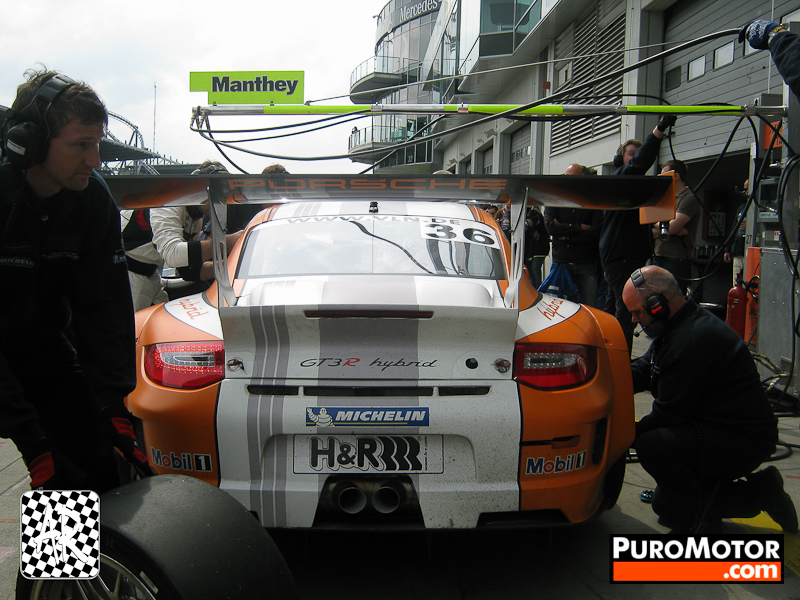
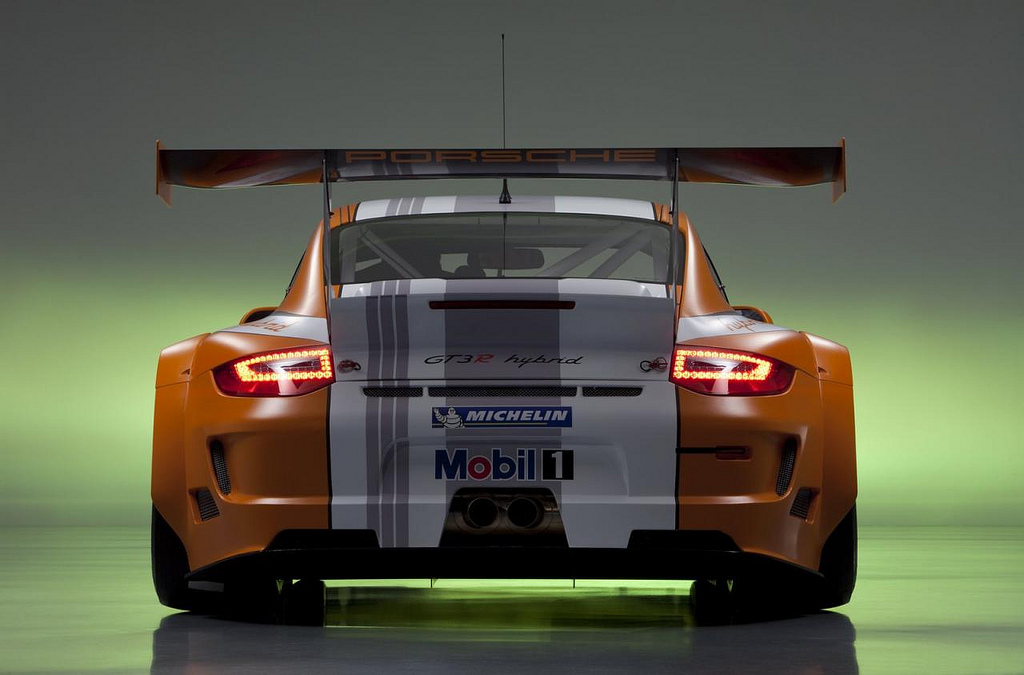
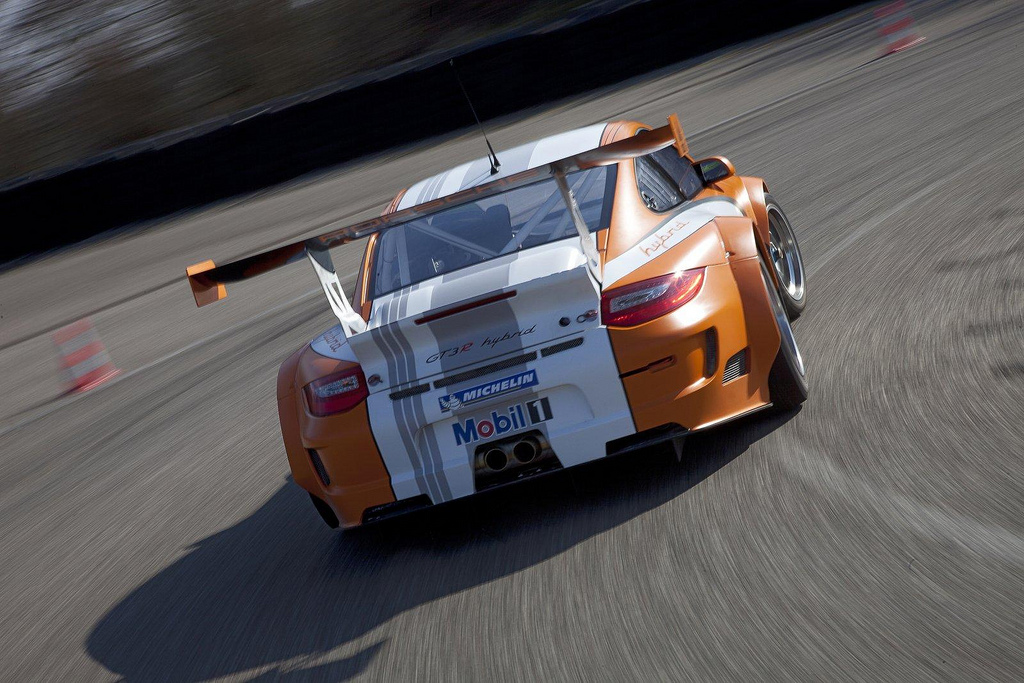
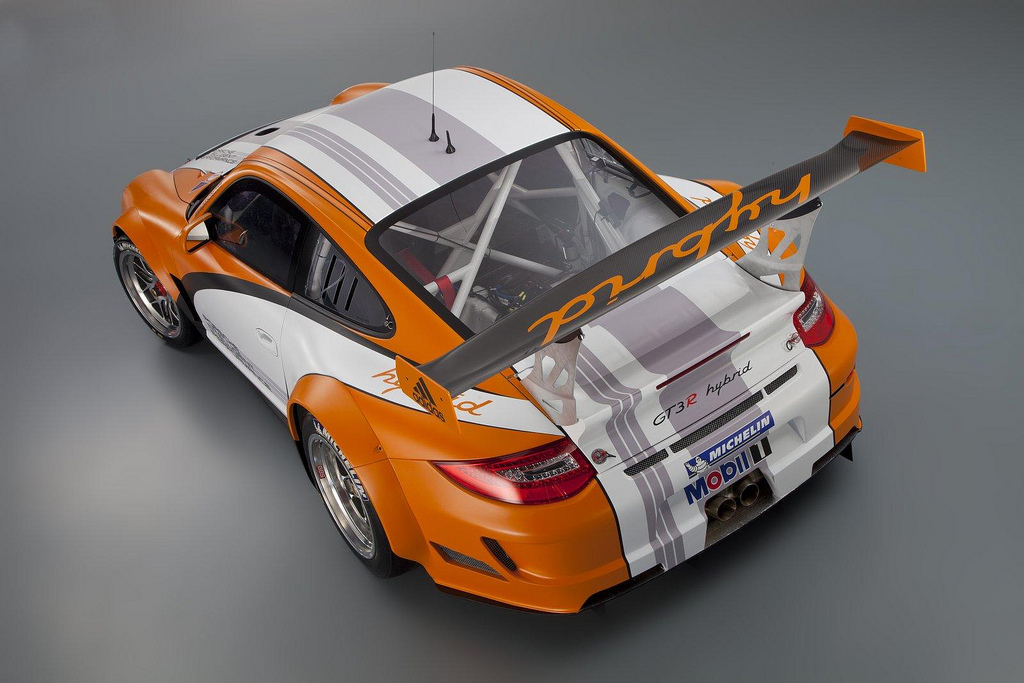
Porsche 911 GT3 R Hybrid celebrates historic 1st VICTORY at the Nurburgring May 28th, 2011

Basis for the first victory was certainly the lower consumption of the hybrid compared to the other cars.

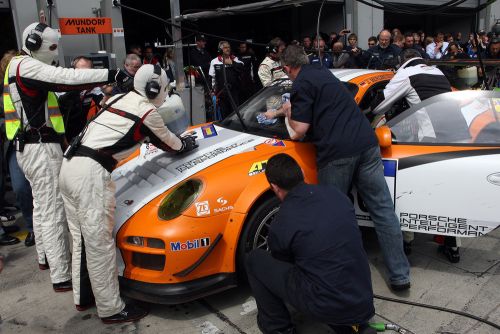
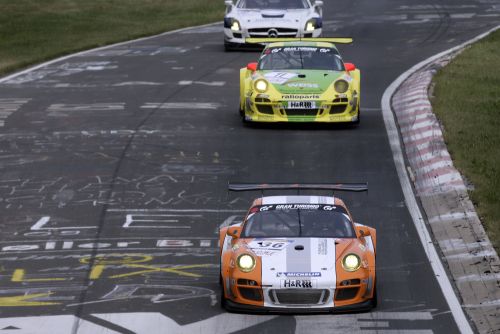
At the fourth round of the VLN, the Porsche 911 GT3 R Hybrid celebrate the first victory – only two stops as the key to success

Less recharge, drive longer: this is the recipe for success of the enhanced Porsche 911 GT3 R hybrid.

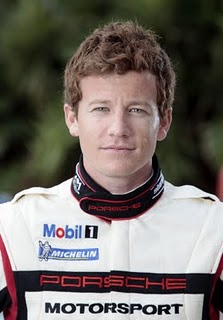
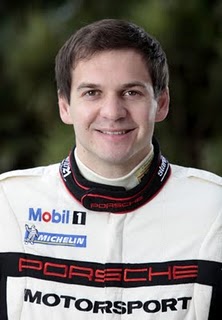
With version 2.0, Porsche works driver Richard Lietz, Marco Holzer and Patrick Long drove in the fourth round of the Endurance Championship for the first victory of the hybrid race car from Weissach.

While almost all direct competitors stopped three times to refuel in the pits, the hybrid with just two stops, was victory and checkered flag for the Porsche hybrid.

The Porsche 911 GT3 RSR with  Manthey Porsche and works driver Marc Lieb, Romain Dumas and Lucas Luhr Manthey-pilot also came with two stops and made the Porsche double victory perfectly.

The second race of the 911 GT3 R hybrid in the Endurance Championship in 2011 is the successful completion of the intensive preparation for the 24-hour race Nürburgring 25-26. June.

“We are using the technical specifications of the vehicle and the reliability of the hybrid system extremely satisfied,” says Porsche head of motorsport Hartmut Kristen.

“We have over the competition a pit stop saving and go with less energy input from the outside similarly fast lap times. This is what we mean by Porsche Intelligent Performance. I am particularly pleased that even the 911 GT3 RSR by Manthey Racing the known efficiency of the Porsche 911 models could prove, and was number two. “

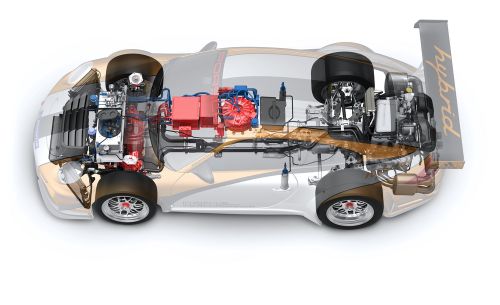
The focus of the development of the Porsche 911 GT3 R hybrid was clearly on the increase in efficiency. For this, the vehicle weight was reduced from 1,350 kg to 1,300, which even the hybrid components are involved. Their weight was reduced by 20 percent by direct optimization. The general hybrid layout was taken from the 2010 model.

This slideshow requires JavaScript.

The power used in the portal axle two electric motors has been increased from every 60 to 75 kilowatts. Overall, the pilot of the 911 GT3 R Hybrid 2.0 seconds, an additional capacity of around 200 horsepower, which corresponds to a lap on the Nordschleife of an additional conventional capacity of approximately 23 kW (32 hp). The electric power is automatically supplied as programmed when the accelerator pedal.

In addition, the pilot, the hybrid-electric auxiliary power to retrieve it manually, for example when overtaking. While the portal axle drives the front wheels, was the 4.0-liter, now 465 hp six-cylinder boxer engine that delivers its power to the rear axle, cut back in power, and optimized in terms of fuel consumption.

“We ran like clockwork with hybrid penalty,” said Marco Holzer.

“The key to success was now near the low fuel consumption and reliable technology that all drivers were on a uniformly high level of the road and have made no mistakes,” added teammate Richard Lietz.

A trouble-free race also went to the yellow-green Porsche 911 GT3 RSR of the Manthey team.

With seven seconds behind occupied Lieb, Luhr and Dumas in second place.

“This was an almost perfect race. Unfortunately, our 911 GT3 R, the cockpit I’ve shared with Timo Bernhard and Romain Dumas, roughly by a competitor of the runway bowled,” said double starter Marc Lieb..

Oliver Hilger-Photo Porsche

Nürburgring Long Distance Championship
PHOTOS: Porsche AG Press


Tags: , , , , , , , , , , , , , , , , , , , , , , , , , , , , , , , ,

Porsche: Robust Growth April Global Deliveries Up 53% On Year

Strong growth in April: Porsche reports a 53 per cent surge in customer deliveries Cayenne sales double and Panamera wins over even more buyers world-wide

FRANKFURT (Dow Jones)–German sportscar manufacturer Porsche Automobil Holding SE (PAH3.XE) said Tuesday its April global vehicle deliveries surged 53% on the year.

MAIN FACTS:

-In April 2011, customer deliveries rose to 11,741 vehicles world-wide.

-During the first four months of 2011, deliveries jumped nearly 32% from the year-earlier period.

-The new generation of the sporty Cayenne off-roader was the main driver of sales.

-With 19,175 deliveries from January to April, sales of this model have virtually doubled compared to the same period in the previous year.

-In Europe, April customer deliveries were up nearly 31% on the year.

-Frankfurt Bureau, Dow Jones Newswires; 49-69-29725-500

Stuttgart. Dr. Ing. h.c. F. Porsche AG, Stuttgart, has made a good start in the spring:in April 2011, the sports car manufacturer showed an increase in customer deliveries to 11,741 vehicles world-wide.

This is a strong gain of 52.8 per cent over the same period in the previous year. Looking back on the first four months of the current financial year 2011, deliveries have jumped 31.5 per cent overall.

The main driving force behind this is the new generation of the sporty Cayenne off-roader. With 19,175 deliveries from January to April, sales of this model have virtually doubled compared to the same period in the previous year.

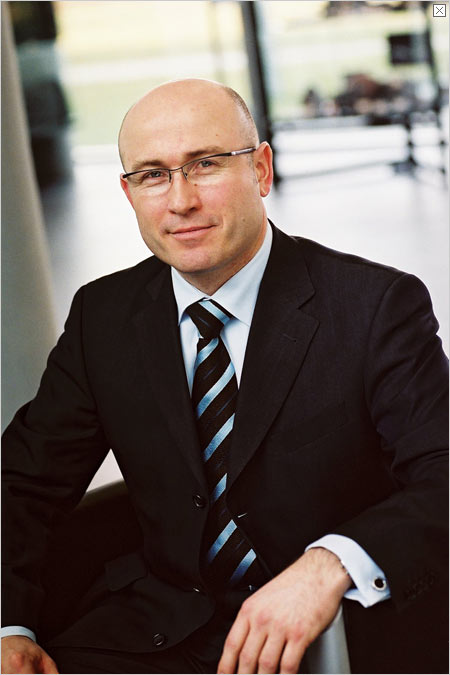
Bernhard Maier, Porsche AG Board of Management Member for Sales and Marketing, sees this as confirmation of the company‘s strategy:

“Every Porsche is the sportiest model in its segment. Our customers world-wide love the combination of performance and efficiency, such as in the new Panamera S Hybrid or 911 GT3 RS 4.0.”

Porsche has posted robust growth in all key sales regions. North America (USA and Canada), saw growth of 77.1 per cent in April, which is 3,495 vehicles more than the same month of the previous year. Of this, 3,172 vehicles (+ 81.5 %) were sold in the USA, which is traditionally the number 1 marketplace for Porsche.

In Europe, Porsche has reported a gain of 30.6 per cent in the fourth month of the year: exactly 3,896 more sporty vehicles were sold than in April 2010. In Germany, sales grew by 1,523 vehicles (+ 19.5 %). In Asia and in the rest of the world, sales rose by 56.5 per cent to 4,029 vehicles. China, now Porsche’s second most important market, reported continued growth; with 2,316 Porsche vehicles delivered, sales were up 48.8 per cent compared to April 2010.

The overall results for all four model series clearly reflect the positive development made by Porsche in the past month: 5,998 Cayenne models were sold, almost double the figure of the same month last year.

The Panamera as well, up 14.9 per cent with unit sales of 2,212, accounts for a significant share of Porsche’s success. In the sports car segment, the 911 almost matched the previous year’s level with 2,225 vehicles delivered (- 2.9%). Sales of Boxster series were down 8.7 per cent at 1,306 units. 762 vehicles were accounted for by the Boxster and 544 units by the Cayman.

PORSCHE AG April 2011 January to April 2011
2011 2010 Diff. in % 2011 2010 Diff. in %
World 11,741 7,684 52.8 38,303 29,135 31.5
Europe 3,896 2,983 30.6 12,967 9,782 32.6
Germany 1,523 1,275 19.5 5,002 3,238 54.5
North America 3,495 1,973 77.1 11,024 7,570 45.6
USA 3,172 1,748 81.5 10,179 6,971 46.0
Asia/Rest of the World 4,029 2,575 56.5 13,333 11,152 19.6
China 2,316 1,556 48.8 7,464 6,696 11.5

Source: Porsche Press Database


Tags: , , , , , , , , , , , ,

PORSCHE VIDEO: Cayman S Black Edition with more power and comprehensive equipment package

Press Release 06/05/2011

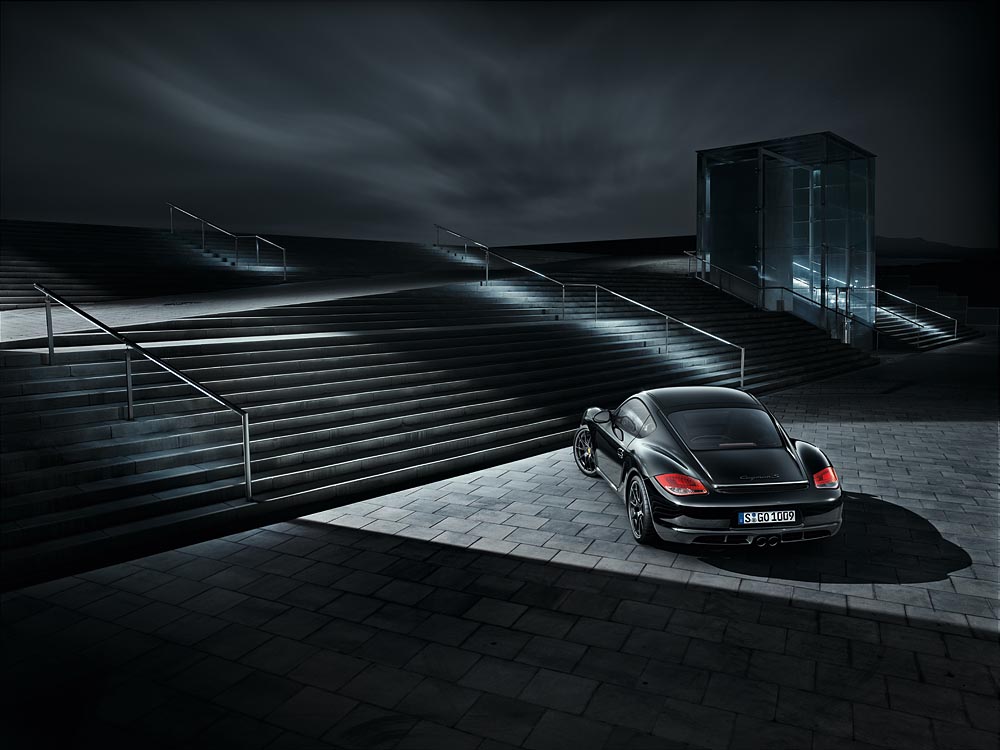
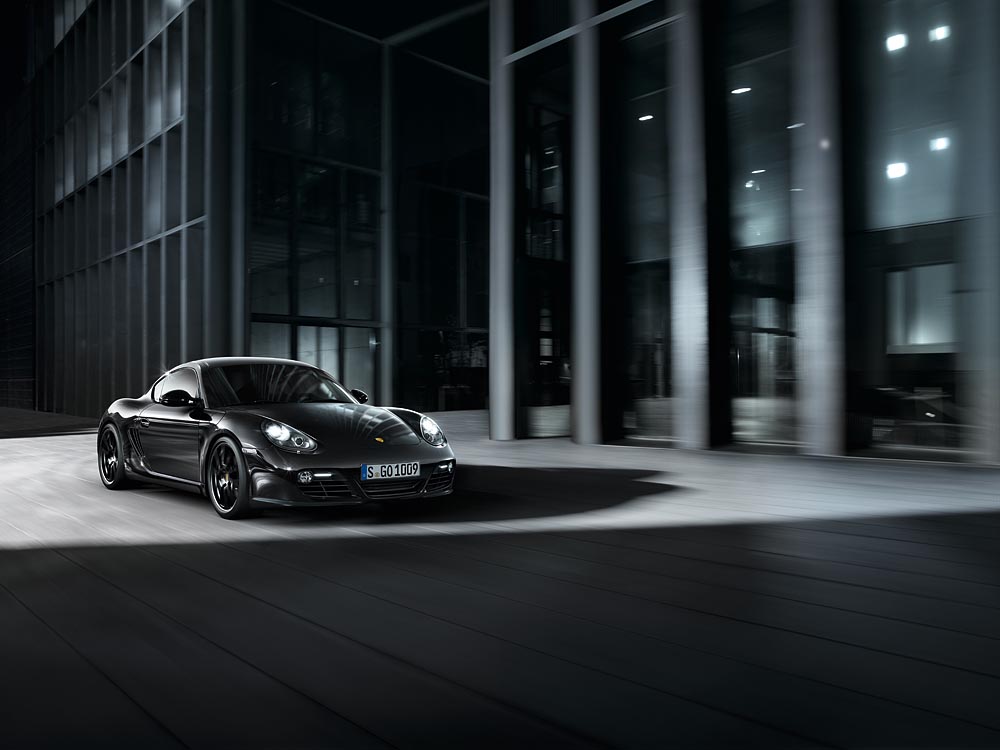
Exclusive special edition of the Porsche mid-engine coupé

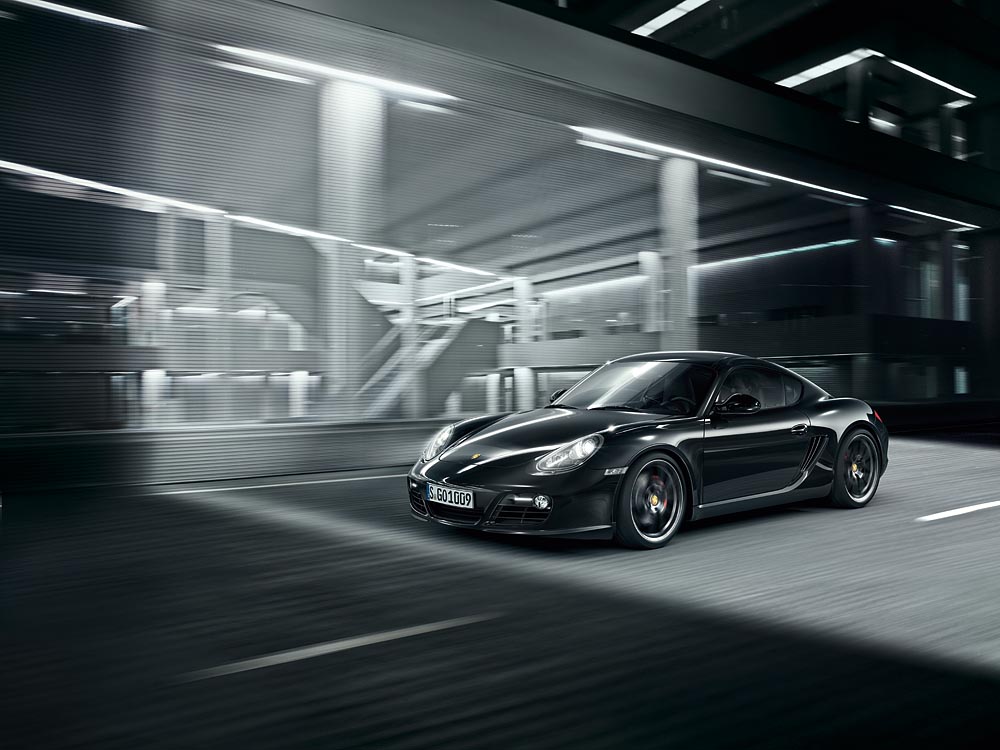
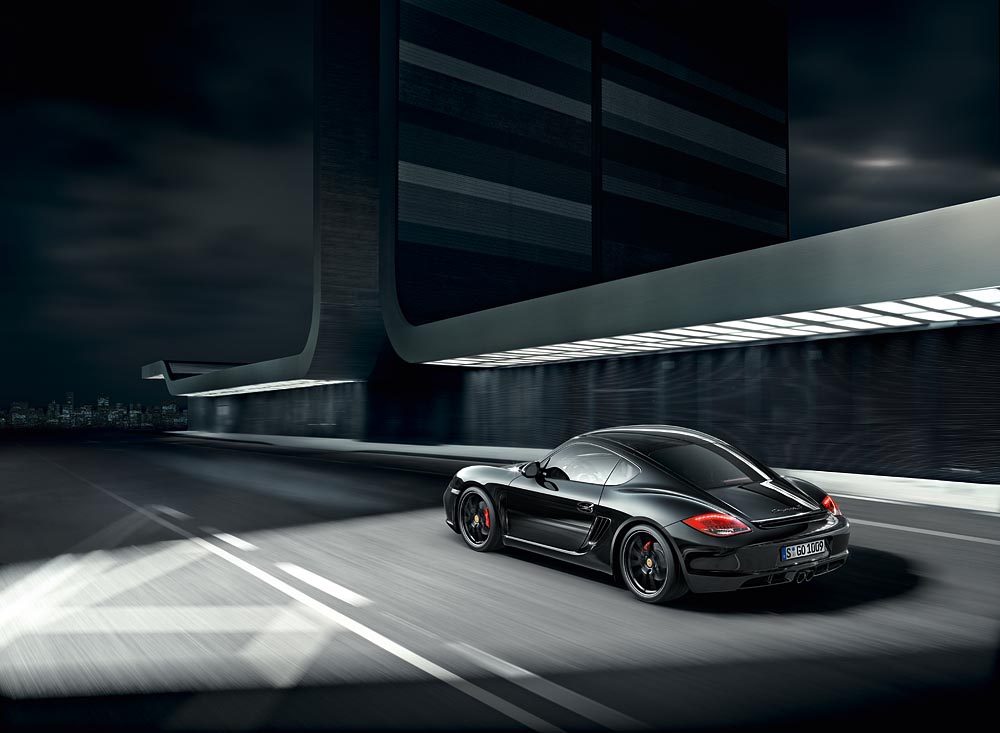
Cayman S Black Edition with more power and comprehensive equipment package

Stuttgart. The next step up from the Cayman S is known as the Cayman S Black Edition: Starting in July 2011, Dr. Ing. h.c. F. Porsche AG, Stuttgart, is bringing the mid-engine coupé to market in a special edition limited to 500 units boasting even better performance and especially lavish equipment specification.

The Cayman S Black Edition is powered by a 3.4 litre six-cylinder boxer engine with power output increased by 10 hp (7 kW) to 330 hp (243 kW) at 7,400 rpm (an additional 200 rpm). The maximum torque remains unchanged at 370 Newton metres at 4,750 rpm.

The extra power feeds directly through into the performance of the all black two-seater. The acceleration times from nought to 100 km/h (62 mph) are improved by a tenth of a second to 5.1 seconds with the six-gear manual transmission and to 5.0 seconds with the optional Porsche Doppelkupplungsgetriebe (PDK) respectively. A mere 4.8 seconds are required if the Launch Control is activated on the Sport Chrono package, available as an option.

The Cayman S Black Edition’s top speed is two kilometres per hour (1.24 mph) faster than that of the Cayman S – 279 km/h (173 mph) with the manual transmission and 277 km/h (172 mph) with the PDK respectively.

The Cayman S Black Edition is not just more sportily agile in terms of its longitudinal dynamics but laterally as well. Among other factors, this is attributable to the Boxster Spyder wheels in black, which with a diameter of 19 inches are not just one inch bigger than the standard Cayman S wheels but are also half an inch wider than the optional 19 inch wheels on the Cayman S. The tyre sizes fitted are 235/35 ZR 19s on the front axle and 265/35 ZR 19s on the rear axle.


With its comprehensive and particularly high-quality equipment, the Cayman S Black Edition also caters for exceedingly exacting demands. For example, Bi-Xenon headlights with dynamic cornering lights and LED daytime running lights are just as much part of the basic specification as are automatic anti-dazzle interior and exterior mirrors with integrated rain sensor. Driver and front seat passenger sit on black partial leather seats with Porsche crest on the headrests; climate control ensures a comfortable temperature. The driver pilots the Cayman Black Edition by means of a Sport Design steering wheel, the cruise control makes driving at constant speed a more comfortable and economical experience.

The colour scheme of the limited edition sports coupé is consistent to the smallest detail: the dashboard trim is black as are the gear lever/selector trim and the instrument dials in the instrument cluster.

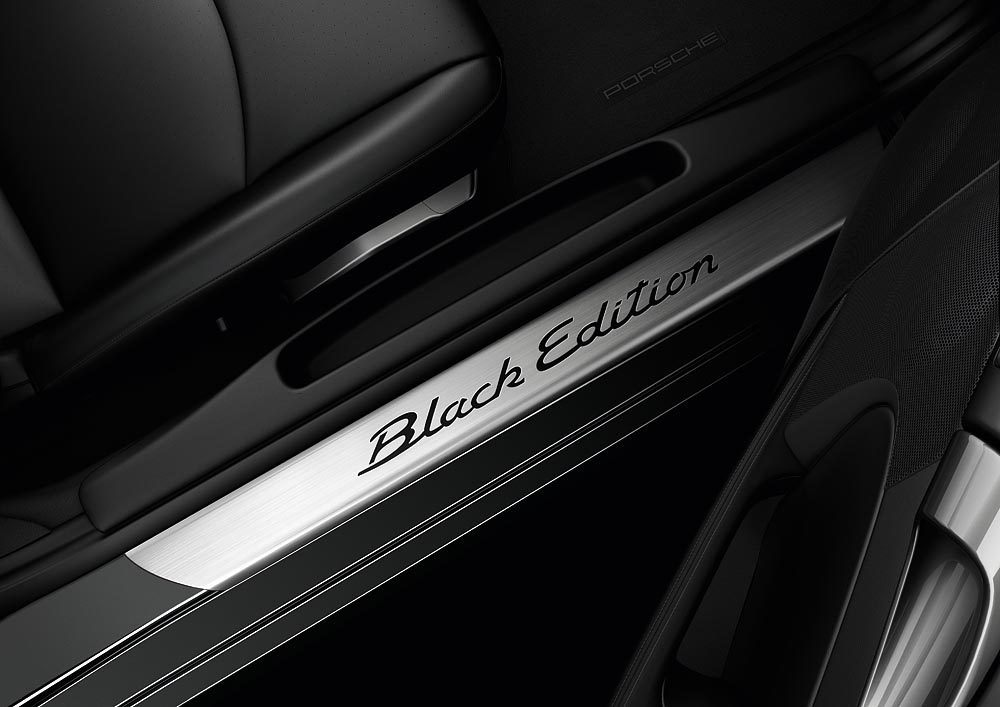
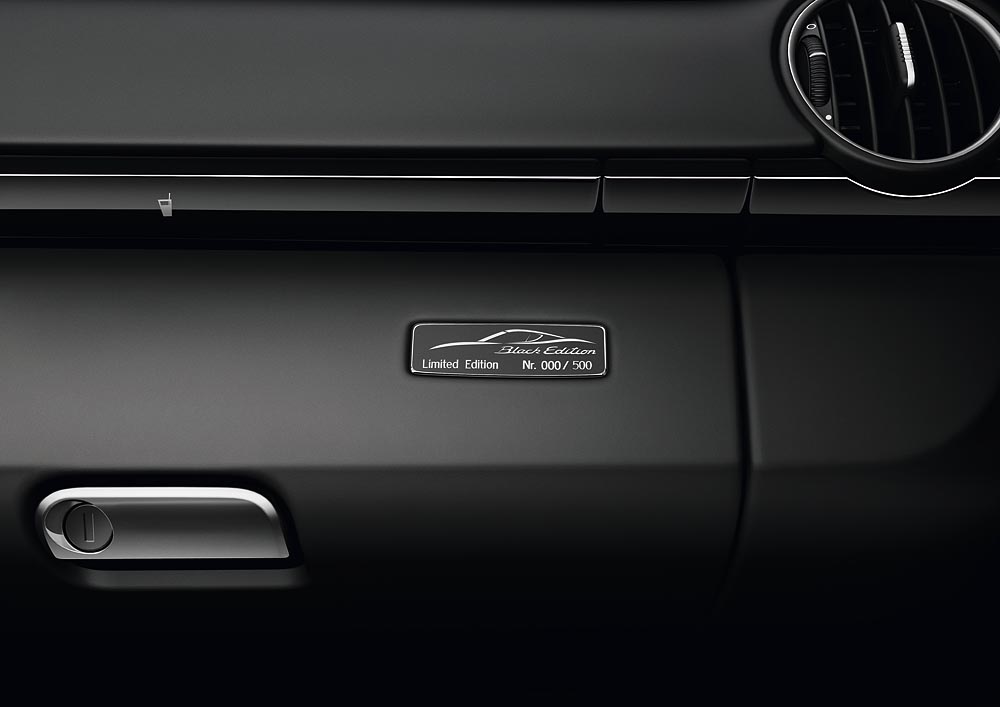
The door entry guards emblazoned with the lettering “Black Edition” are made of stainless steel; the glove compartment lid bears the badge proclaiming the limited edition status.

Equipped with Sound Package Plus, the Cayman S Black Edition’s infotainment systems are controlled via Porsche Communication Management (PCM).

This also includes, for example, the navigation module and universal audio interface (AUX, USB, iPod). Mobile phone integration is already enabled. In all, the Cayman S Black Edition features the Porsche Comfort, Infotainment and Design packages, offering a price reduction into the bargain.

With country-specific equipment, the Cayman S Black Edition costs 67,807 euro in Germany including VAT.

SOURCE: PORSCHE AG DATABASE


Tags: , , , , , , , , , , , , , ,

PORSCHE: “125 years of the car” birthday procession kicks off on the Porscheplatz

 Summer 2011: Germany celebrates cars

Automobilsommer 2011

Germany – birthplace of the inventors of the automobile and home to chief brands in the four wheels market, such as Mercedes-Benz, BMW, Audi, Volkswagen and Porsche, of course – is celebrating the 125° anniversary of this mean of transportation with a series of events in several cities. The hub of celebrations will be the region of Baden-Württemberg and its capital, Stuttgart.

FOR PORSCHE: “125 years of the car” birthday procession kicks off on the Porscheplatz

Porsche classic cars on the streets of Stuttgart

Stuttgart. On Sunday 8 May 2011, Dr. Ing. h.c. F. Porsche AG, Stuttgart, will be teaming up with Mercedes-Benz and Audi, two other car brands also based in Baden-Württemberg, to stage a car procession through Stuttgart. 125 vehicles, contemporary witnesses all, will bring the history of the three carmakers to life – in some cases with well-known drivers at the wheel.

The Zuffenhausen sports car manufacturer will be putting 45 current and historic vehicles from more than six decades of Porsche history on the start line.

The “125 years of the car” procession will get under way at 11.00 a.m. at the Porsche museum, which will be offering visitors free admission on the day.

Matthias Müller, Chairman of the Board of Management of Porsche AG, will head the birthday procession in a Porsche 911 Turbo S – together with his Mercedes-Benz and Audi opposite numbers.

Dr. Wolfgang Porsche, Chairman of the Supervisory Board of Porsche Automobil Holding SE, will be driving the first Porsche prototype, the Type 356 “No. 1”, developed by his father Ferry Porsche in 1948.


Ferry Porsche with the Porsche Type 356 “Nr. 1”

Current and former Porsche AG works and racing drivers will also be taking part in the drive through the town. For example, racing legend Hans Hermann will be piloting the Porsche 917 KH on the streets of Stuttgart, the same car he and Richard Attwood drove in the 1970 Le Mans 24 Hours when they won the first ever overall victory for the Zuffenhausen company.

Le Mans winner car 917 KH with Hans Herrmann and Richard Attwood.

The three times winning Porsche 908/03 Spyder is being withdrawn from the Porsche museum’s exhibition for Porsche works driver Marc Lieb.

Porsche 908/03 Spyder – 970 2997cc 350PS

Finally, the 612 hp (450 kW) Carrera GT high performance sports car, once limited to 1,270 units, will be driven by double world rally champion Walter Röhrl.

In addition to a “police presence”, the car procession will also give an outing to the Swabian sense of humour. Stuttgart “Tatort” (Crime Scene Investigation) Inspector Richy Müller will be switching on the blue lights on the Porsche 356 C Cabriolet. In the Sixties, this classic car was used by the Württemberg motorway police.

http://c.photoshelter.com/img-get/I0000bU1y7De_V2g/s/860/860/Stylin-Police-InterceptorPolice Interceptor, German style: A 1956 Porsche 356C 1600SC Cabriolet.

And cabaret artist Christof Sonntag will be behind the wheel of a Porsche 911 Targa (Type 964).

The destination of the procession that will start at Zuffenhausen’s Porscheplatz is the Schlossplatz in the centre of Stuttgart. Here there will be an opportunity on Sunday afternoon to admire all the participating vehicles at close quarters.

https://i0.wp.com/lh4.ggpht.com/_5VSk9dzp-oo/S0jnvIN7l4I/AAAAAAAABHU/tRJFUCPEq4Y/DSC_0011.JPG

Porsche will also be showcasing itself on the Schlossplatz as part of an innovation exhibition true to its “Porsche Intelligent Performance” philosophy: more power with lower consumption, increased efficiency and reduced CO2 emissions.

Three modern day Porsche vehicles await the visitor there, providing an impressive demonstration of alternative driveline technologies: the Porsche Boxster E, the Porsche Cayenne S Hybrid and the Porsche 911 GT3 R.

SOURCE: PORSCHE AG DATABASE

(photos courtesy of Porsche AG)


Tags: , , , , , , , , , , , , , , , , , , , , , , , , , , , , , , , , , , , , ,

VIDEO: Porsche lines up with an even more efficient 911 GT3 R Hybrid – Nürburgring

Porsche Hybrid GT3 R beim freien Training der VLN auf der Nordschleife 29.04.2011

Stuttgart. The development of the Porsche 911 GT3 R Hybrid 2.0 is running at full revs.

This Saturday, April 30th, the further-developed version of the innovative Hybrid race car contests round two of the Nürburgring Long Distance Championship (VLN).

IMG_4322.jpg

Another test under race conditions is planned at the fourth VLN round on 28 May.

At the race debut of the modified version of the 911 GT3 R Hybrid on 30th April, Porsche works drivers Joerg Bergmeister (Germany),

Comentario: Joerg Bergmeister/Porsche Hibrido.
Foto: AmigosRacing
IMG_3749.JPG

Marco Holzer (Germany)

Comentario: Marco Holzer – Johan Koning.
IMG_4370.jpg

and Patrick Long (USA) share driving duties in the orange and white ‘race lab’.

IMG_4360.jpg

At the second race meeting in late May, Holzer and Long join forces with Richard Lietz (Austria) to pilot the Hybrid-911.

24h Nürburgring, Nürburgring 24 hour race

Porsche takes up the Nürburgring 24 hour race on 25 June with a further developed version of the Porsche 911 GT3 R Hybrid.

So, what’s been done with this latest Porsche 911 Hybrid race car?

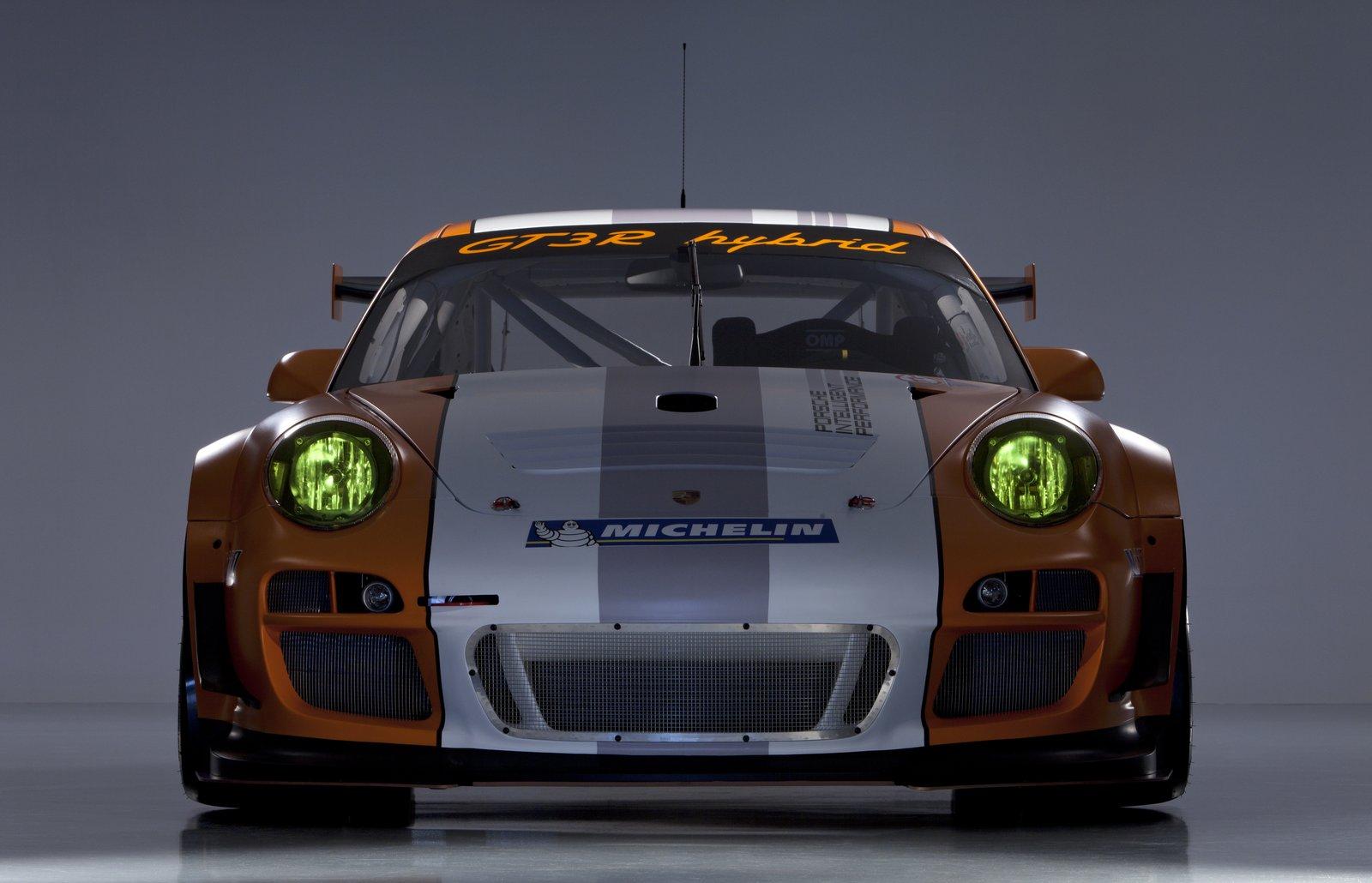
Priority of the development was given to the improvement of efficiency through the targeted optimisation of hybrid components, which also resulted in a 20 percent weight reduction. Version 2.0 of the 911 GT3 R Hybrid is intended to achieve the same lap times as its predecessor but with less fuel consumption.

The general layout of the hybrid was adopted from the 2010 model. A portal axle with two electric motors drives the front wheels and supplements the four-litre, depending on the balance of performance classification approximately 470 hp, six-cylinder boxer engine at the rear. The output of both electric motors has increased from 60 to 75 kilowatts each. For seconds at a time, pilots now have almost an additional 200 hp at their disposal with the 911 GT3 R Hybrid 2.0.

Depending on the programming, this power is automatically activated through use of the throttle pedal. Moreover, pilots can manually call up this extra power, for instance when overtaking.

The electric flywheel accumulator, with its rotor spinning up to 40,000 rpm and stor-ing energy mechanically as rotational energy, is now housed with the other hybrid components in a carbon fibre safety cell on the passenger’s side.

At first glance, the new GT3 R Hybrid is clearly distinguishable from the 2010 model. Thanks to the optimisation of the hybrid system’s high voltage components, the large louvres in front of the rear fenders were no longer necessary. This reduces drag and also lowers fuel consumption. All in all, the weight of the vehicle decreased from 1,350 to 1,300 kilograms.

“We’ve collected a great deal of information from our races on the Nürburgring, at the ALMS race at Road Atlanta in the USA, as well as from the ILMC race on China’s Zhuhai circuit, which was an invaluable help for the further development of our racing laboratory,” says Hartmut Kristen, head of Porsche motorsport.

“The emphasis of our work was on improving efficiency. That means we want to keep the lap times consis-tent with 2010 but use less energy, hence less fuel. In this way, we support future developments of road-going, sporting hybrid vehicles.”

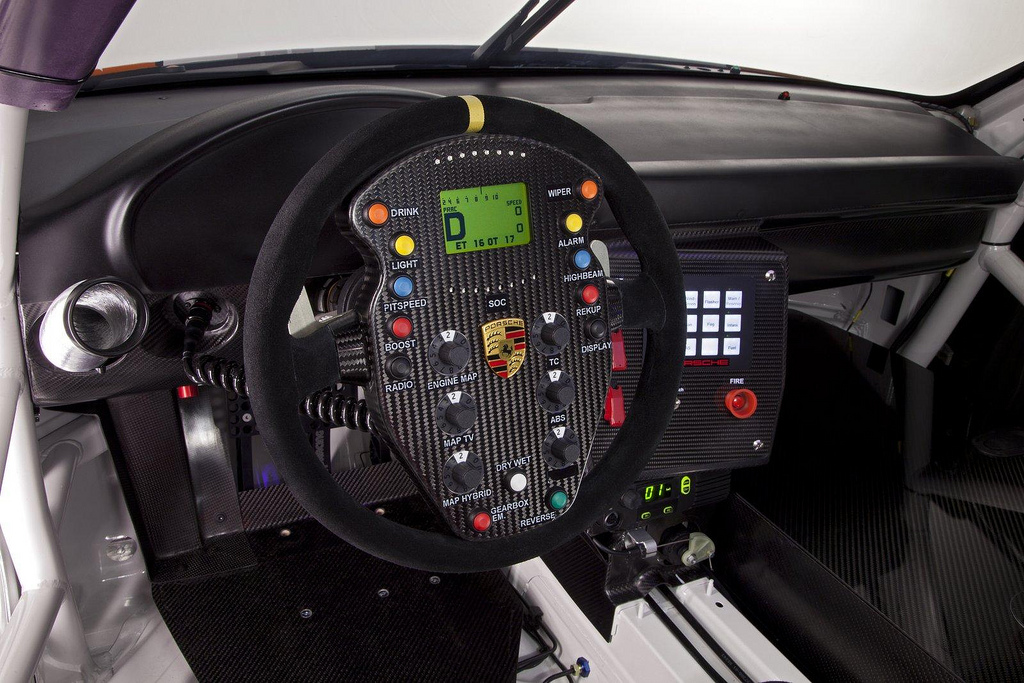
The cockpit of the 911 GT3 R Hybrid has also been completely revised. Most of the displays and controls have moved to the steering wheel. Drivers can operate the rest of the functions via backlit buttons now situated on the centre console.

Priority was placed on the ergonomics and the clear layout for pilots – particularly in darkness.

The new 911 GT3 R Hybrid is a perfect example of the ‘Porsche Intelligent Performance’ philosophy, a principle found in every Porsche: More power on less fuel, more efficiency and lower CO2 emissions – on the race track and on the road.

Source: Porsche

This slideshow requires JavaScript.


Tags: , , , , , , , , , , , , , , , , , , , , , , , , , , ,

PORSCHE: Prof. Ferdinand Porsche Created The First Functional Hybrid Car

The name Porsche has been associated with pioneering innovations in automotive engineering since the beginning of the last century. In 1900 Ferdinand Porsche, founding father of the present-day Dr. Ing. h.c. F.Porsche AG, Stuttgart, entered uncharted territory. With the first functional, full-hybrid car in the world, the ‘Semper Vivus’ (‘always alive’), the principle of the serial hybrid drive had been born. In a four year project the Porsche Museum in Stuttgart had the Semper Vivus recreated. 111 years after this ground breaking innovation by Ferdinand Porsche the Semper Vivus will again drive into the limelight of future appearances as part of the Porsche Museum collection in Stuttgart.

This slideshow requires JavaScript.

Source: Porsche AG

photo

He developed the world’s first hybrid car, advanced electric car, and all-wheel drive car a century ago, and now Porsche brings a recreation of his Semper Vivus to New York

NEW YORK – April 20, 2011 – The name Porsche has been associated with pioneering automotive engineering innovations since the beginning of the last century. In 1900 Prof. Ferdinand Porsche unveiled his Lohner Porsche, an electric car with wheel-hub motors driving the front wheels. Soon after, this car featured all-wheel drive and four-wheel brakes, another world first. A highlight of his early years as an automotive designer was the Lohner-Porsche Semper Vivus that went down in history 111 years ago as the first functional hybrid car.

Video: Fox Car Report @ New York

Porsche’s Semper Vivus (Always Alive) recreation is a tribute to Prof. Porsche’s visionary invention. The fully functional Semper Vivus replica, based on original drawings and exhaustive research, is a collaborative effort between Porsche Engineering and Karosseriebau Drescher, a coachbuilding company based in Hinterzarten in the state of Baden-Württemberg, Germany.  This faithful replica, whose visionary design impresses to this very day, is on display at the New York Auto Show press day on April 20.


Source & Credits: Porsche

The history of the Lohner-Porsche Semper Vivus

Prof. Ferdinand Porsche was busy designing and developing his cars as early as 1896. The first fruit of his endeavors was an electric vehicle known as the Lohner-Porsche. It was driven by steered wheel-hub motors, and it caused a sensation at the Paris World Exhibition in 1900. This was soon followed by an even more impressive example of Prof. Porsche innovative spirit. A racing car boasting four wheel-hub electric motors became the world’s first all-wheel drive passenger car and marked the automotive engineering debut of four-wheel brakes. No less visionary was Prof. Porsche’s next idea; in 1900 he combined his battery-powered wheel hub drive with a petrol engine, thus creating the serial hybrid drive principle.

Prof. Porsche had entered uncharted territory with the Semper Vivus, the world’s first functional, full-hybrid car. In this vehicle, two generators paired with petrol engines formed a single charging unit, simultaneously supplying electricity to wheel-hub motors and batteries. In autumn 1900, Prof. Porsche set to work on a first prototype with petrol-electric hybrid drive. Presumably he based the world’s full hybrid car on a conversion of his electric racing vehicle from the Semmering-Bergrennen race. To this end he combined his electrical wheel-hub motors with two combustion engines and no mechanical connection whatsoever to a drive axle. Instead, they each drove an electric generator supplying both the wheel-hub motors and accumulators with electricity. This was the birth of serial hybrid drive. As a full hybrid concept, the Semper Vivus was also able to cover longer distances purely on battery power until the combustion engine had to be engaged to recharge the batteries.

To save weight and create room for a petrol engine, Prof. Porsche swapped the original 74-cell accumulator in his electromobiles for a smaller battery with only 44 cells. In the middle of the vehicle he installed two water-cooled 3.5 PS (2.6 kW) DeDion Bouton petrol engines — driving two generators to create electricity — each producing 2.5 hp (1.84 kW). Both engines operated independently, each delivering 20 amperes with a voltage of 90 volts. The electricity generated by the dynamos initially flowed to the wheel-hub motors, with the surplus power being sent on to the batteries. An added bonus was that it was also possible to use the generators as electric starter motors for the petrol engines by reversing the direction of rotation.

In practice, Prof. Porsche still had to contend with the principal problem of his wheel-hub cars – the vehicle’s heavy weight. Although the Semper Vivus hybrid car’s total weight was only 70 kg more than the original version, the 1,200 kg prototype was a challenge for the pneumatic tires’ soft rubber mix. In other respects as well the hybrid concept was still a long way away from being ready for series production. With its bodiless chassis, exposed petrol engines and unsprung rear axle, the Semper Vivus may have impressed visitors to the Paris Motor Show in 1901 but potential car buyers must have felt the bare-bones prototype was not for them. The interaction of engine, batteries and control system also still needed a lot of development and in addition to the ambitious control technology, a constant problem was dirt being thrown up and fouling of the accumulators. Yet the hybrid concept pointed to new possibilities that Prof. Porsche resolutely set about turning into reality.

The road to the Lohner-Porsche Mixte

In 1901 Prof. Porsche developed the revised concept of his ‘petrol-electric hybrid car’ into a variant that was ready for series production under the Lohner-Porsche Mixte name (borrowing the French term ‘voitures mixtes’). With a four-cylinder, front-mounted engine, this model mirrored the Mercedes vehicle concept just recently designed by Wilhelm Maybach but with its two wheel-hub motors still conforming to the concept of a serial hybrid car. Prof. Porsche was now using a powerful 5.5-liter, 25-hp (18 kW) four-cylinder engine from the Austrian Daimler engine company as an electrical generator. The engine was connected by a driveshaft to the electric generator located under the seat, with control handled by a primary controller next to the steering wheel.

To solve his vehicles’ weight problems, Prof. Porsche was constantly reducing battery size while also attempting to design a dust-proof battery housing. While the Lohner-Porsche Mixte was only able to drive a few kilometers on electric power alone because of the reduced battery capacity, the unladen weight of the four-seat touring car including body fell to around 1,200 kg. In normal driving mode the petrol engine and generator ran at a constant speed, feeding the wheel-hub motors and battery with electricity at a constant voltage. In addition to his drive concept’s high-level of efficiency, the car offered other advantages as well. By reversing the polarity, the generator could be used as an electric starter motor, eliminating the need for the strenuous and hazardous hand cranking of the engine.

Before the end of 1901, Ludwig Lohner and Prof. Ferdinand Porsche had pulled off a respectable result by selling five Lohner-Porsche Mixte cars. With a selling price of approximately 14,000 Krone each, this made the cars very exclusive commodities. The purchaser of this initial series was Emil Jellinek, the well-known general agent of the Daimler engine company in Stuttgart-Untertürkheim and the inspiration behind the first Mercedes (named after his daughter) only the year before. Despite this contact, a cooperation agreement to supply Mercedes engines failed to materialize and only seven Lohner-Porsches with Daimler engines were built. From 1903 onwards, petrol engines from Panhard & Levassor were used because the large French automotive manufacturer had acquired the license rights for France, Great Britain and Italy from Ludwig Lohner.

At about the same time, Prof. Porsche again significantly modified his cars’ drive concepts. For the weight reasons and to reduce production costs he dispensed with the purely electric driving capability and shrunk the battery to a minimum for initiating the starter motor. He replaced the missing energy storage unit with another innovation. The generator, designed as a stationary armature machine, was fitted with an electro-mechanical speed regulator patented as a “device for automatically regulating electric generators.” Prof. Porsche also ushered in a further development in wheel-hub motor technology. A redesigned hub casing allowed the kingpins to be relocated closer to the center of the wheel. This steering geometry, patented in May 1902, significantly reduced the effect of road impacts and the effort needed to turn the steering wheel. To reduce the unsprung mass of the wheels, Prof. Porsche also reduced the diameter of his wheel-hub motors, which he compensated for by using wider windings.

In April 1902, having incorporated these improvements, Prof. Porsche took his place on the starting grid for the Exelberg race. His two-seat Mixte racing car was not only visually impressive due to its modern proportions but impressive on the track, as well. His Lohner-Porsche seemed to cope effortlessly with even the steepest gradients of the 4.2-km gravel road leading up to the Exelberg, and it emerged as the victor in the large car class. Porsche received additional high-profile publicity in the autumn of 1902 when he chauffeured Austrian Archduke Franz Ferdinand in the Lohner-Porsche during a military maneuver. The aristocratic passenger seems to have liked the vehicle with its elegant touring body. Soon after, Prof. Porsche received a thank you letter testifying “just how satisfied in every respect his Imperial Majesty” was after the ride.

Despite these impressive demonstrations, sales of the Mixte production variants remained far lower than expectations. With only 11 hybrid cars sold, the return on investment was not on par with the enormous technical development costs between 1900 and 1905. The main problem was undoubtedly the high sales price. Depending on design and equipment, a Lohner-Porsche Mixte cost between 14,400 and 34,028 Krone, in some cases making it almost twice as expensive as comparable, conventionally powered motor vehicles. This was compounded by the high maintenance cost of the complex drive system that was unable to keep pace with the ever increasing reliability of normal petrol cars. Pure electric vehicles, however, were economically more successful. Approximately 65 Lohner-Porsche electric cars were sold during the first five years of series production to the end of 1905.

The reincarnation of the Semper Vivus

In November 2007 the Porsche Museum embarked on one of the most interesting and challenging projects in its history: the construction of a faithful replica of the 1900 Lohner-Porsche Semper Vivus. Even 111 years after its invention, building the world’s first functioning hybrid car was a great challenge for all. Ultimately it was not just about an extreme attention to visual details but also achieving the same performance as the original. The Porsche Museum entrusted the workmanship to a team of experts led by coachbuilder Hubert Drescher, who had already proven his competence in numerous difficult restoration projects. As with a number of racing car projects, the aluminum body of the Porsche Type 64 museum exhibit originates from the Hinterzarten coachbuilder workshop, as well.

Exhaustive research in various archives the across Europe was the first step. The outcome was a handful of black-and-white photos and an original technical drawing serving as the project’s foundation. As with Prof. Porsche, the Semper Vivus replica initially began as a blank sheet of paper. This meant that in addition to a good deal of imagination, the project required extensive research and calculations in order to be faithfully recreate an accurate and working likeness of the electric wheel-hub motor. Since no specifications or other helpful records had survived, experts initially created ready reckoners and design drawings on graph paper in the time-honored fashion. This involved the painstaking study and laborious measurement of photos and drawings. As there was no functioning wheel hub motor in existence, technical details such as performance and range had to be resurrected and calculated from scratch.

When it came to selecting materials, coachbuilder Drescher took his inspiration, among other sources, from coaches and carriages from the dawn of the 20th Century. This required the assistance of experienced suppliers who were entrusted with the manufacturing of the special materials. The fully functioning Semper Vivus replica, which took approximately three years to build, does not solely include replica components. For example, it was possible to fit some original components including combustion engines.

Today, Prof. Ferdinand Porsche’s innovative spirit lives on at Porsche AG’s Research and Development Center in Weissach, Germany where the company is applying its engineering strength to develop various hybrid systems. Porsche’s first production hybrid, the 2011 Cayenne S Hybrid SUV, is on sale in many markets including the United States. Its parallel full hybrid system will be adapted for use in the Panamera S Hybrid that goes on sale later this year with a U.S. MSRP of $95,000 (excluding destination). Porsche engineers are busy developing its 911 GT3 R Hybrid racecar for further competition while continuing work on the 918 Spyder plug-in hybrid super sports car the company first showed at the Geneva Auto Show in 2010.

Semper Vivus Facts and Figures

Year Units
Engine: 2x Single cylinder De-Dion-Bouton combustion engine
Output: 2.5 hp (1.85 kW) per cylinder
Electric motor output: 2.7 hp (2 kW) per wheel
Top speed: 35 km/h (22 mph)
Range: 200 km (124 miles)
Overall width: 1,880 mm
Overall length: 3,390 mm
Overall height: 1,850 mm
Total weight: 1.7 tons
Front wheel weight (single): 272 kg (with wheel hub motor)
Track width front: 1,350 mm
Track width rear: 1,540 mm
Wheelbase: 2,310 mm
Ground clearance: 250 mm

About Porsche Cars North America

Porsche Cars North America, Inc. (PCNA), based in Atlanta, Ga. is the exclusive U.S. importer of Porsche sports cars, the Cayenne SUV and Panamera Gran Turismo. Established in 1984, it is a wholly-owned subsidiary of Porsche AG, which is headquartered in Stuttgart, Germany, and employs approximately 220 people who provide parts, service, marketing and training for 196 dealers. They, in turn, work to provide Porsche customers a best-in-class experience that is in keeping with the brand’s 63-year history and leadership in the advancement of vehicle performance, safety and efficiency. At the core of this success is Porsche’s proud racing heritage that boasts some 30,000 motorsport wins to date.

Source & Credits: Porsche Press Database

Contact: Porsche Cars North America, Inc.


Tags: , , , , , , , , , , , ,

Porsche puts on sale the 918 Spyder super sports car with its innovative plug-in hybrid drive

Starting gun for sales of the Porsche 918 Spyder hybrid super sports car 918 units of exclusive future technology

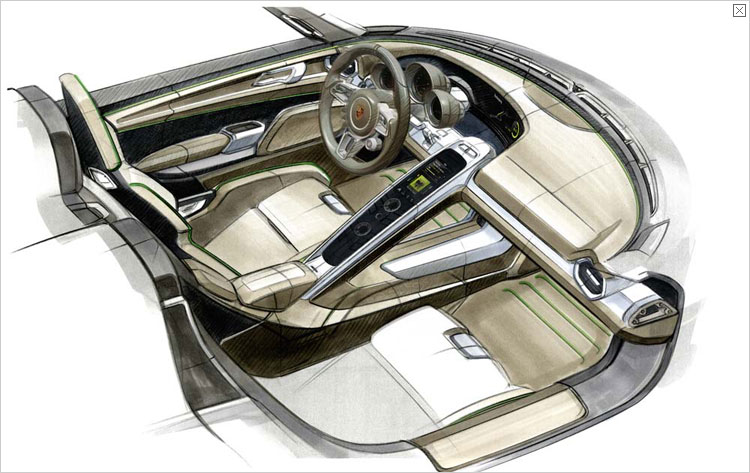
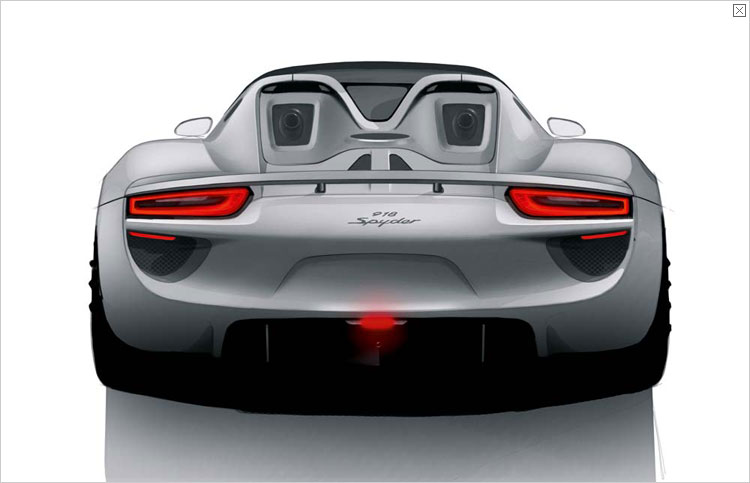
The latest rendering of Porsche’s plug-in hybrid 918 Spyder super sports car.

Now available for ordering, the 918 Spyder will feature cutting-edge plug-in hybrid technology and stunning performance, forever changing the future of the super sports car

ATLANTA – March 21, 2011 — After outstanding customer response to the concept car first shown at the 2010 Geneva Motor Show, Porsche today announced that dealers around the world will begin taking 918 Spyder customer orders. This is a significant step toward actual production of the company’s next super sports car, a Porsche that marries unique plug-in hybrid technology and outstanding performance in a visually stunning and purely Porsche package. Porsche Press Release

Stuttgart. Today is the day that Dr. Ing. h.c. F. Porsche AG, Stuttgart, puts on sale the 918 Spyder super sports car with its innovative plug-in hybrid drive. Production development is proceeding apace in the wake of the outstanding customer response to the concept car unveiled at the Geneva Motor Show 2010. Thanks to its unique hybrid technology, the 918 Spyder is estimated to consume a mere three litres of fuel per 100 kilometres (94 mpg imp.) based on the New European Driving Cycle (NEDC). Its V8 engine delivers more than 368 kW (500 hp), assisted by two electric motors with a total of at least 160 kW (218 hp). The 918 Spyder is available for immediate order priced from 645,000 Euro – subject to VAT and country-specific charges.

To ensure a 918 Spyder’s exclusivity, the two-seater is limited to no more than 918 units. The earlier a customer orders his vehicle, the earlier it will be delivered, as production is initialized in the same sequence in which orders are received. Production of the 918 Spyder is scheduled to commence on 18 September 2013 – 9/18 in US date convention – in a quasi manufacturing operation at Porsche’s main plant in Stuttgart-Zuffenhausen. Delivery of the initial vehicles will commence in November 2013.

The design’s DNA is derived from the Carrera GT and Porsche 917 sports car as well as the RS Spyder and is very closely modeled on the 2010 concept car. Unlike the concept car, however, the production version of the two-seater, based on a carbon fibre-reinforced plastic monocoque, features a manual roof system with removable roof panels that can be stowed in the front luggage compartment.

The 918 Spyder is driven by a unique type of plug-in hybrid system. It comprises a high-revving V8 engine with a displacement exceeding four litres and output of more than 368 kW (500 hp). The mid-engine power unit is based on the racing engine of the successful Porsche RS Spyder, which provided impressive proof of its efficiency with its multiple victories in the Michelin Green X Challenge in the American Le Mans Series, the Le Mans Series and the 24 Hours of Le Mans. Power transmission to the rear wheels is by means of a compact, seven gear Porsche-Doppelkupplungsgetriebe (PDK). This is complemented by two electric motors – one each on the front and rear axle – with a joint mechanical output of at least 160 kW (218 hp). This configuration offers an innovative, variable all-wheel drive with independent control of the propulsion force on both axles. The energy storage unit is a liquid-cooled lithium-ion battery that can be charged from a conventional domestic power socket, delivering a range in excess of 25 km (16 miles) in the NEDC on purely electric power. The charging time depends on the country-specific mains network, being approximately three hours in Germany, for example. A quick charging option is planned to reduce charging time yet further.

The 918 Spyder’s combined total fuel consumption in the NEDC (ECE-R 101) is anticipated to be 3.0 l/100 km (94 mpg imp.), equating to CO2 emissions of 70 g/km (112 g/mile). Despite that, the super sports car offers performance of the highest order. It accelerates from a standing start to 100 km/h (62 mph) in a maximum of 3.2 seconds and has a top speed of more than 320 km/h (199 mph). That means the Spyder will be able to manage a lap of the Nürburgring Nordschleife in less than seven minutes and 30 seconds – trumping the Porsche Carrera GT, which needs seven minutes and 32 seconds. The top speed on purely electric power is 150 km/h (94 mph).

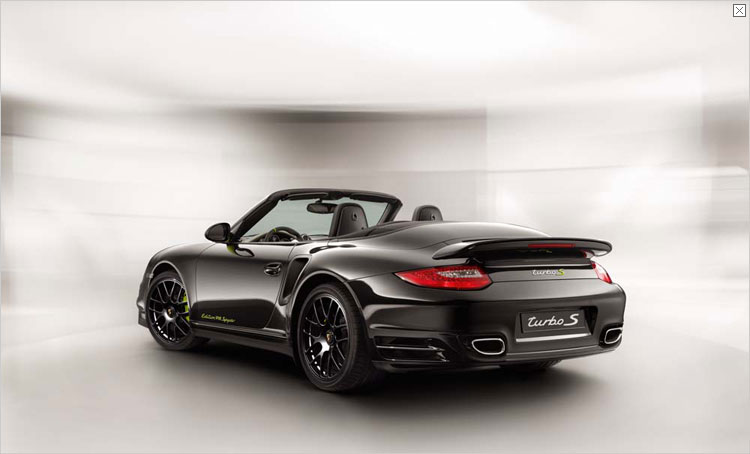
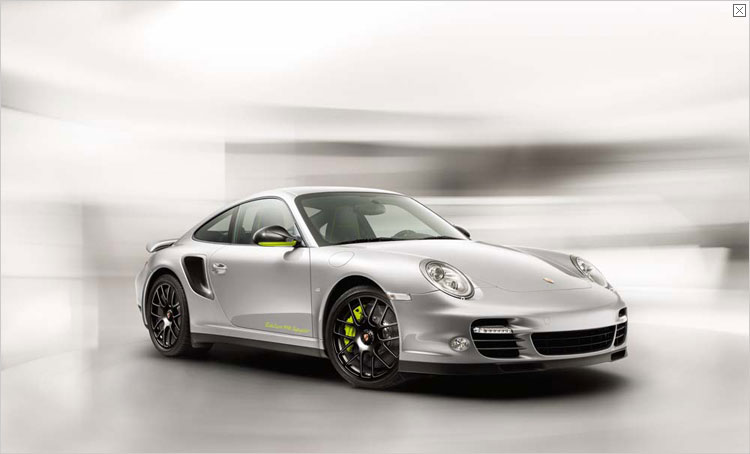
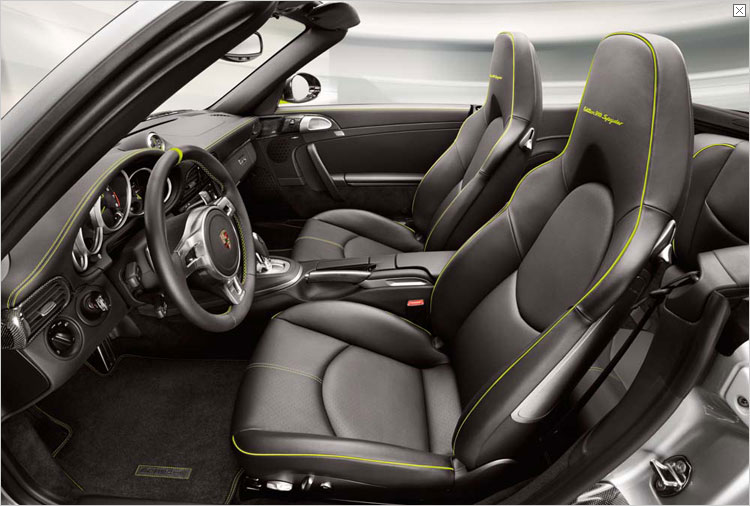
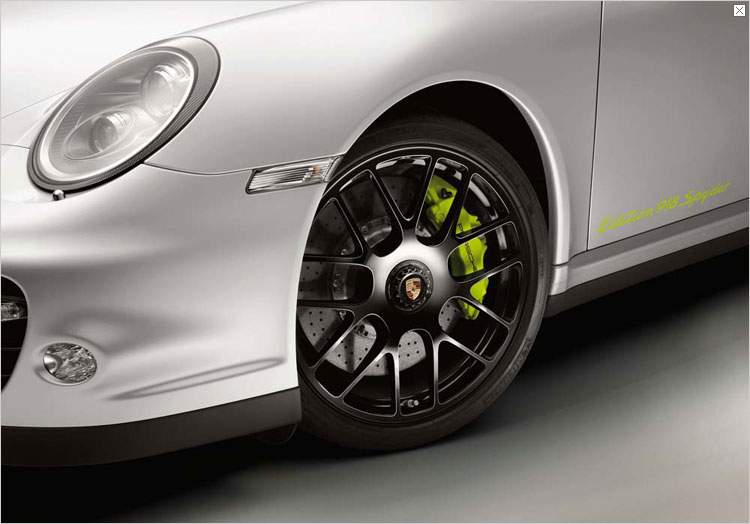
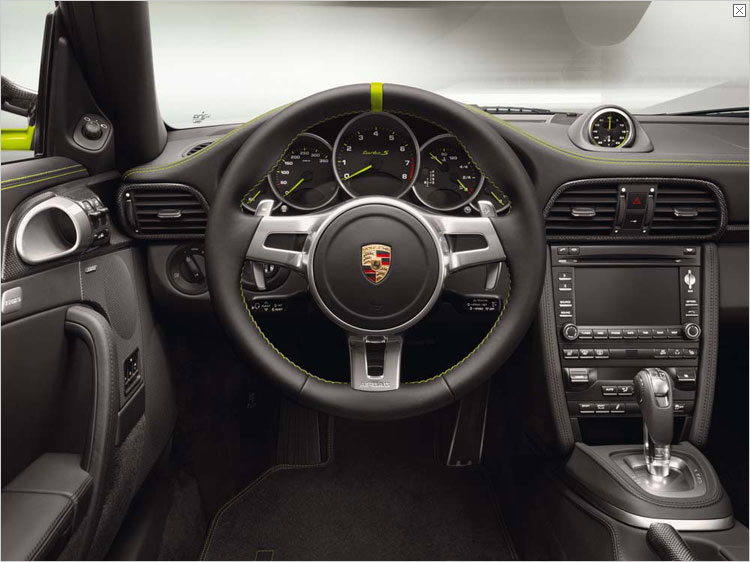
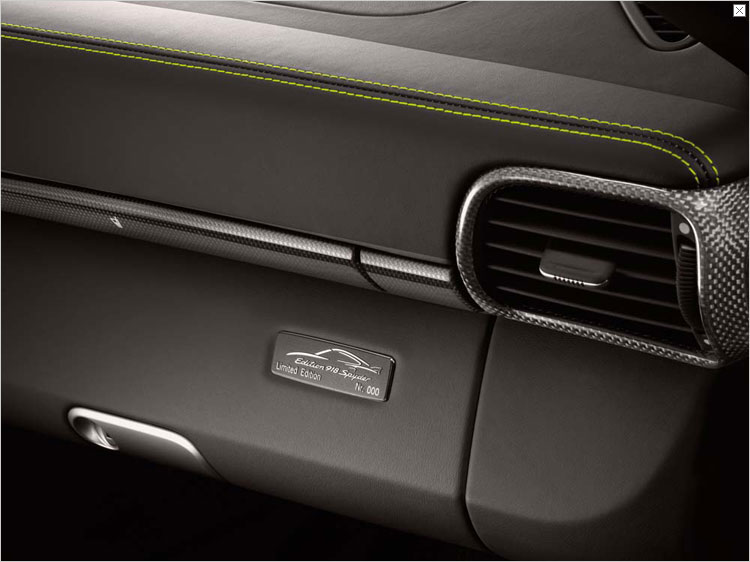
To shorten the time the customer has to wait for the 918 Spyder, Porsche is offering everyone placing an order the exclusive opportunity to acquire a 911 Turbo S “Edition 918 Spyder”, also limited to no more than 918 units. Visually, both inside and out, the special edition is inspired by the 918 Spyder’s characteristic individual features. That includes the distinctive acid green features such as the specific and part-embroidered model logos and seams, the instrument cluster needles, the specific PCM screen and illuminated door entry guards. The limited edition badge on the glove compartment lid bears the same number as the 918 Spyder the customer has ordered. The 911 Turbo S “Edition 918 Spyder” can also be ordered in the same colour.

Both the technology and basic equipment of the new 911 Turbo S “Edition 918 Spyder” are based on the 530 hp (295 kW) 911 Turbo S. In the case of the special edition, the already comprehensive standard equipment is complemented in particular by an enhanced leather interior, a special instrumentation version and additional carbon elements both inside and out.

The 911 Turbo S “Edition 918 Spyder” is being offered to coincide with the commencement of sales of the 918 Spyder with deliveries starting in June 2011. The Coupé version of the special edition costs 173,241 Euro in Germany and 184,546 Euro as a Cabriolet – including VAT and country-specific equipment items respectively.

Note: Images of the 918 RSR and the 911 Turbo S “Edition 918 Spyder” from the Porsche press database

How Porsche dealers will order the 918 Spyder – Autoblog

According to Porsche, you can buy a 918 Spyder from any Porsche dealer anywhere in the world, provided they’ve signed a participation agreement with Porsche. Details are few and far between on what that agreement entails. What Porsche is saying, though, is how dealers who sign the agreement will order their cars.

Dealers who want to place an order for a 918 will have to submit an “Allocation Request Form.” Porsche will reply with an “Allocation Response Form,” which tells the dealer whether there’s a car available for them. Once that’s done, the dealer submits an order form, along with a $200,000 down payment. Porsche will respond with a confirmation and an estimated month for production.

The next step is another $200,000 deposit 12 months before the production date. The balance – $445,000 plus shipping, if you’re counting – is due when Porsche says the car is done. Porsche says the car will not be shipped until it has been paid for in full. The reason, apparently, is that it won’t be building any of the hyper-expensive 918s on speculation, and that each car needs to have an owner before it is built.

918 Spyder Program

Porsche 918 Hybrid dealer information

Frequently asked questions
 

Tags: , , , , , , , , , ,

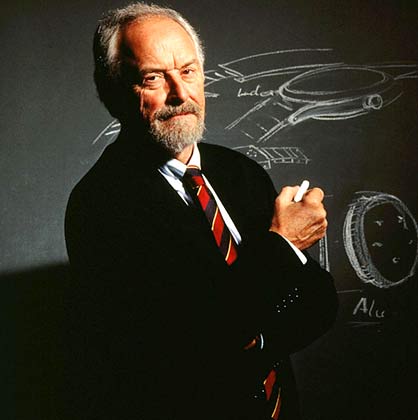
Ferdinand Alexander Porsche – The legendary designer of the Porsche 911 turns 75
Ferdinand Alexander Porsche – The legendary designer of the Porsche 911 turns 75
Stuttgart. Professor Ferdinand Alexander Porsche, Honorary Chair of the Supervisory Board of Dr. Ing. h.c. F. Porsche AG, Stuttgart, celebrated his 75th birthday on 11 December 2010. As a designer of true genius, F.A. Porsche was the creator of such legendary automobiles as the 904 Carrera GTS, or the Porsche 911. After stepping down from the management of Porsche KG, in 1972 he founded the “Porsche Design“ Studio, and achieved worldwide fame and recognition as an independent product designer.

Ferdinand Alexander Porsche was born on 11 December 1935 in Stuttgart, the eldest son of Dorothea and Ferry Porsche. As a child his world was already being influenced by automobiles, with him spending a lot of time in the design offices and development workshops of his grandfather Ferdinand Porsche. In 1943 the family, together with the company of Porsche, relocated to Austria, where he went to school in Zell am See. After returning to Stuttgart in 1950, he passed the final school examination, the “Abitur”, at the Waldorf School, and registered at the College of Design in Ulm. In 1958 F.A. Porsche joined the design department of what was at that time Dr. Ing. h.c. F. Porsche KG.

This slideshow requires JavaScript.

]

His talent for design very soon became apparent when, with the Type 754 “T7“, he formally presented to the world the direction which was to be followed in the succession to the 356 Series. In 1962 he took charge of the management of the Porsche Design Studio, and one year later took the world by storm with the Porsche 901 (also referred to as the 911). As well as passenger cars, F.A. Porsche was also deeply involved in the design of the racing cars of the 1960’s. Among his most famous designs were the Formula One Type 804 racer, or the Porsche 904 Carrera GTS, which motoring fans have always regarded as one of the finest and most beautiful racing vehicles ever made.

With the conversion of Porsche KG into a share company in 1971/72, F.A. Porsche and all the other family members stepped aside from the operational business of the company. As a shareholder and member of the Supervisory Board, he oversaw the development of Dr. Ing. h.c. F. Porsche AG for many years, and from 1990 to 1993 he served as the Chair of the Supervisory Board. In 2005 he passed the mantle of responsibility as a Porsche AG Supervisory Board member to his son Oliver, and took on the position of Honorary Chair of the Board.

Ferdinand Alexander Porsche founded the “Porsche Design Studio“ in Stuttgart in 1972, the headquarters being relocated to Zell am See in Austria in 1974. Over the decades which followed he designed a wide range of classic men’s accessories, such as watches, spectacles, and writing implements, which achieved worldwide fame under the brand name “Porsche Design“. In parallel with this, he and his team, using the trademark “Design by F.A. Porsche“, created a large number of industrial products, domestic appliances, and consumer goods for internationally famous clients. Ferdinand Alexander Porsche has been acclaimed for his work as a designer by the bestowing of many honors and awards.

In autumn 2003 F.A. Porsche and the other shareholders of “Porsche Design“, together with Dr. Ing. h.c. F. Porsche AG, founded the Porsche Lizenz- und Handelsgesellschaft mbH & Co. KG (PLH, Porsche License and Trading Company). The aim of this company is to make best use of the potential of the name Porsche in sectors which go beyond the automobile. The focus here is on the trademark “Porsche Design“, which in recent years has developed to become one of the world’s leading brand names in luxury articles, with its own marketing network.

12/7/2010

Photo credits: Porsche AG

[Source: Porsche]

In the video at the age of 70 in 2005 on the Austrian highest mountain the GROSSGLOCKER, celebrating his birthday. Now celebrating his 75th birthday December 11th, 2010.  Happy Birthday!! …Ferdinand Alexander Porsche …”Butzi”

 
3 Comments

Posted by on December 11, 2010 in Ferdinand Alexander Porsche


Tags: , , , , , , , , , , , , ,